
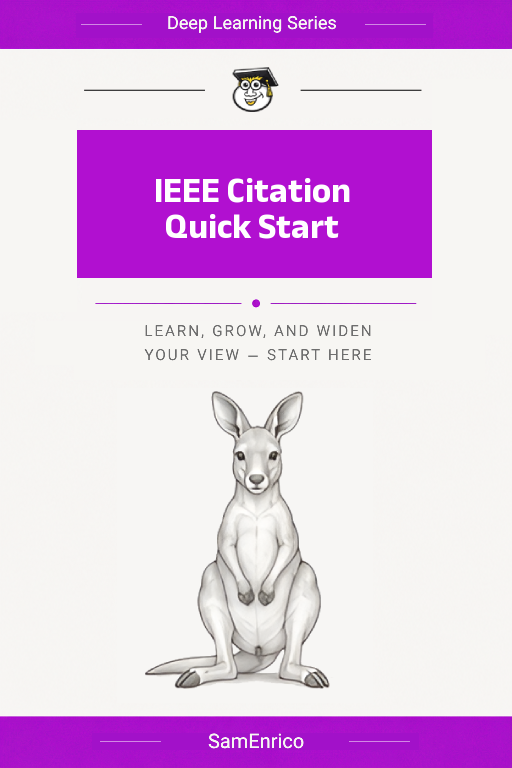
Non-FictionStudent's ShortcutIEEE Style
IEEE Citation Quick Start eBook
Bracketed numbers and reference list formatting fo
Bracketed numbers and reference list formatting for engineering and computer science papers.
Formats
Free sample
Chapter 1: The Hidden Cost--–- Every year, thousands of engineering papers and computer science theses are desk-rejected within minutes of submission. Not because the research is flawed. Not because the data is weak. But because the citations are wrong. A misplaced bracket, an alphabetized reference list, or a missing page range can undo twelve months of work in twelve seconds.
This chapter reveals why IEEE citation exists, how it differs from every other style you have encountered, and why mastering it will save you from the hidden cost of formatting rejection.The $10,000 Citation Mistake Consider two graduate students: Elena and James. Both have completed identical research on neural network pruning. Both have written clear, rigorous papers. Both submit to the same IEEE Transactions journal on the same Friday afternoon.Elena’s reference list is alphabetized by author’s last name—a habit she carried over from her undergraduate APA training. James’s reference list is numbered sequentially by first appearance in text, per IEEE standard.
Elena uses parenthetical citations like “(Chen, 2023)” throughout her literature review. James uses bracketed numbers like “[3]”.The associate editor opens both submissions. Elena’s paper is rejected without review in under an hour. The rejection letter cites “severe citation formatting errors inconsistent with IEEE submission guidelines.” James’s paper moves to peer review.What cost Elena her submission? Not her science.
Not her writing. A fifteen-minute failure to understand IEEE citation logic. She now waits another four months for the next submission cycle. Her graduation is delayed. Her funding risks expiration.
All because of square brackets and numbering.This is the hidden cost of citation ignorance. It is measured not in dollars alone but in rejected months, lost priority claims, and the quiet humiliation of a desk-reject email.Why Engineering and Computer Science Demand Numbered Citations Before you learn how to format a single reference, you must understand why IEEE uses numbers instead of names and dates. The answer lies in three engineering values: traceability, precision, and efficiency.Traceability means that a reader can move from a citation in your text to the exact source in under five seconds. In APA style, a citation like “(Rodriguez & Wong, 2022)” requires the reader to scan an alphabetized reference list for “R.” In a list of two hundred sources, that scan takes ten to fifteen seconds. In IEEE style, the same source appears as “[14]”.
The reader glances down to the numbered list, finds “14” immediately, and returns to your argument in two seconds. When a paper contains fifty citations, that time saving adds up to minutes of reader patience preserved.Precision means directing the reader not just to a source but to the exact location within that source. Engineering readers need to verify your claim about a specific equation, figure, or data table. IEEE allows you to write “[3, Fig. 2]” or “[3, p.
45]” or “[3, Sec. IV]”. That locator tells the reader exactly where to look. No guesswork. No paging through an entire article to find a single number.Efficiency means minimizing the visual interruption citations create.
Compare these two sentences:APA: “Previous work has shown that convolutional layers reduce parameter count by approximately 60 percent (Hinton, 2018; Le Cun, 2015; Bengio, 2016).”IEEE: “Previous work has shown that convolutional layers reduce parameter count by approximately 60 percent [1]–[3].”The IEEE version contains nine fewer characters and three fewer punctuation marks. In a paper with one hundred citations, that efficiency compounds into a leaner, more readable document. Engineers value brevity. IEEE delivers it.How IEEE Differs from APA, MLA, and Chicago If you have already learned another citation style, you must unlearn some habits. The table below shows the critical differences at a glance.Feature IEEEAPAMLAChicago (Notes)In-text citation Bracketed numbers [1](Author, year)(Author page)Superscript number¹Reference list order Sequential by first citation Alphabetical by author Alphabetical by author Sequential by citation“et al.” usage Reference list only (for 7+ authors)In-text (3+ authors) and reference list In-text (4+ authors) and reference list Notes only Page range formatpp.
45-5245-5245-5245-52Access dates Only for unstable online sources Required for all online sources Optional Required for websites The most dangerous difference for new IEEE users is the reference list order. In APA, MLA, and Chicago author-date, you alphabetize by the first author’s last name. In IEEE, you number references in the exact order they first appear in your paper. Your first citation becomes [1]. Your tenth becomes [10].
If you cite a source on page 2 and another on page 1, the page 1 source becomes [1] and the page 2 source becomes [2]. The order of appearance in the text determines the number—nothing else.A second dangerous difference is the complete absence of author names from in-text citations. In APA, you write “Smith (2020) demonstrated that...” In IEEE, you write “Smith [4] demonstrated that...” or simply “[4] demonstrated that...” The author name appears only in the reference list, never alone in brackets.A third difference is how you handle multiple sources. In APA, you write “(Smith, 2020; Jones, 2019; Lee, 2021).” In IEEE, you write “[4], [7], [12]” for non-consecutive sources or “[4]–[6]” for a consecutive range. The semicolons disappear.
The parentheses become brackets. The order becomes numerical rather than chronological or alphabetical.When to Use IEEE Style (And When to Run Away)IEEE style is not universal. It is designed for a specific set of publication venues and document types. Using it outside these contexts marks you as an amateur. Using it inside these contexts marks you as a professional.You must use IEEE style when submitting to any IEEE journal, conference, or magazine.
This includes over 200 journals such as IEEE Transactions on Pattern Analysis and Machine Intelligence, IEEE Transactions on Signal Processing, and IEEE Spectrum. It also includes all IEEE conference proceedings, which number in the hundreds annually.You should use IEEE style when submitting to many non-IEEE engineering and computer science venues. Elsevier’s computer science journals (e.g., Computers & Electrical Engineering), Springer’s Lecture Notes in Computer Science (LNCS) series, and many ACM publications accept or require IEEE-style citations. Always check the author guidelines. When in doubt, default to IEEE for engineering and CS.You may use IEEE style for theses, dissertations, lab reports, and technical memos in engineering and CS departments.
Many universities require IEEE for these documents. Some leave the choice to the student. If your advisor has no preference, IEEE is a safe, professional choice.You should avoid IEEE style when writing for humanities, social sciences, life sciences, or business. APA is standard in psychology and education. MLA is standard in literary studies.
Chicago is standard in history and some social sciences. AMA is standard in medicine. Using IEEE in these fields announces that you are an engineer lost in a foreign department.The Two-Part System: Brackets and List IEEE citation operates as exactly two parts. There is no third part. There are no footnotes, no endnotes, no separate bibliography.
Just two parts: bracketed numbers in the text and a numbered reference list at the end.Part one lives in your sentences. Every time you reference an external source, you insert a bracketed number. That number matches the position of the source in your reference list. If it is the first source you cite, it wears [1]. The second source you cite—even if you cite it on page one after…
This is the end of the free sample. Get the eBook to keep going. Buy now
About this book
Details
- Author
- Emanuel Madaline
- Publisher
- SamEnrico
- Language
- English
- Genre
- Non-Fiction, Student's Shortcut, IEEE Style
- Released
- 2026-05-29
- Pages (approx.)
- 135
- Available as
- eBook, Audiobook

Read better in the ZLOADR app
Your eBooks on your phone or tablet. Sign in with your SamEnrico account and start reading.
More by Emanuel Madaline
 Virtual Speaking BusinessEmanuel Madaline$11.99
 Upwork Project Catalog LaunchEmanuel Madaline$11.99
 Immigrant Landscaping EmpireEmanuel Madaline$11.99
 Diaphragm GuideEmanuel Madaline$11.99
 The Betrayed Partner's Healing GuideEmanuel Madaline$11.99
 Spouse Homicide GriefEmanuel Madaline$11.99
 Instagram Comparison Trap GuideEmanuel Madaline$12.99
 The Self Hypnosis for ConfidenceEmanuel Madaline$11.99
 Kurt Cobain JournalsEmanuel Madaline$11.99
 The Dancer Who Defied Kings: María de las Nieves and the Birth of Latin American BalletEmanuel Madaline$11.99
 Baldr's Last Lesson: The Viking Warrior Who Defied FateEmanuel Madaline$11.99
 Growing Cedrus (Cedar)Emanuel Madaline$11.99
You may also like
 Hong Kong Handover 1997Dunn Johnnie$11.99
 Zumba For Postnatal Recovery CourseNeal Christian$11.99
 Zumba for BeginnersLadner Nikia$11.99
 YouTube Comment Mining GuideHumes Pandora$12.99
 Worry Box MeditationCarlin Rudy$11.99
 Workplace Stress MeditationNguyen Lynn$11.99
 Workplace Stress and Sleep RepairHawley Ivory$11.99
 Workplace Perfectionism CureDelaney Jeffry$11.99
 Workplace Injustice Anger GuideWallen Isabelle$11.99
 Work Addiction and Burnout LinkGreenwood Ester$11.99
 Women in Yoga and WellnessBeattie Galina$11.99
 Women in Stand Up ComedyChun Evangeline$11.99