

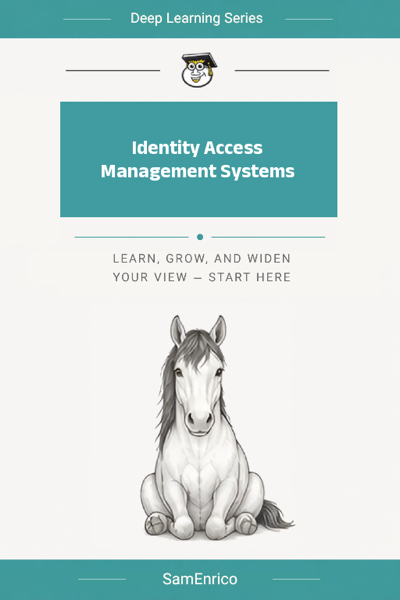
Non-FictionInformativeEducational
Identity Access Management Systems eBook
A Coursebook on Identity Access Management Systems
A Coursebook on Identity Access Management Systems
Formats
Free sample
Chapter 1: The Identity Heist--–- The notification arrived at 3:47 AM on a Tuesday. Marcus Tull, the Chief Information Security Officer of a Fortune 500 financial services firm, was asleep in his suburban Chicago home when his phone buzzed once, then again, then continuously—a cascade of alerts that pulled him from a deep sleep into the cold sweats of crisis. Seventeen privileged accounts had just logged in from an IP address in eastern Europe. Among them: the global administrator for the company's cloud infrastructure, the root user for their customer database, and the service account that rotated encryption keys. Within forty-seven minutes, the attackers had exported ten million customer records, initiated wire transfers totaling three million dollars, and deleted every backup.
The perimeter firewall had reported no intrusion. The endpoint detection system had raised no alarms. The breach had not happened through the network; it had happened as the network—because the attackers weren't breaking in. They were logging in.This is not a hypothetical scenario. In 2023, a similar attack against MGM Resorts paralyzed hotel operations, casino floors, and corporate systems for ten days, costing the company over one hundred million dollars.
The attackers did not exploit a zero-day vulnerability or fire a single line of malware code. They called the MGM help desk, impersonated an employee whose identity had already been compromised in a separate data breach, and requested a password reset. The help desk obliged. Within hours, the attackers had administrative control over the entire enterprise. The identity, not the firewall, had become the new perimeter—and that perimeter had failed.The fundamental thesis of this book is simple but profound: in the modern cybersecurity landscape, identity is the only perimeter that matters.
Firewalls, intrusion detection systems, and network segmentation remain valuable, but they address a reality that no longer exists—the reality of a static corporate network with clear boundaries and trusted insiders. Today's enterprise operates in the cloud, across multiple geographies, through mobile devices, with contractors, partners, and customers all requiring access. The boundaries have dissolved. What remains is the identity of every user, every device, and every service requesting access to resources. If you control identity, you control access.
If you lose control of identity, you have lost everything.This chapter establishes the foundation for everything that follows. It defines the "Identity Trust Gap"—the dangerous disconnect between traditional authentication models and the continuous verification required by modern threats. It introduces the core lexicon of Identity Access Management (IAM): subjects, identities, attributes, entitlements, and the three major IAM domains (Enterprise IAM, Customer IAM, and Privileged Access Management). It explains the concept of the "digital twin" and why every user's virtual persona must be governed as carefully as their physical presence. Finally, it makes the business case for IAM as a strategic enabler, not a security blocker—demonstrating how effective identity management drives revenue, reduces risk, and enables digital transformation.
By the end of this chapter, you will understand why identity has become the most valuable asset and the most vulnerable attack surface in the modern enterprise.The Death of the Perimeter To understand why identity has become the new perimeter, we must first understand what the perimeter used to be. For thirty years, the dominant model of enterprise security was the "castle-and-moat" approach. The castle was the corporate network—a clearly defined space containing servers, databases, and applications. The moat was the firewall, a barrier that inspected traffic entering and leaving the castle. Users inside the moat were trusted.
Users outside the moat were not. This model worked reasonably well when all employees worked on company-owned devices within company-owned buildings, accessing company-owned servers. The perimeter was physical, and physical boundaries are relatively easy to defend.The castle-and-moat model began to crumble in the late 2000s with three simultaneous trends. First, the rise of cloud computing moved servers and data outside the corporate network. When a company runs its customer database on AWS and its email on Microsoft 365, the concept of a single network perimeter becomes meaningless.
Second, the proliferation of mobile devices meant that employees accessed corporate resources from home, from coffee shops, from airports—from countless networks the company did not control. Third, the shift toward remote work, accelerated dramatically by the COVID-19 pandemic, eliminated the assumption that trusted users are physically present inside trusted facilities.Yet many organizations continued to operate as if the perimeter still existed. They invested heavily in next-generation firewalls, intrusion prevention systems, and network segmentation, while neglecting the one control that actually mattered in a perimeter-less world: identity. The result is the Identity Trust Gap: the dangerous assumption that a user who authenticates successfully at login remains trustworthy indefinitely. Traditional IAM systems perform authentication once, issue a session token or cookie, and then trust that token for hours, days, or even weeks.
During that time, the user's device could be compromised, their credentials could be stolen, their behavior could become anomalous—but the system continues to trust them because they passed the initial gate.The Identity Trust Gap is not a theoretical vulnerability; it is the primary vector for the most damaging breaches of the past decade. The 2021 Colonial Pipeline attack, which shut down fuel delivery across the eastern United States, began with a compromised VPN password—a single identity that lacked multi-factor authentication. The 2020 Twitter hack, in which teenagers took over the accounts of Barack Obama, Elon Musk, and Joe Biden, succeeded because a handful of privileged identities had excessive permissions without adequate protection. The 2017 Equifax breach, which exposed the personal data of 147 million Americans, traced back to a web application whose identity management was so flawed that attackers could trivially impersonate legitimate users.Crucially, basic IAM as traditionally implemented does NOT include continuous verification. This is not a failure of IAM; it is a limitation of the legacy model.
Traditional IAM was designed for a world where authentication happened at a single point—login—and that was sufficient because the network perimeter provided a secondary layer of defense. In the modern world, that secondary layer is gone. This is precisely why Zero Trust Architecture (covered in Chapter 10) emerged as an evolutionary response: Zero Trust introduces continuous monitoring, dynamic risk assessment, and per-session authorization. But before we can understand the solution, we must understand the foundation. That foundation is IAM.The Core Lexicon of Identity Before we can manage identities, we must define them.
The field of IAM uses precise terminology to avoid the ambiguity that leads to security gaps. Every practitioner must internalize the following definitions:Subject – Any entity that can request access to a resource. Subjects can be humans (employees, contractors, customers), devices (laptops, smartphones, Io T sensors), or services (API clients, automated scripts, microservices). The critical insight is that non-human subjects now outnumber human subjects in most enterprises by a factor of ten or more. A single Kubernetes cluster might run hundreds of service accounts, each requiring its own identity and permissions.Identity – The digital representation of a subject.
An identity is not the subject itself; it is the collection of data that distinguishes one subject from another. For a human employee, the identity might include a username, employee ID, email address, department, and manager. For…
This is the end of the free sample. Get the eBook to keep going. Buy now
About this book
Details
- Author
- Finney Stacie
- Publisher
- SamEnrico
- Language
- English
- Genre
- Non-Fiction, Informative, Educational
- Released
- 2026-06-02
- Pages (approx.)
- 160
- Available as
- eBook, Audiobook

Read better in the ZLOADR app
Your eBooks on your phone or tablet. Sign in with your SamEnrico account and start reading.
More by Finney Stacie
 Road Rage and Revenge DrivingFinney Stacie$11.99
 Farm Equipment Depreciation GuideFinney Stacie$11.99
 Constipation Relief AyurvedaFinney Stacie$11.99
 Day Theming for CreativesFinney Stacie$11.99
 Metta for a Co ParentFinney Stacie$11.99
 Immigrant Real Estate Mogul GuideFinney Stacie$11.99
 Hourglass Dream ArchetypeFinney Stacie$11.99
 Working Memory for SeniorsFinney Stacie$11.99
 Observations Without EvaluationFinney Stacie$11.99
 The Silent War Beneath the Waves: The Submarine Arms Race of the Cold WarFinney Stacie$11.99
 The Great Banana Bread Bake-Off: How a Pandemic Recipe Went ViralFinney Stacie$11.99
 Longwu: The Dragon King’s OathFinney Stacie$11.99
You may also like
 Hong Kong Handover 1997Dunn Johnnie$11.99
 Zumba For Postnatal Recovery CourseNeal Christian$11.99
 Zumba for BeginnersLadner Nikia$11.99
 YouTube Comment Mining GuideHumes Pandora$12.99
 Worry Box MeditationCarlin Rudy$11.99
 Workplace Stress MeditationNguyen Lynn$11.99
 Workplace Stress and Sleep RepairHawley Ivory$11.99
 Workplace Perfectionism CureDelaney Jeffry$11.99
 Workplace Injustice Anger GuideWallen Isabelle$11.99
 Work Addiction and Burnout LinkGreenwood Ester$11.99
 Women in Yoga and WellnessBeattie Galina$11.99
 Women in Stand Up ComedyChun Evangeline$11.99