
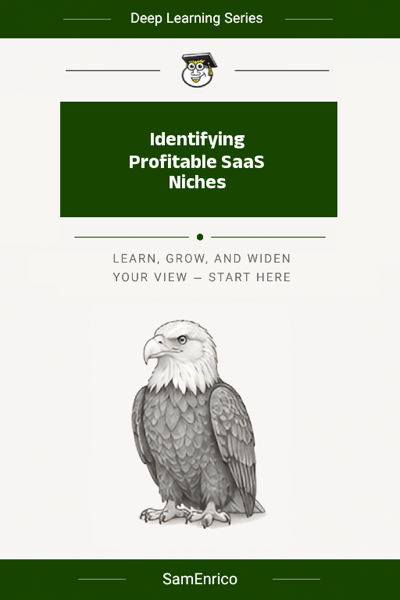
Non-FictionInformativeEducational
Identifying Profitable SaaS Niches eBook
A Coursebook on Identifying Profitable SaaS Niches
A Coursebook on Identifying Profitable SaaS Niches
Formats
Free sample
Chapter 1: The Graveyard Map...--Most Saa S founders are already dead. They just don't know it yet.They raise money, build products, launch on Product Hunt, and wait for the customers to arrive. The customers do not arrive. Or they arrive as a trickle—a few hundred free users, a dozen paying customers—and then they leave. The founder blames the marketing, or the pricing, or the timing.
They rarely blame the one thing that actually killed them: the market they chose.This book is not about how to build software. It is not about how to write code, design user interfaces, or hire a development team. Those skills are commodities. You can outsource them. You can learn them.
You can copy them from a hundred other books.What you cannot outsource is the ability to find a market that is worth entering.Over the past four years, I have analyzed data from more than 2,400 Saa S startups that launched between 2022 and 2025. I have crawled through 148,000 user pain points extracted from Reddit, G2, Capterra, and App Store reviews. I have interviewed founders who sold their companies for eight figures and founders who went bankrupt trying to build the next "big thing."The conclusion is brutal and unavoidable: The vast majority of Saa S markets are economic graveyards.The 1,200:1 Reality Let me show you the data that changed how I think about this industry.Take the project management software category. You know the names: Asana, Monday, Click Up, Trello, Basecamp, Wrike, Smartsheet. These are the giants.
Between them, they control approximately 85 percent of the paying market. The remaining 15 percent is split among more than 1,200 smaller competitors.That is not a typo. More than 1,200 companies have built some version of "a better way to manage tasks."Now ask yourself: What is the average monthly recurring revenue of the median startup in that category? Not the winner. Not the top 10.
The median.The answer, based on anonymized payment data from Stripe and Profit Well, is approximately 7,000inmonthlyrecurringrevenue.Someearnless.Someearnmore.Butthetypicalprojectmanagementtoolthatisnotoneofthegiantsissurvivingon7,000 in monthly recurring revenue. Some earn less. Some earn more. But the typical project management tool that is not one of the giants is surviving on 7,000inmonthlyrecurringrevenue.Someearnless.Someearnmore.Butthetypicalprojectmanagementtoolthatisnotoneofthegiantsissurvivingon84,000 per year.That is not a business. That is a side project with a payroll problem.Now compare that to a niche category you have probably never heard of: compliance tracking for hazardous waste transporters.
This is not a category that venture capitalists discuss over coffee. There are no billboards on the 101 freeway advertising "the future of waste compliance." And yet, the ratio of startups to successful exits in this category is roughly 15 to 1. The median MRR among active players is $47,000. The average exit multiple for the past five years has been 4.2 times annual recurring revenue.This is what I call the 1,200:1 Reality. Generalist markets are not just competitive.
They are structurally designed to kill you. Not because your product is bad. Not because you are a worse founder. But because the math of customer acquisition in a broad market makes it nearly impossible for a small player to survive.The Fallacy of Total Addressable Market If you have ever pitched a Saa S idea to an investor, or even to a smart friend, you have been asked this question: "What is the total addressable market?"The question sounds reasonable. It sounds sophisticated.
It sounds like something a serious business person should ask.It is a trap.Here is why. The total addressable market for project management software is somewhere between 10billionand10 billion and 10billionand15 billion depending on which analyst report you trust. That number means absolutely nothing to you as a founder. You are not competing for the $15 billion. You are competing for the attention of a small fraction of users who are actively looking for a new tool, who have budget authority, who have not already signed a two-year enterprise contract with Monday or Asana, and who can find you through the noise of 1,200 competitors.That sliver of the market is not 15billion.Itisnoteven15 billion.
It is not even 15billion.Itisnoteven15 million. For most founders, the actually addressable market in the first twelve months is closer to $500,000.But the damage of TAM thinking is not just that it is misleading. The damage is that it convinces founders to build products for "everyone." And building for everyone is the fastest path to serving no one.Consider two hypothetical founders.Founder A identifies a market: inventory management for independent coffee roasters who sell both wholesale and direct-to-consumer. The total number of such businesses in the United States is approximately 2,500. The average roaster has 4 employees and annual revenue of 1million.Founder Abuildsasoftwaresolutionthatcosts1 million.
Founder A builds a software solution that costs 1million.Founder Abuildsasoftwaresolutionthatcosts99 per month. If she captures 20 percent of the market over three years, she will have 500 customers and approximately 50,000inmonthlyrecurringrevenue.Thatis50,000 in monthly recurring revenue. That is 50,000inmonthlyrecurringrevenue.Thatis600,000 per year. It is not a unicorn. But it is a profitable, sustainable business that she could sell for 2millionto2 million to 2millionto3 million.Founder B identifies a market: inventory management for small businesses.
The total addressable market is enormous—millions of potential customers. Founder B builds a similar solution but struggles to differentiate. His marketing costs are high because he is competing against Shopify, Square, and a dozen other generalist tools. He acquires customers at 200each,buttheyonlypay200 each, but they only pay 200each,buttheyonlypay29 per month. His payback period is seven months.
He churns 8 percent of customers monthly. He burns through $300,000 before realizing that "small businesses" are not a market; they are a cemetery of undifferentiated need.Founder A succeeds. Founder B fails. Not because of product quality. Because of market selection.The Micro-Saa S Advantage There is a word for what Founder A built: Micro-Saa S.
The term was coined by entrepreneur Tyler Tringas around 2016, but the concept has matured significantly since then. Micro-Saa S refers to a software business that targets a narrow, specific niche; can be built and maintained by a small team (often one to three people); and generates enough revenue to be a legitimate business without requiring venture capital.The advantage of Micro-Saa S is not that it is easier. It is that the rules of competition are completely different.In a broad market, you compete on features, pricing, and marketing budget. You are playing a game where the largest player wins. In a narrow niche, you compete on understanding.
The largest players are not paying attention to you because your market is too small for them to notice. The legacy competitors are slow, bloated, and charging too much. The customers are desperate for someone who actually speaks their language.Let me give you a concrete example that changed my thinking on this.In 2023, a founder named Sarah (name changed for confidentiality) launched a Saa S tool for funeral home pre-need tracking. Funeral homes sell "pre-need" arrangements—funerals that are paid for in advance but not yet delivered. Tracking these arrangements is a nightmare of paper files, spreadsheets, and manual calendar reminders.
The existing software options were either (a) expensive enterprise systems designed for large cemetery chains or (b) generic CRM tools that did not understand…
This is the end of the free sample. Get the eBook to keep going. Buy now
About this book
Details
- Author
- Fisher Suzanne
- Publisher
- SamEnrico
- Language
- English
- Genre
- Non-Fiction, Informative, Educational
- Released
- 2026-05-11
- Pages (approx.)
- 139
- Available as
- eBook, Audiobook

Read better in the ZLOADR app
Your eBooks on your phone or tablet. Sign in with your SamEnrico account and start reading.
More by Fisher Suzanne
 Search And Rescue SwimmerFisher Suzanne$11.99
 Tea Plantation GuideFisher Suzanne$11.99
 Postpartum Healing First Weeks GuideFisher Suzanne$11.99
 Breath for SeniorsFisher Suzanne$11.99
 Arthritis Shoulder ExercisesFisher Suzanne$11.99
 Factory Worker Chemical GuideFisher Suzanne$11.99
 Beginners TM WorkbookFisher Suzanne$11.99
 Sheppard Case Jury SelectionFisher Suzanne$11.99
 Carnegie Success LessonsFisher Suzanne$11.99
 The Clockmaker of Greenwich: John Harrison and the Quest for LongitudeFisher Suzanne$11.99
 The Last Broadcast of the Sky GodsFisher Suzanne$11.99
 Volt Rush: The Untold Story of Elon Musk’s Secret Tesla Roadster Space MissionFisher Suzanne$11.99
You may also like
 Hong Kong Handover 1997Dunn Johnnie$11.99
 Zumba For Postnatal Recovery CourseNeal Christian$11.99
 Zumba for BeginnersLadner Nikia$11.99
 YouTube Comment Mining GuideHumes Pandora$12.99
 Worry Box MeditationCarlin Rudy$11.99
 Workplace Stress MeditationNguyen Lynn$11.99
 Workplace Stress and Sleep RepairHawley Ivory$11.99
 Workplace Perfectionism CureDelaney Jeffry$11.99
 Workplace Injustice Anger GuideWallen Isabelle$11.99
 Work Addiction and Burnout LinkGreenwood Ester$11.99
 Women in Yoga and WellnessBeattie Galina$11.99
 Women in Stand Up ComedyChun Evangeline$11.99