
Non-FictionSelf-HelpIdea Management
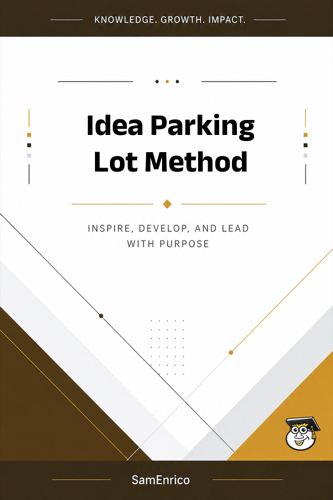
Idea Parking Lot Method eBook
Table off topic but valuable ideas without killing
by Zimmer Amina
Table off topic but valuable ideas without killing creative momentum.
Formats
Free sample
Chapter 1: The Curse of Good Ideas–- The email arrived at 11:47 PM. You know the one. Not a crisis, not an emergency—something worse. An idea. A real one.
The kind that makes you sit up straighter, reach for a notebook, and immediately forget what you were doing five seconds ago.For Sarah, that idea arrived while she was supposed to be finishing a client proposal. She was three paragraphs from done. Three paragraphs. And then her brain offered her a gift: a brilliant concept for a new service line that could double her revenue. Within thirty seconds, the proposal was minimized, a new document was open, and she was typing furiously.
Two hours later, she had twelve pages of notes, a domain name registered, and a proposal that remained three paragraphs from done.That was four months ago. The service line never launched. The proposal was eventually finished—late, rushed, and mediocre. And Sarah started six other projects in the meantime, each one following the same arc: excitement, initiation, distraction, abandonment, guilt. She is brilliant, passionate, and utterly unproductive in any measurable sense.
Her story is not unique. Her story is most likely your story.This book exists because you have too many good ideas. Not too few. Not bad ideas. Genuinely good, potentially life-changing, absolutely distracting ideas that keep you from finishing what you started.The Paradox No One Talks About We live in a culture that worships creativity.
We celebrate the generation of new ideas, the spark of innovation, the "aha moment" that changes everything. And yet, the same trait that makes you creative—the ability to generate associations, see connections, and produce novel concepts—is the trait most likely to prevent you from finishing anything at all.Consider the research. A study of over 1,500 creative professionals found that the single strongest predictor of creative output was not the number of ideas generated but the number of ideas deliberately abandoned. The most productive people in the study generated just as many ideas as their less productive peers. The difference was simple: they killed more of them.But killing ideas feels wrong.
It feels like failure. It feels like you're throwing away your future. So instead, you hold onto everything. Every idea gets a mental parking spot. Every thought gets saved for later.
And your brain, which was never designed for storage, begins to short-circuit.The Myth of the Linear Genius There is a story we tell ourselves about creative work. It goes like this: the genius sits down at their desk, uninterrupted, and works in a straight line from inspiration to completion. The painter paints until the canvas is done. The writer writes until the manuscript is finished. The entrepreneur executes from vision to exit without deviation.This figure does not exist.I have interviewed dozens of highly creative people—authors who have sold millions of copies, founders who have built billion-dollar companies, artists whose work hangs in museums.
Not one of them works in a straight line. Their creative process is messy, recursive, interrupted, and full of detours. The difference between them and the rest of us is not the absence of distraction. It is the presence of a system.The myth of the linear genius has caused immeasurable harm. It has convinced you that interruptions are a sign of failure rather than a feature of creative work.
It has taught you to feel guilty every time a new idea pulls you away from your current project. And it has left you without any tools to manage the fundamental tension of creative labor: you must be open to new ideas to be creative, but you must say no to almost all of them to make progress.Introducing Resistance Steven Pressfield, in his essential book The War of Art, named the force that sabotages creative work: Resistance. Resistance is the enemy of all creative labor. It manifests as procrastination, self-doubt, perfectionism, and fear. But Pressfield missed something important.
Resistance has an advanced form, a more sophisticated trick that fools even the most disciplined creators.Resistance disguises itself as inspiration.The sudden "brilliant idea" that pulls you away from your current project is not always a genuine insight. Often, it is Resistance's most elegant deception. Your current project has reached a difficult point—the messy middle, the boring execution, the terrifying moment before completion. Your brain, seeking to avoid discomfort, offers you an escape route. It packages that escape as a new idea, complete with a dopamine hit and the intoxicating feeling of fresh possibility.You are not being creative when you chase that idea.
You are being avoidant. And the sooner you recognize the difference, the sooner you can stop the cycle.Creative Momentum vs. Creative Progress Here is a distinction that will change everything you think about productivity.Creative Momentum is the feeling of energy, excitement, and forward motion. It feels productive. It feels like you're making progress.
You can feel it for days, weeks, even months. But momentum is measured subjectively. You can have tremendous momentum and produce absolutely nothing of value. Momentum is the feeling of doing. It is not the same as done.Creative Progress is completed work.
Shipped projects. Tangible outcomes. It often feels boring, painful, or scary in the moment. Progress requires doing the hard part, not just the exciting part. Progress is measurable objectively.
You can point to a finished product and say, "That exists because I worked on it."The tragedy of the creative mind is that momentum and progress are often inversely correlated. The more momentum you feel—the more excited you are about new possibilities—the less progress you tend to make on existing commitments. Your brain is constantly offering you the dopamine of starting something new. It rarely offers you the satisfaction of finishing something hard.You can have momentum for months without making a single inch of progress. The Idea Parking Lot Method is designed to convert momentum into progress.The Real Problem Is Not Focus Every productivity book you have ever read has told you the same thing: you need more discipline.
You need to focus. You need to say no. This advice is not wrong, exactly. It is incomplete. It assumes that your inability to focus is a character flaw rather than a structural problem.Here is what the research actually shows.
The average person can hold only three to five discrete items in working memory at once. Every attempt to "hold onto" an idea mentally engages continuous partial attention, which reduces your cognitive capacity by up to fifty percent. And the Zeigarnik Effect means that unfinished tasks and "held" ideas create persistent mental loops that consume background processing power even when you're trying to focus on something else.Your brain is not a hard drive. It is a processor. It was optimized over millions of years for pattern recognition, association, and idea generation.
It was never optimized for storage. In ancestral environments, forgetting irrelevant information was adaptive. You did not need to remember where you saw that berry bush three years ago. You needed to notice the tiger in front of you.In modern knowledge work, the same feature that kept your ancestors…
This is the end of the free sample. Get the eBook to keep going. Buy now
About this book
Details
- Author
- Zimmer Amina
- Publisher
- SamEnrico
- Language
- English
- Genre
- Non-Fiction, Self-Help, Idea Management
- Released
- 2026-06-10
- Pages (approx.)
- 133
- Available as
- eBook, Audiobook

Read better in the ZLOADR app
Your eBooks on your phone or tablet. Sign in with your SamEnrico account and start reading.
More by Zimmer Amina
 Assertiveness for EmpathsZimmer Amina$11.99
 Flow Recovery GuideZimmer Amina$11.99
 Growth Mindset Praise GuideZimmer Amina$11.99
 Outsourcing for TherapistsZimmer Amina$11.99
 The Team OKR Facilitation GuideZimmer Amina$11.99
 Financial Support Group GuideZimmer Amina$11.99
 Dual Diagnosis MasterZimmer Amina$11.99
 The Lost Voyages of Abubakari II: The African Admiral Who Sailed Beyond the HorizonZimmer Amina$11.99
 The God Complex: How a Self-Help Guru Built a Billion-Dollar Empire on BeliefZimmer Amina$11.99
 Runner Bean: Harvesting For Shelling & Immature PodsZimmer Amina$11.99
 The Essential Guide to German FolkZimmer Amina$11.99
 How to Produce Punch Bowl StandsZimmer Amina$11.99
You may also like
 Hong Kong Handover 1997Dunn Johnnie$11.99
 Zumba For Postnatal Recovery CourseNeal Christian$11.99
 Zumba for BeginnersLadner Nikia$11.99
 YouTube Comment Mining GuideHumes Pandora$12.99
 Worry Box MeditationCarlin Rudy$11.99
 Workplace Stress MeditationNguyen Lynn$11.99
 Workplace Stress and Sleep RepairHawley Ivory$11.99
 Workplace Perfectionism CureDelaney Jeffry$11.99
 Workplace Injustice Anger GuideWallen Isabelle$11.99
 Work Addiction and Burnout LinkGreenwood Ester$11.99
 Women in Yoga and WellnessBeattie Galina$11.99
 Women in Stand Up ComedyChun Evangeline$11.99