
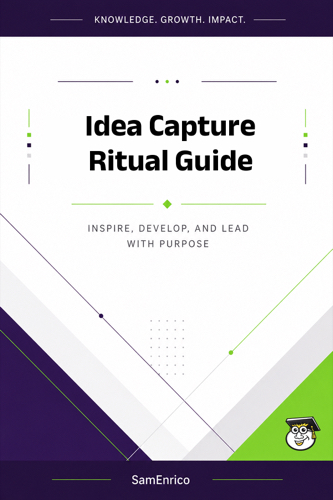
Non-FictionSelf-HelpIdea Management
Idea Capture Ritual Guide eBook
Never lose a creative thought with a daily capture
by Redding Yuri
Never lose a creative thought with a daily capture habit using this guide.
Formats
Free sample
Chapter 1: The Archaeological Mindset--–- You have already lost thousands of great ideas today. Not yesterday. Not last year. Today. While you brushed your teeth, a solution to a problem you have been wrestling with for months floated through your consciousness and then vanished.
While you waited for your coffee to brew, a million-dollar business concept arrived, stayed for exactly four seconds, and left without a forwarding address. While you scrolled through your phone on the toilet, a sentence so perfect it could have unlocked an entire novel passed through your neural circuitry and was overwritten by a cat video.You are not broken. You are not uncreative. You are not "bad at ideas."You are suffering from a single, correctable problem: you believe creativity works like a lightning strike when it actually works like an archaeological dig.This chapter will dismantle the most expensive myth in modern creative culture—the belief that ideas arrive in dramatic, fully-formed flashes of genius—and replace it with a practice that has worked for every prolific creator from Leonardo da Vinci to Maya Angelou to the engineers at Pixar. By the time you finish these pages, you will understand why waiting for inspiration is a losing strategy, why the people who generate endless ideas are not more talented than you, and exactly what to do tomorrow morning to triple your raw idea output.The Great Lie of the Lightbulb Moment The story goes like this: Archimedes steps into a bath, notices the water rising, shouts "Eureka!" and discovers the principle of buoyancy.
Isaac Newton sits under an apple tree, gets bonked on the head, and invents gravity. Paul Mc Cartney wakes up with the melody for "Yesterday" fully formed in his head and plays it on a piano the same morning.These stories are seductive because they promise a shortcut. They suggest that creativity is something that happens to you, not something you do. They imply that if you are not having lightning-strike moments, you must lack the mysterious spark of genius.Every single one of these stories is a lie.Not a malicious lie, perhaps, but a dangerous distortion. Archimedes had been wrestling with the problem of measuring volume for weeks before that bath.
Newton had spent years studying motion and mathematics before that apple fell. Mc Cartney had written dozens of songs, played hundreds of shows, and absorbed thousands of hours of music before that melody arrived. The "Eureka moment" was not the creation of the idea. It was the culmination of a process that had been running silently in the background for days, weeks, or years.What the lightbulb myth hides is the unglamorous truth: ideas are not born in a flash. They are unearthed through daily, repetitive, often boring excavation.
You do not wait for lightning to strike. You dig. Every day. In the rain, in the heat, when you feel inspired and when you feel like a fraud. You dig fragments—broken pottery, partial inscriptions, shards of glass—and you store them without judgment.
And then one day, without warning, the fragments assemble themselves into a statue.This is not poetry. This is neuroscience.How Your Brain Actually Generates Ideas The Reticular Activating System (RAS) is a bundle of neurons at the base of your brain that acts as a filter between your subconscious and your conscious awareness. Every second, your senses are bombarded with approximately eleven million bits of information. Your conscious mind can process only about fifty bits per second. The RAS is the bouncer at the club of your awareness, deciding what gets in and what gets left outside in the rain.Here is what matters: the RAS is trainable.
It prioritizes what you tell it to prioritize. If you decide, consciously and repeatedly, that you are looking for ideas, your RAS will begin flagging raw material that it previously ignored. That crack in the sidewalk becomes a metaphor. That frustrated sigh from your coworker becomes a product opportunity. That strange angle of afternoon light becomes a photograph.But there is a catch.
The RAS does not respond to passive intention. You cannot simply decide to be more creative and expect your brain to rewire itself. The RAS responds to action. Specifically, it responds to the act of capture. When you write down an idea—any idea, even a bad one—you are not just storing information.
You are programming your brain's filtering system to recognize more of that kind of information in the future.This is why people who keep notebooks generate more ideas than people who do not. It is not because they are more creative. It is because the act of writing flips a switch in the brain. The notebook user trains their RAS to see idea-worthy material everywhere. The non-notebook user walks through the same world blind.The Two Mindsets That Determine Your Creative Destiny After studying hundreds of creative workers across industries—writers, engineers, chefs, parents, entrepreneurs, nurses, and retirees—I have observed exactly two mindsets that predict creative output.
Every person falls into one of these categories, and the difference between them explains almost everything about why some people constantly generate ideas while others feel perpetually blocked.The first mindset I call the Archaeologist. The Archaeologist believes that creativity is a practice, not a talent. They wake up each morning expecting to find fragments—broken pieces, partial thoughts, half-formed notions—and they log these fragments without judgment. They know that a complete statue is assembled from dozens of small discoveries, and that most of those discoveries will look like garbage until the moment they suddenly don't.The Archaeologist has a simple daily practice: they capture. They do not wait for inspiration.
They do not ask whether an idea is "good enough" to write down. They do not silently rehearse a sentence before committing it to paper. They capture first and judge later. As a result, they generate between fifteen and thirty raw ideas per day. Most of these are useless.
Some are seeds. A few, over time, become oaks.The second mindset I call the Statue-Waiter. The Statue-Waiter believes that creativity is a lightning strike. They sit by the window of their attention, waiting for a fully-formed marble Venus to arrive on their doorstep. When it does not arrive—and it never does—they conclude that they lack talent.
They close their notebook. They stop trying. They tell themselves that some people have ideas and some people do not, and they are the second kind.The Statue-Waiter has no daily practice. They capture occasionally, when an idea feels "important enough" to write down. They edit in their heads before writing, killing most ideas before they ever reach the page.
As a result, they generate between zero and three raw ideas per day. Most of these are forgotten within hours. The few that survive are never developed because the Statue-Waiter is waiting for the next lightning strike instead of doing the work of excavation.Here is the brutal truth: there is no third category. You are either an Archaeologist or a Statue-Waiter. The difference is not intelligence, education, or natural ability.
The difference is a single daily habit. The Archaeologist captures. The Statue-Waiter waits.The Archaeology of Genius Consider the notebooks of…
This is the end of the free sample. Get the eBook to keep going. Buy now
About this book
Details
- Author
- Redding Yuri
- Publisher
- SamEnrico
- Language
- English
- Genre
- Non-Fiction, Self-Help, Idea Management
- Released
- 2026-06-06
- Pages (approx.)
- 140
- Available as
- eBook, Audiobook

Read better in the ZLOADR app
Your eBooks on your phone or tablet. Sign in with your SamEnrico account and start reading.
More by Redding Yuri
 Twelve Step Meetings OnlineRedding Yuri$11.99
 Self Hypnosis For Test AnxietyRedding Yuri$11.99
 Recurring Dreams of Winning LotteryRedding Yuri$11.99
 Imposter Syndrome Workplace SolutionsRedding Yuri$11.99
 The EQ for First RespondersRedding Yuri$11.99
 Pediatric Chiropractic CareRedding Yuri$11.99
 Asia Growth Capital AllocationRedding Yuri$11.99
 Abigail AdamsRedding Yuri$11.99
 The Timbuktu Scholars: Architects of Mathematical BrillianceRedding Yuri$11.99
 The Last Broadcast: How a Radio Station Outlasted the End of the WorldRedding Yuri$11.99
 The Cave of Stars: Unlocking the Prehistoric Sky in the LevantRedding Yuri$11.99
 The Mineral Guide to TugtupiteRedding Yuri$11.99
You may also like
 Hong Kong Handover 1997Dunn Johnnie$11.99
 Zumba For Postnatal Recovery CourseNeal Christian$11.99
 Zumba for BeginnersLadner Nikia$11.99
 YouTube Comment Mining GuideHumes Pandora$12.99
 Worry Box MeditationCarlin Rudy$11.99
 Workplace Stress MeditationNguyen Lynn$11.99
 Workplace Stress and Sleep RepairHawley Ivory$11.99
 Workplace Perfectionism CureDelaney Jeffry$11.99
 Workplace Injustice Anger GuideWallen Isabelle$11.99
 Work Addiction and Burnout LinkGreenwood Ester$11.99
 Women in Yoga and WellnessBeattie Galina$11.99
 Women in Stand Up ComedyChun Evangeline$11.99