
Non-FictionHealth & WellnessColdIce
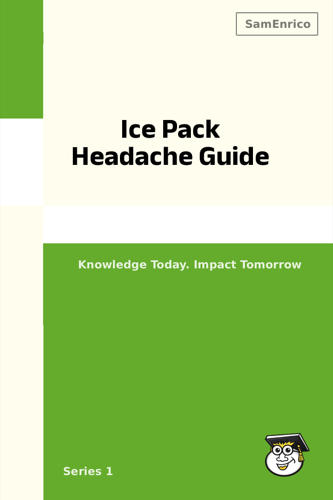
Ice Pack Headache Guide eBook
Apply cold therapy to temples or neck for acute re
Apply cold therapy to temples or neck for acute relief.
Formats
Free sample
Chapter 1: The Cold Threshold...--–- The first time Eleanor pressed a bag of frozen peas against her temple, she wasn't thinking about vasoconstriction or gate control theory or the trigeminal nerve. She was thinking about survival. The migraine had been building for three hours—that telltale pressure behind her left eye, the creeping nausea, the way fluorescent lights suddenly felt like daggers. She had already taken two ibuprofen, then a third, then a triptan she'd been saving for an emergency. Nothing worked.
In desperation, she opened the freezer, grabbed the first cold thing she could find, and pressed it against her throbbing temple. Thirty seconds later, something remarkable happened. The pain didn't disappear, but it changed. The sharp, stabbing quality softened into a dull ache. The pulsating rhythm slowed.
For the first time that day, Eleanor could think clearly enough to wonder: Why does this work?She is not alone. Every year, millions of headache sufferers stumble upon the same discovery—not in clinical trials or neurology textbooks, but in their own kitchens. They press ice to their heads and feel relief. Some do it because a grandparent recommended it. Others because they've run out of medication options.
A few because they've read something online about "cryotherapy" and decided to experiment. But very few understand the elegant, powerful science that explains why a simple ice pack can interrupt one of the most complex pain conditions known to medicine.This chapter is the foundation of everything that follows. Before you learn which ice pack to buy, how long to apply it, or where to place it on your head, you must understand why cold therapy works at all. The answer lies not in folklore or placebo, but in three distinct physiological mechanisms that have been validated by decades of pain research. These mechanisms are vascular, neurological, and conductive.
Each one targets a different aspect of the headache process. When combined, they create a cascade of pain relief that pharmaceutical companies have spent billions trying to replicate—often with less success than a five-cent bag of frozen vegetables.The Vascular Theory: Why Your Head Pounds To understand why ice helps headaches, you must first understand what causes the throbbing quality that defines so many headache types. The answer begins with blood vessels—specifically, the arteries that supply the tissues of your head and face.Under normal conditions, your cerebral blood vessels maintain a steady diameter, delivering oxygen and nutrients to the brain without creating sensation. But during a migraine or vascular headache, something goes wrong. The current scientific consensus, refined over decades of research, points to a process called neurogenic inflammation.
Here is what happens: A trigger—stress, lack of sleep, a specific food, hormonal fluctuation, or sometimes nothing identifiable at all—activates the trigeminal nerve, the major sensory nerve of the face and head. This activation causes the release of inflammatory neuropeptides, particularly calcitonin gene-related peptide (CGRP) and substance P. These chemicals then act on the walls of cerebral blood vessels, causing them to dilate—to widen beyond their normal diameter.This dilation creates two problems. First, the widened vessels stretch the nerve endings wrapped around them, generating pain signals. Second, the increased blood flow creates a pulsating sensation that synchronizes with your heartbeat—the characteristic "throbbing" of a migraine.
This is why headache pain often feels like it's pounding in time with your pulse. It literally is.Now consider what happens when you apply ice to the temple or neck. The cold temperature triggers an immediate reflex called vasoconstriction—the narrowing of blood vessels. Your body does this to preserve heat; when the skin senses cold, it signals the smooth muscle in vessel walls to contract. In the context of a headache, this contraction directly counteracts the pathological dilation that is causing your pain.
As the vessels narrow, the stretching of nerve endings decreases. The pulsatile blood flow slows. The inflammatory chemicals that accumulated during the dilation phase begin to disperse because the blood flow that carried them in is now reduced.This is not theoretical speculation. Studies using transcranial Doppler ultrasound have shown that applying cold to the forehead or neck reduces blood flow velocity in the middle cerebral artery within 60 to 90 seconds. Other research has demonstrated that cold therapy lowers skin and muscle temperature over the superficial temporal artery by 10 to 15 degrees Fahrenheit within five minutes, producing measurable vasoconstriction.
Patients report that the throbbing quality of their headache diminishes before the actual intensity of pain changes—exactly what the vascular mechanism would predict.But there is a catch, and it is an important one. The vasoconstriction produced by cold is temporary. If you apply ice for too long—beyond approximately 15 minutes—your body's protective mechanisms reverse course. This is called rebound vasodilation. The vessels, having been constricted for an extended period, overcompensate by dilating even more than before.
The result is a headache that returns with equal or greater intensity. This is why timing, covered in detail in Chapter 6, is not an afterthought but a core component of effective cold therapy. More ice is not better. Precise ice is better.The Gate Control Theory: How Cold Outruns Pain The vascular mechanism explains why ice reduces the throbbing quality of headaches. But what about the sharp, stabbing, or aching components?
And why does cold sometimes provide relief even when applied to areas far from the pain—for example, cooling the neck to relieve a forehead headache? The answer lies in the spinal cord and a revolutionary theory of pain processing proposed in 1965 by psychologists Ronald Melzack and Patrick Wall.Before Melzack and Wall, the dominant model of pain was a simple "alarm bell" theory: damage to tissue sends a signal up the spinal cord to the brain, and the brain rings the alarm. Pain was thought to be a direct, unmodulated readout of tissue injury. But this model could not explain many common experiences: why rubbing a bumped elbow reduces pain, why soldiers wounded in battle sometimes feel no pain until they reach safety, or why cold can relieve headache pain that originates deep inside the head.Melzack and Wall proposed something radically different. They suggested that the spinal cord contains a neurological "gate" that can either allow pain signals to pass through to the brain or block them.
This gate is influenced by two types of nerve fibers. The first type, called A-delta and C fibers, are small and slow. They carry pain signals from the body to the spinal cord. The second type, called A-beta fibers, are large and fast. They carry non-painful sensations—touch, pressure, vibration, and importantly, temperature.Here is the critical insight: the gate can only process one type of signal at a time.
When the fast A-beta fibers are active, they essentially "beat" the slow pain fibers to the gate and close it, preventing the pain signal from passing through. This is why rubbing an injured area helps: the fast touch signals from rubbing close the gate to the slower pain signals. And this is why cold is so effective for headaches. The sensation of cold travels on those same fast A-beta fibers. When you apply an ice pack to your temple…
This is the end of the free sample. Get the eBook to keep going. Buy now
About this book
Details
- Author
- Petersen Alesha
- Publisher
- SamEnrico
- Language
- English
- Genre
- Non-Fiction, Health & Wellness, Cold, Ice
- Released
- 2026-06-11
- Pages (approx.)
- 156
- Available as
- eBook, Audiobook

Read better in the ZLOADR app
Your eBooks on your phone or tablet. Sign in with your SamEnrico account and start reading.
More by Petersen Alesha
 Critique Circle Score TrapPetersen Alesha$11.99
 Metabolic Syndrome LatinosPetersen Alesha$11.99
 Meth Psychosis First AidPetersen Alesha$11.99
 The Shanghai Shadow: The Spy Who Sold Secrets for GoldPetersen Alesha$11.99
 Legal Document QA with AIPetersen Alesha$12.99
 How to Start a Action Figures Business (Beginners Guide)Petersen Alesha$11.99
 Learn to Play the Multi Chambered OcarinaPetersen Alesha$11.99
 Corporate AccountantPetersen Alesha$11.99
You may also like
 Hong Kong Handover 1997Dunn Johnnie$11.99
 Zumba For Postnatal Recovery CourseNeal Christian$11.99
 Zumba for BeginnersLadner Nikia$11.99
 YouTube Comment Mining GuideHumes Pandora$12.99
 Worry Box MeditationCarlin Rudy$11.99
 Workplace Stress MeditationNguyen Lynn$11.99
 Workplace Stress and Sleep RepairHawley Ivory$11.99
 Workplace Perfectionism CureDelaney Jeffry$11.99
 Workplace Injustice Anger GuideWallen Isabelle$11.99
 Work Addiction and Burnout LinkGreenwood Ester$11.99
 Women in Yoga and WellnessBeattie Galina$11.99
 Women in Stand Up ComedyChun Evangeline$11.99