
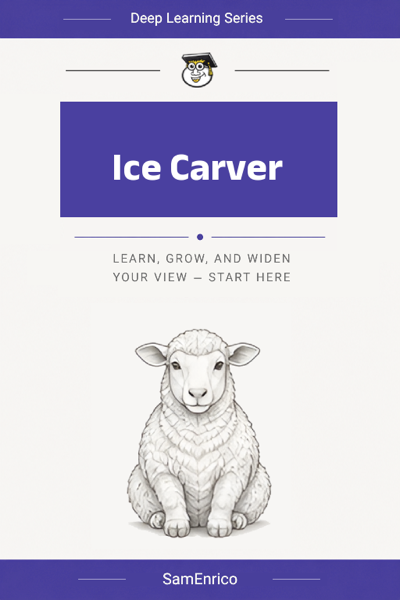
Non-FictionInformativeEducational
Ice Carver eBook
A Coursebook on Ice Carver
by Hicks Jamie
A Coursebook on Ice Carver
Formats
Free sample
Chapter 1: The Crystal Canvas...--–- The room was forty-two degrees Fahrenheit, which is precisely the temperature at which an ice sculpture the size of a grown man begins to weep. Not cry in the emotional sense, though watching six hours of work drip onto a ballroom floor can certainly bring a carver to tears. No, ice weeps literally—water beads forming on its surface like sweat on a marathon runner, gathering weight until gravity pulls them down into thin, glistening streaks that trace the contours of what was, just moments ago, a sharp-edged eagle mid-flight.I learned this lesson my second week on the job at the Grand Majestic Hotel, standing in my brand-new waterproof apron, watching the eagle's beak soften from a precise point into something resembling a novelty eraser. The banquet manager, a woman named Diane who had been running events since before I learned to tie my shoes, walked past, glanced at the sculpture, and said exactly four words: "Should have used clear."She was right. I had carved that eagle from a block of bagged ice—the kind you buy at gas stations for coolers—and it was filled with microscopic bubbles that caught light beautifully but melted twice as fast as clear ice.
The bubbles acted like insulation, trapping heat against the surface. By dinner service, the eagle looked less like America's symbol and more like a melted snowman that had been through a divorce.That night, I went home and calculated the cost of my mistake: seventy dollars for the ice, eight hours of labor at my then-apprenticeship rate of fifteen dollars an hour, and the silent judgment of every guest who wondered why the centerpiece looked like it had been left in a car. Total cost of learning: one hundred ninety dollars and a bruised ego. Total value of that lesson: immeasurable.Because here is the truth about ice carving that no one tells you when you're staring at photos of crystal-clear dolphins and thinking, I could do that. Ice carving is not art.
Not primarily. Art is what happens when everything goes right. Ice carving, first and foremost, is a battle against thermodynamics. It is you, a pile of frozen water, and the unrelenting laws of physics that insist your creation would rather be a puddle. Every cut you make is a negotiation with entropy.
Every finished piece is a temporary victory.And yet, people have been fighting this fight for over four hundred years.The Frozen Beginnings: 17th Century China The first ice carvers were not artists. They were fishermen.In the northern Chinese province of Heilongjiang, where the Songhua River freezes solid for five months each year, the winters are not an inconvenience but a landscape. Temperatures drop to minus thirty degrees Fahrenheit. The river ice thickens to three feet or more—so thick that trucks drive across it, so strong that it supports temporary villages of ice-fishing huts. The fishermen who worked this river noticed something curious about the ice they hauled ashore.
When the sun hit a block at the right angle, light scattered through its interior in ways that transformed the dull, opaque surface into something that glowed from within. Some blocks were clear. Some were white with trapped bubbles. Some had streaks of color from minerals in the riverbed.These fishermen, waiting out the long winter between catches, began carving. Not swans or eagles or corporate logos—they had no need for such things.
They carved lanterns. Simple hollow blocks with a hole cut in the top, wide enough to hold a candle. When lit from inside, the ice scattered the flame's light into a soft, amber glow that could be seen from across the frozen river. The lanterns became signals—this hut is occupied, this stretch of ice is safe, come share a meal.The tradition spread. By the late 1600s, villages along the river competed to see who could build the most elaborate ice structures.
They carved animals, mythical creatures, entire gateways. The ice was free. The tools were simple—hand saws and chisels adapted from woodworking. The only cost was time, and in a Heilongjiang winter, time was something you had in abundance.The Harbin International Ice and Snow Sculpture Festival, which now draws millions of visitors each year, traces its roots directly to these fisherman-carvers. Today, teams from dozens of countries compete using power tools, colored ice, and internal lighting systems that would have looked like sorcery to those first lantern-makers.
But the fundamental insight remains unchanged: ice, properly carved and lit, transforms a dark winter night into something worth traveling across the world to see.The Russian Obsession: Empress Anna's Ice Palace If the Chinese invented ice carving as folk art, the Russians elevated it to propaganda.The year was 1739. Empress Anna Ivanovna ruled Russia with a combination of extravagance and cruelty that made her the subject of both admiration and fear. She was known for her grotesque sense of humor—she once forced two elderly courtiers to dress as clowns and sit in baskets suspended from the ceiling while eagles pecked at them. Another time, she ordered a wedding between a dwarf and one of her maids, forcing the entire court to attend the ceremony dressed as peasants.But her most infamous creation was the Ice Palace.The story begins with a prince named Mikhail Golitsyn, who had committed the unpardonable crime of marrying a woman of lower social standing without the empress's permission. Anna sentenced him to a punishment designed to be both humiliating and fatal: he would live in a palace made entirely of ice, and he would die there, alone and frozen, as entertainment for the court.The palace was no small structure.
Architects and ice carvers—skilled laborers pulled from across the empire—spent months constructing a building that measured eighty feet long, twenty feet wide, and twenty feet high. The walls were ice blocks two feet thick, cut from the Neva River and fitted together with water that froze into mortar stronger than the ice itself. The furniture was ice: beds with ice mattresses, chairs with ice cushions, a fireplace with ice logs painted to look like burning wood. Cannons made of ice stood at the entrance, loaded with ice cannonballs. An ice elephant, life-sized, stood in the courtyard, its trunk designed to spray water from a hidden pump.The carvers who built this palace were not volunteers.
They worked in temperatures far below zero, their tools sticking to their hands, their breath freezing on their faces. They knew that the man who would live in their creation was being sent to die. They built it anyway.Golitsyn survived the night—barely. The palace, designed as a death sentence, turned out to be better insulated than anyone expected. He was found the next morning, alive but severely frostbitten, huddled in a corner of the ice bedroom.
Anna, disappointed that her spectacle had failed, eventually pardoned him and allowed him to live out his days in exile.The Ice Palace was demolished the following spring when the Neva thawed. But its legend endured, spreading across Europe and cementing ice carving's reputation as an art form capable…
This is the end of the free sample. Get the eBook to keep going. Buy now
About this book
Details
- Author
- Hicks Jamie
- Publisher
- SamEnrico
- Language
- English
- Genre
- Non-Fiction, Informative, Educational
- Released
- 2026-05-23
- Pages (approx.)
- 135
- Available as
- eBook, Audiobook

Read better in the ZLOADR app
Your eBooks on your phone or tablet. Sign in with your SamEnrico account and start reading.
More by Hicks Jamie
 The Climate Policy Advocate PathHicks Jamie$11.99
 Emotion Chain Analysis GuideHicks Jamie$11.99
 The Exam Anxiety WorkbookHicks Jamie$11.99
 Dreams After First Responder TraumaHicks Jamie$11.99
 Chase Elliott Most PopularHicks Jamie$11.99
 Silent Revolution: How Smartphones Transformed Mime into a Global Art FormHicks Jamie$11.99
 Understanding Syphilis EmbryopathyHicks Jamie$17.99
 Underrepresented Minorities PhDHicks Jamie$12.99
 Lagos Pop Up Retail GuideHicks Jamie$12.99
 How to Start a Wireless Telecommunications Carriers (except Satellite) BusinessHicks Jamie$11.99
You may also like
 Hong Kong Handover 1997Dunn Johnnie$11.99
 Zumba For Postnatal Recovery CourseNeal Christian$11.99
 Zumba for BeginnersLadner Nikia$11.99
 YouTube Comment Mining GuideHumes Pandora$12.99
 Worry Box MeditationCarlin Rudy$11.99
 Workplace Stress MeditationNguyen Lynn$11.99
 Workplace Stress and Sleep RepairHawley Ivory$11.99
 Workplace Perfectionism CureDelaney Jeffry$11.99
 Workplace Injustice Anger GuideWallen Isabelle$11.99
 Work Addiction and Burnout LinkGreenwood Ester$11.99
 Women in Yoga and WellnessBeattie Galina$11.99
 Women in Stand Up ComedyChun Evangeline$11.99