
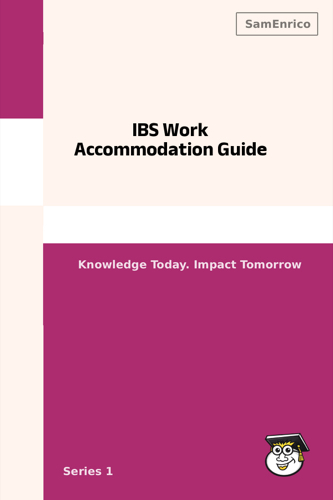
IBS Work Accommodation Guide eBook
Request bathroom access and remote work flexibilit
Request bathroom access and remote work flexibility.
Formats
Free sample
Chapter 1: The Invisible Weight...–- Imagine waking up thirty minutes before your alarm, not from ambition, but from a low, gnawing cramp in your lower abdomen. You lie perfectly still, calculating: if you get up now, you can make it to the bathroom twice before you need to start getting dressed. You build this buffer into every morning. You’ve learned to map every restroom between your apartment and the office, to know which gas stations are open early and which coffee shops have single-stall locks. You’ve become an expert in logistics no one else sees.
Then you walk into your workplace, smile at your colleagues, sit down at your desk, and begin the silent calculus of survival: How far is the restroom? How many people will I have to walk past? What excuse will I use if I have to leave mid-meeting? This is not anxiety about performance or deadlines. This is the invisible weight of living with Irritable Bowel Syndrome (IBS) in a world designed for bodies that obey schedules.This chapter exists to lift that weight off your shoulders by giving you a single, unshakeable truth: your IBS is not a personal failing, a weakness, or a nuisance.
Under the law, it is a disability. And that legal status is the key that unlocks your right to work without fear, shame, or physical distress. Before we discuss accommodation requests, doctor’s notes, or remote work strategies, we must first build the foundation. You cannot advocate for yourself if you do not believe you are entitled to protection. By the end of this chapter, you will not only understand why IBS qualifies as a disability under the Americans with Disabilities Act (ADA), the Rehabilitation Act, and the UK’s Equality Act, but you will also be able to articulate that status with confidence to employers, doctors, and even to yourself.The Common Misconception That Keeps You Silent Let’s start with the voice inside your head.
The one that says, “Other people have real disabilities. I just have a sensitive stomach.” That voice is wrong, and it is also incredibly common. For decades, IBS has been dismissed as a “functional” disorder—a polite way of saying the medical establishment could see the symptoms but couldn’t find a visible, structural cause. No tumor, no bleeding ulcer, no clear lesion on a scan. Because IBS hides, millions of people have been told, “It’s all in your head,” or “Try eating more fiber,” or “You just need to manage your stress better.”These responses, however well-intentioned, share a toxic assumption: that your suffering is not real enough to warrant protection.
This chapter dismantles that assumption completely.The truth is that IBS affects an estimated 10 to 15 percent of the global population. In the United States alone, that is between 25 and 45 million people. It is one of the most common reasons for primary care visits, missed workdays, and reduced productivity. Yet the vast majority of those millions never request a workplace accommodation. Why?
Because they have internalized the same message: “It’s not that serious.” They suffer in silence, developing elaborate coping mechanisms—sitting near the door, avoiding coffee or lunch with colleagues, lying about needing to take a phone call when they really need a bathroom. They burn enormous amounts of mental energy on concealment, leaving less energy for actual work.This chapter is the permission slip you have been waiting for. Your IBS is serious. Your IBS is real. And your IBS is protected.What the Law Actually Says: Major Life Activities The Americans with Disabilities Act was passed in 1990 with a revolutionary definition of disability.
The law does not require a person to have a specific, named condition from an official list. Instead, the ADA defines a disability as “a physical or mental impairment that substantially limits one or more major life activities.” The Rehabilitation Act of 1973 uses nearly identical language for federal employees and federal contractors. The UK’s Equality Act 2010 defines disability as “a physical or mental impairment that has a substantial and long-term adverse effect on your ability to carry out normal day-to-day activities.”The key phrase in all three laws is “major life activities” or “normal day-to-day activities.” This is where IBS finds its legal home.In 2008, Congress passed the ADA Amendments Act (ADAAA) specifically to overturn court decisions that had narrowed the definition of disability too strictly. The ADAAA explicitly added a non-exhaustive list of major life activities, including “caring for oneself, performing manual tasks, seeing, hearing, eating, sleeping, walking, standing, lifting, bending, speaking, breathing, learning, reading, concentrating, thinking, communicating, and working.” But the amendments went further. They added a second category: “major bodily functions,” including “functions of the immune system, normal cell growth, digestive, bowel, bladder, neurological, brain, respiratory, circulatory, endocrine, and reproductive functions.”Read that list again.
Digestive. Bowel. These are explicitly named in the statute as major bodily functions. When IBS substantially limits your digestive or bowel function—even intermittently, even unpredictably—you are covered. There is no legal ambiguity here.
The authors of the ADAAA wanted to make absolutely certain that conditions like IBS would not be dismissed.The Episodic Nature of IBS: Why You Don’t Have to Be Sick Every Day One of the most common reasons people with IBS fail to seek accommodations is the belief that they need to be actively suffering every single workday to qualify. “I have good weeks and bad weeks,” a reader might think. “Last month I only had two bad days. That doesn’t count.”The law explicitly accounts for episodic conditions. The ADAAA states that an impairment that is episodic or in remission is still a disability if it would substantially limit a major life activity when active.
Let that sink in. Your IBS does not need to flare every day. It does not need to be constant. It only needs to be substantially limiting when it does occur.Imagine you have a colleague with epilepsy. They have a seizure once every three months.
No one would argue they do not have a disability because the seizures are infrequent. The same logic applies to IBS. A flare-up that requires immediate bathroom access, causes severe pain, or forces you to leave a meeting is a substantial limitation, regardless of whether it happens daily or monthly.The legal term for this is “predictable assessments.” Employers are allowed to evaluate whether you can perform the essential functions of your job on a regular, predictable basis. But IBS is, by its nature, unpredictable. You cannot schedule a flare-up around a quarterly review.
You cannot tell your body, “Wait until after the all-hands meeting.” The law protects you precisely because of this unpredictability. The whole point of an accommodation is to create flexibility for the unpredictable.The Concentration Connection: When IBS Impairs Thinking Many people are surprised to learn that IBS can qualify as a disability not only through digestive and bowel function but also through concentration. The ADAAA explicitly lists “concentrating” as a major life activity. Anyone who has experienced a sudden, urgent need to use a restroom knows that concentration becomes impossible. You cannot focus on a spreadsheet, a customer call, or…
This is the end of the free sample. Get the eBook to keep going. Buy now
About this book
Details
- Author
- Laughlin Emilee
- Publisher
- SamEnrico
- Language
- English
- Genre
- Non-Fiction, Health & Wellness, Workplace
- Released
- 2026-06-08
- Pages (approx.)
- 133
- Available as
- eBook, Audiobook

Read better in the ZLOADR app
Your eBooks on your phone or tablet. Sign in with your SamEnrico account and start reading.
More by Laughlin Emilee
 Shopping Addiction and Seasonal SalesLaughlin Emilee$11.99
 Smoking Habit Replacement ManualLaughlin Emilee$11.99
 Manufacturing Tariff EngineeringLaughlin Emilee$11.99
 The Celestial Keys of Constantinople: Byzantine Astronomy and the Birth of Modern CosmologyLaughlin Emilee$11.99
 Invitation Round Prediction GuideLaughlin Emilee$12.99
 Underwriting ManagerLaughlin Emilee$11.99
 How to Produce Ant and Roach Control ProductsLaughlin Emilee$11.99
 How to Become a Radio MechanicLaughlin Emilee$11.99
You may also like
 Workplace Napping GuideSteffen Rutha$11.99
 IBS At Work Management GuideButler Rosalie$11.99
 Endometriosis Accommodation LetterHuey Ilda$11.99
 IBS Workplace AccommodationDoherty Leola$11.99
 Workplace AED RequirementsHagen Amada$11.99
 Food Intolerance at WorkManzo Billye$11.99
 CRSD Workplace AccommodationsFindley Frederica$11.99
 Ayurvedic Workplace WellnessWeiss Santana$11.99
 Office Aromatherapy GuideGrubb Felica$11.99
 Workplace Dysthymia AccommodationsBueno Donald$11.99
 Workplace Weight Loss GuideLockwood Rocky$11.99
 The Office Chair Stretch RoutineTripp Reynalda$11.99