

Non-FictionHealth & WellnessDining
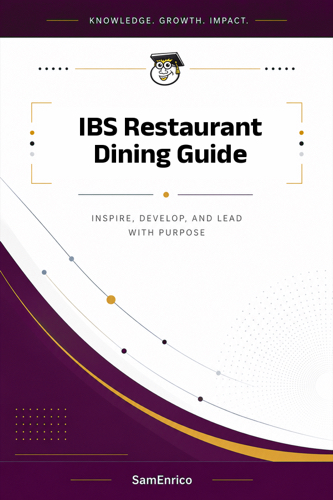
IBS Restaurant Dining Guide eBook
Navigate menus and communicate needs to servers.
Navigate menus and communicate needs to servers.
Formats
Free sample
Chapter 1: The Gut GPS--–- The first time I canceled on a friend’s birthday dinner, I told myself I was just tired. The second time, I blamed a headache. By the tenth time, I had stopped inventing excuses. I simply stopped being invited. That silence—the quiet disappearance of dinner plans, the slow unraveling of a social life—was louder than any symptom I had ever felt in my gut.
If you are reading this book, you already know that silence. You know the calculus that runs through your head every time a restaurant is suggested: How far is the bathroom? Is the menu online? Can I eat anything there? What if I can’t?
What if I order something that seems safe, and my body betrays me in the middle of the appetizer course? This chapter is not about food. Not yet. Before you can navigate a single menu, before you can speak a single word to a server, you must build something that no restaurant can provide: a complete, honest, unflinching map of your own digestive triggers. I call it the Gut GPS, and without it, every meal out is a gamble.
With it, you stop guessing and start choosing.The Myth of the “Safe” Food Let us begin by dismantling a dangerous assumption. Most people with IBS spend years chasing what they believe is a universal list of “safe” foods and “unsafe” foods. They read online forums. They follow influencers. They memorize low-FODMAP charts.
And then they go to a restaurant, order something that should be safe according to the internet, and spend the next six hours in gastrointestinal distress. This is not because the internet lied to you. It is because your gut is not the internet’s gut. It is not your neighbor’s gut. It is not even your sibling’s gut, despite sharing DNA and a childhood kitchen.
IBS is a fiercely individual condition. One person’s trigger—say, a single clove of garlic—may be another person’s completely benign flavoring. Some people with IBS cannot tolerate any lactose; others handle hard cheeses without issue. Some bloat from raw vegetables; others find raw vegetables are the only things that keep them regular. The single greatest mistake you can make before walking into a restaurant is assuming that what worked for someone else will work for you.
The Gut GPS exists to replace that assumption with evidence.Step One: The Twenty-Four-Hour Recall Before you build your map, you must gather your data. This is not a vague exercise in “listening to your body,” which is about as useful as telling someone to “just relax” during a panic attack. You need structure. Start with a simple, low-stakes exercise: the twenty-four-hour recall. For one week, write down everything you eat and drink, down to the smallest bite of a partner’s dessert or a single piece of gum.
Alongside each entry, note any gastrointestinal symptoms that occur within the next twelve hours—bloating, pain, urgency, gas, constipation, diarrhea, or that peculiar sensation of incomplete evacuation. Do not judge what you ate. Do not preemptively decide that something was “bad” or “good.” Just record. At the end of the week, you will have between twenty-one and thirty-five meals worth of data. This is your raw material.Now look for patterns.
They will not be obvious at first. You may notice that every time you eat avocado, you bloat exactly four hours later—but only when you eat more than half of one. You may notice that you tolerate wheat perfectly well in small quantities but suffer after a full sandwich. You may notice that symptoms correlate not with what you ate, but with how quickly you ate it, or whether you were stressed, or whether you drank carbonated water alongside the meal. The twenty-four-hour recall is not about finding a simple list of villains.
It is about understanding the context of your symptoms. Many people with IBS find that a food is only a trigger in certain quantities, or when combined with another food, or when consumed after a period of poor sleep. The Gut GPS will account for all of this.Step Two: The Traffic Light System Once you have a week of data, you are ready to build your Trigger Map. I recommend the traffic light system because it is intuitive, memorable, and actionable. You will create three lists: Red, Yellow, and Green.
Red foods are your absolute never foods. These are the ingredients that have caused you moderate to severe symptoms more than twice in your recall period. They are the foods you will learn to avoid entirely when dining out. Yellow foods are your sometimes foods. They may be safe in small portions, or when prepared in a certain way (cooked versus raw, for example), or only when your gut is already in a stable state.
Green foods are your safe bets. These are the foods that never caused symptoms in your recall period, regardless of quantity or context. Your Green list will likely be short when you first build it. That is normal. Do not panic.
The purpose of the Gut GPS is not to give you a long list of everything you can eat. It is to give you a short list of reliable anchors that you can build meals around.Let me give you a real example from my own recall. My Red list includes garlic (any form, any quantity), onion (raw or powdered; cooked onion is Yellow for me), inulin and chicory root (common additives in “healthy” processed foods), and high-fructose corn syrup. My Yellow list includes lactose (I can tolerate hard cheeses and butter but not milk or soft cheese), beans and lentils (safe in very small portions, dangerous in larger ones), and apples (safe if peeled and cooked, dangerous if raw). My Green list includes white rice, lean poultry and fish, eggs, small amounts of olive oil, salt, most herbs (except garlic and onion), cucumbers, carrots, and lettuce (in small quantities).
Notice that my Green list is not exciting. It is not the kind of menu you would frame and hang on a wall. But it is reliable. And reliability is worth more than excitement when you are sitting in a restaurant booth, ten minutes before your first date arrives, trying to order something that will not ruin your evening.Step Three: The Hidden Trigger Investigation The most dangerous ingredients in any restaurant are not the obvious ones. You know to avoid the bowl of garlic bread.
You know to skip the onion rings. The real threats are the ingredients that hide in plain sight, buried in sauces, seasonings, and processed ingredients that restaurants do not consider worth mentioning. This section will save you more pain than any other part of this book, so read it carefully.Garlic and onion powder are everywhere. They are in “house seasoning blends,” “steak rubs,” “vegetable stock,” “broth,” “gravy,” “marinara sauce,” “barbecue sauce,” “teriyaki sauce,” “salad dressing,” “soup bases,” and even in the brine injected into supermarket-style “grilled chicken” breasts. A restaurant may tell you that a dish contains “no garlic or onion,” meaning no fresh cloves or slices, while…
This is the end of the free sample. Get the eBook to keep going. Buy now
About this book
Details
- Author
- Coolidge Tommye
- Publisher
- SamEnrico
- Language
- English
- Genre
- Non-Fiction, Health & Wellness, Dining
- Released
- 2026-06-07
- Pages (approx.)
- 135
- Available as
- eBook, Audiobook

Read better in the ZLOADR app
Your eBooks on your phone or tablet. Sign in with your SamEnrico account and start reading.
More by Coolidge Tommye
 Mindless Snacking Interruption ManualCoolidge Tommye$11.99
 Compulsive Spending for DentistsCoolidge Tommye$11.99
 Ecommerce Tariff Strategy GuideCoolidge Tommye$11.99
 Tom Wills: The Man Who Invented Australian Rules FootballCoolidge Tommye$11.99
 Skilled Employment Reference GuideCoolidge Tommye$12.99
 Umbrella Stand CraftCoolidge Tommye$11.99
 Ultimate Handbook Guide to Duque De Caxias : (Brazil) Travel GuideCoolidge Tommye$11.99
You may also like
 Hong Kong Handover 1997Dunn Johnnie$11.99
 Zumba For Postnatal Recovery CourseNeal Christian$11.99
 Zumba for BeginnersLadner Nikia$11.99
 YouTube Comment Mining GuideHumes Pandora$12.99
 Worry Box MeditationCarlin Rudy$11.99
 Workplace Stress MeditationNguyen Lynn$11.99
 Workplace Stress and Sleep RepairHawley Ivory$11.99
 Workplace Perfectionism CureDelaney Jeffry$11.99
 Workplace Injustice Anger GuideWallen Isabelle$11.99
 Work Addiction and Burnout LinkGreenwood Ester$11.99
 Women in Yoga and WellnessBeattie Galina$11.99
 Women in Stand Up ComedyChun Evangeline$11.99