
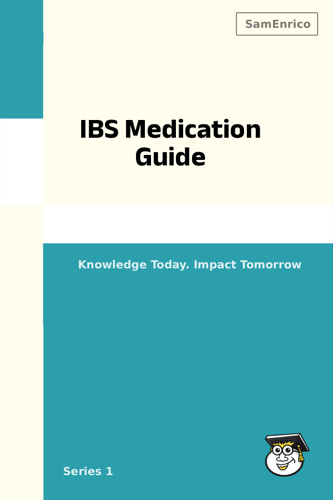
Non-FictionHealth & WellnessIBS Pharmacology
IBS Medication Guide eBook
Reviews rifaximin, lubiprostone, linaclotide, and
Reviews rifaximin, lubiprostone, linaclotide, and other prescriptions.
Formats
Free sample
Chapter 1: The Failure Ladder...--For five years, Sarah woke up every morning and played a game she never wanted to play. Before she opened her eyes, she performed a mental scan: How bad is it today? Sometimes the answer was a dull ache, manageable enough to make it to her desk job by 9:00 AM. Other times, the answer was a searing cramp that meant she would spend the next hour on her bathroom floor, phone in hand, drafting the text she had sent seventeen times before: "Can't make it in. Working from home." Her boss had stopped asking questions two years ago.
He just sent back a thumbs-up emoji and stopped assigning her client-facing work.Sarah had tried everything. The Low-FODMAP diet for eighteen months, weighing every gram of garlic and onion, avoiding apples like they were poison. Probiotics from three different brands, including the expensive refrigerated ones that cost eighty dollars a month. Psyllium fiber every morning, chased with a full glass of water. Peppermint oil capsules that gave her heartburn.
Yoga classes. Meditation apps. A naturopath who sold her five hundred dollars' worth of supplements in glass bottles. A gastroenterologist who told her to "eat more fiber" and sent her on her way with a prescription for dicyclomine that made her so dizzy she couldn't drive.Nothing worked. Or rather, nothing worked enough.
The Low-FODMAP diet helped her bloating a little, but the pain remained. The psyllium made her constipation worse. The probiotics did nothing she could feel. And the dicyclomine stopped the cramping but left her slurring her words like she had downed three martinis before noon.Sarah is not alone. According to the American Gastroenterological Association, approximately 10 to 15 percent of the global population suffers from irritable bowel syndrome.
That is nearly 800 million people worldwide. In the United States alone, 25 to 45 million people have IBS. Yet despite these staggering numbers, the vast majority of IBS patients spend years cycling through the same ineffective treatments before anyone mentions prescription medications that actually target the underlying mechanisms of the disease.This book exists because that waiting period is unnecessary and unacceptable.If you are reading this, you have almost certainly tried the "first-line" treatments. You have googled "IBS diet" and spent weeks avoiding FODMAPs. You have bought the probiotic supplements at Whole Foods.
You have tried the fiber powder that turned into a gel in your glass and tasted like chalk. You have been told to "reduce stress" and "exercise more" and "drink more water" by people who have never spent an hour in a public bathroom wondering if you were going to make it home.And you are still suffering.This chapter is going to do something that no doctor has probably done for you: give you an objective, evidence-based framework for determining when conservative therapy has failed and when it is time to escalate to prescription medications. We are going to climb the Failure Ladder together, rung by rung, and at the end of this chapter, you will have a checklist that tells you exactly when to stop chasing dietary solutions and start demanding better treatment.The Problem with "Try More Fiber"Let us start with a hard truth: most primary care doctors receive fewer than ten hours of nutrition training in medical school and even less training on the pharmacology of IBS. The American Journal of Gastroenterology's 2021 clinical guidelines dedicate exactly three paragraphs to fiber and diet before moving on to prescription medications. Yet when you walk into a general practitioner's office with abdominal pain, the first thing you will hear is some version of "try more fiber."This is not malicious.
It is a relic of medical training from the 1990s, when the treatment ladder for IBS was genuinely: fiber, then antispasmodics, then "learn to live with it." But the science has moved on. We now understand that IBS is not a disease of "not enough fiber" or "too much stress." It is a disorder of brain-gut dysregulation — specifically, a condition called visceral hypersensitivity where the nerves in your gut have become so sensitized that normal amounts of gas, stool, or even peristalsis (the normal wave-like contractions of the intestine) trigger pain signals that your brain interprets as cramping, burning, or stabbing.Fiber does not fix visceral hypersensitivity. Probiotics do not recalibrate overactive gut nerves. Peppermint oil does not change the way your brain processes pain signals from your abdomen.Here is what fiber actually does, broken down by type:Soluble fiber (psyllium, inulin, oats, barley) dissolves in water to form a gel. In constipation-predominant IBS, it can soften stool by holding water in the bowel.
In diarrhea-predominant IBS, it can bulk up loose stool by absorbing excess fluid. Sounds great, right? The problem is that for patients with visceral hypersensitivity, the very act of the gel expanding in the intestine can trigger pain. Psyllium can make your bloating worse because it ferments in the colon, producing gas. Up to 30 percent of IBS patients in clinical trials actually have worsening symptoms on psyllium.Insoluble fiber (wheat bran, cellulose, nuts, seeds) does not dissolve in water.
It adds bulk to stool by physically irritating the intestinal lining, triggering a reflex contraction. For patients with normal guts, this is helpful. For patients with hypersensitive guts, this is like rubbing sandpaper on a sunburn. Wheat bran, in particular, has been shown in multiple trials to increase abdominal pain in IBS patients.The takeaway: Fiber is not a harmless, benign intervention. It is a drug with side effects.
And like any drug, it has a failure threshold.Rung One: Bulk-Forming Agents (The Fiber Step)The first rung on the Failure Ladder is the one you have probably already climbed: bulk-forming agents. These include psyllium (Metamucil, Konsyl, generic), methylcellulose (Citrucel), calcium polycarbophil (Fiber Con, Equalactin), wheat bran, and inulin (often hidden in "fiber gummies" and "prebiotic supplements").How they work: These agents absorb water in the intestine, forming a gel or bulk that theoretically normalizes stool consistency. In constipation, they make stool softer and easier to pass. In diarrhea, they make stool more formed by binding excess water.The evidence: A 2018 meta-analysis in the American Journal of Gastroenterology pooled data from fourteen trials and found that psyllium had a Number Needed to Treat of approximately seven for global symptom improvement — meaning seven people had to take psyllium for one person to get meaningful benefit. That is better than placebo, but hardly a home run.
Wheat bran, in the same analysis, was no better than placebo.When it fails: You have climbed off this rung if, after four weeks of consistent use at the recommended dose (typically three to ten grams per day, titrated up slowly over two weeks), you experience no improvement in your primary symptom (pain, bloating, or altered bowel habits), worsening of bloating or gas, new or worsened abdominal pain, or no change in stool frequency or consistency.Do not spend six months on psyllium hoping it will eventually work. If four weeks at an adequate dose does nothing, you are unlikely to ever see benefit.Rung Two: Antispasmodics (The Cramp Step)The second rung is antispasmodics — drugs that relax the smooth muscle of the gut, theoretically reducing cramping. If you…
This is the end of the free sample. Get the eBook to keep going. Buy now
About this book
Details
- Author
- Stubblefield Albertina
- Publisher
- SamEnrico
- Language
- English
- Genre
- Non-Fiction, Health & Wellness, IBS Pharmacology
- Released
- 2026-06-07
- Pages (approx.)
- 155
- Available as
- eBook, Audiobook

Read better in the ZLOADR app
Your eBooks on your phone or tablet. Sign in with your SamEnrico account and start reading.
More by Stubblefield Albertina
 Travel Tech InvestmentStubblefield Albertina$11.99
 The Arm Levitation Trance MethodStubblefield Albertina$11.99
 The Healing Light TechniqueStubblefield Albertina$11.99
 Strength Training For FootballStubblefield Albertina$11.99
 High Pressure Sales Stress PlanStubblefield Albertina$11.99
 OCD and WorkStubblefield Albertina$11.99
 Wu MichelleStubblefield Albertina$11.99
 Flooding Self RegulationStubblefield Albertina$11.99
 The Last Stand at the Sydney Hilton: The Untold Siege of 1980Stubblefield Albertina$11.99
 Anansi Weaves the Sky: The Spider’s Cosmic TrickStubblefield Albertina$11.99
 The Last Breath of the Ice MaidenStubblefield Albertina$11.99
 Research Proposal Pilot Study IntegrationStubblefield Albertina$12.99
You may also like
 Hong Kong Handover 1997Dunn Johnnie$11.99
 Zumba For Postnatal Recovery CourseNeal Christian$11.99
 Zumba for BeginnersLadner Nikia$11.99
 YouTube Comment Mining GuideHumes Pandora$12.99
 Worry Box MeditationCarlin Rudy$11.99
 Workplace Stress MeditationNguyen Lynn$11.99
 Workplace Stress and Sleep RepairHawley Ivory$11.99
 Workplace Perfectionism CureDelaney Jeffry$11.99
 Workplace Injustice Anger GuideWallen Isabelle$11.99
 Work Addiction and Burnout LinkGreenwood Ester$11.99
 Women in Yoga and WellnessBeattie Galina$11.99
 Women in Stand Up ComedyChun Evangeline$11.99