
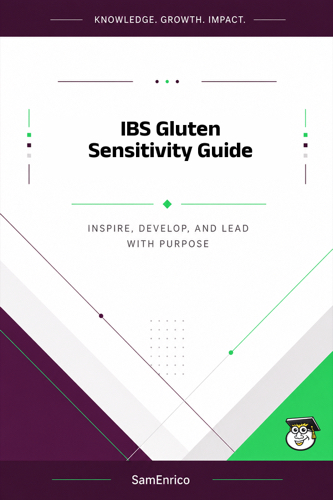
Non-FictionHealth & WellnessGluten
IBS Gluten Sensitivity Guide eBook
Differentiate non celiac gluten sensitivity from c
Differentiate non celiac gluten sensitivity from celiac disease.
Formats
Free sample
Chapter 1: Beyond the Loaf...--There is a moment in every gluten-related health journey that changes everything. It is not the moment you first hear about gluten. It is not the moment you decide to try a gluten-free diet. It is the moment you realize that the food you have eaten your entire life—the bread at dinner, the pasta on Tuesday nights, the beer at ballgames, the pastry at celebrations—has been quietly making you sick. That moment arrives differently for everyone.
For some, it comes after years of unexplained fatigue that doctors dismissed as depression. For others, it comes after a night of such violent bloating that they look nine months pregnant. For many, it comes when they accidentally eat gluten after weeks of feeling better and watch in horror as all their symptoms return within hours.That moment is a gift and a curse. A gift because it provides an explanation. A curse because it raises a terrifying question: now what?If you are reading this book, you have likely already had that moment.
You have already connected your symptoms to gluten. You have already started wondering whether you have Celiac disease, whether you are simply sensitive, or whether something else entirely is going on. You may have already gone gluten-free and felt dramatically better. Or you may be standing at the precipice, wondering whether to take the leap.This chapter is designed to meet you exactly where you are. It will not pressure you to change your diet overnight.
It will not scare you with worst-case scenarios. It will simply lay out the landscape of gluten-related disorders in clear, compassionate, science-based terms. By the end of this chapter, you will understand the fundamental distinction between Celiac disease and Non-Celiac Gluten Sensitivity. You will understand why that distinction matters for your health, your family, and your future. And you will have a roadmap for the rest of this book, which will guide you step by step toward clarity and healing.The Great Gluten Confusion Let us begin with a simple observation.
Walk into any grocery store in America today, and you will find an entire aisle dedicated to gluten-free products. Gluten-free crackers, gluten-free cookies, gluten-free bread, gluten-free pizza crust, gluten-free beer. Celebrities endorse gluten-free diets. Athletes credit gluten-free eating for their performance. Wellness influencers claim that eliminating gluten cured their acne, their brain fog, their arthritis, their everything.Walk into any gastroenterologist's office, and you will hear a very different story.
Many doctors are frustrated by what they see as a fad. They treat patients who demand Celiac testing but refuse to eat gluten for the required six to eight weeks. They see patients who feel better off gluten but have completely normal test results. They watch as the gluten-free food industry grows into a multi-billion dollar juggernaut, fueled more by marketing than by medicine.Both perspectives contain pieces of the truth. And both perspectives miss the larger picture.The truth is that genuine gluten-related disorders exist.
Celiac disease is a real, serious, autoimmune condition that affects approximately one percent of the global population. NCGS is a real, distinct condition that may affect an additional one to six percent of people. Together, these conditions affect tens of millions of people worldwide, the majority of whom are undiagnosed.The truth is also that the vast majority of people who try a gluten-free diet do not have a medical need for it. They feel better because they have eliminated processed junk food, not because they have eliminated gluten. They feel better because of the placebo effect.
They feel better because they are paying more attention to what they eat. None of this is bad. But it has created a cultural environment where people with genuine, serious gluten-related disorders are dismissed as fad followers.This chapter, and this entire book, is written for the people in the middle. You suspect gluten is a problem for you. You may be right.
But until you understand the difference between Celiac disease and NCGS, you are navigating in the dark.The Three Pillars of Wheat Reactions To understand gluten-related disorders, we must first understand that the human body can react to wheat in three fundamentally different ways. Think of these as three separate medical conditions that happen to share a common trigger. They have different mechanisms, different diagnostic pathways, different treatments, and different prognoses.Pillar One: Wheat Allergy A wheat allergy is exactly what it sounds like: an allergic reaction to proteins found in wheat. This is the same type of immune response that causes peanut allergies, shellfish allergies, and bee sting allergies. When someone with a wheat allergy eats wheat, their immune system produces Ig E antibodies that trigger the release of histamine and other chemicals.
Symptoms typically appear within minutes to two hours and can include hives, itching, swelling of the lips or tongue, nasal congestion, wheezing, nausea, vomiting, diarrhea, and in severe cases, anaphylaxis—a life-threatening reaction that requires immediate epinephrine.Wheat allergy is most common in children, affecting approximately 0.5 percent of children. Many outgrow it by adolescence. In adults, wheat allergy is rare. Diagnosis is made through skin prick testing or blood tests for wheat-specific Ig E antibodies. Treatment is strict avoidance of wheat, not just gluten, because other wheat proteins can trigger the reaction.
People with severe wheat allergy carry epinephrine auto-injectors.Wheat allergy is the easiest of the three conditions to identify because the symptoms are rapid and unmistakable. If you eat wheat and your throat swells or you break out in hives, you probably have a wheat allergy. Most people reading this book do not have a wheat allergy. But it is important to mention because it is sometimes confused with the other conditions.Pillar Two: Celiac Disease Celiac disease is not an allergy. It is an autoimmune disorder.
This distinction is crucial. In an autoimmune disorder, the immune system does not just react to an external trigger—it attacks the body's own tissues. In Celiac disease, the trigger is gluten, a protein found in wheat, barley, and rye. The target is the lining of the small intestine.When a person with Celiac disease eats gluten, their immune system launches a coordinated attack. Specialized immune cells called T-cells recognize gluten peptides as dangerous.
These T-cells then release inflammatory signals that cause damage to the tiny, finger-like projections called villi that line the small intestine. The villi are responsible for absorbing nutrients from food. When they are damaged, they flatten and shrink, dramatically reducing the surface area available for absorption.This damage leads to malabsorption. Nutrients that should be absorbed—iron, calcium, vitamin D, B12, folate, fat-soluble vitamins—pass through the body unabsorbed. Over time, this causes a cascade of secondary problems.
Iron deficiency anemia is one of the most common presentations of Celiac disease in adults. Osteoporosis from calcium and vitamin D malabsorption is another. Neurological problems from B12 deficiency, infertility from hormonal disruption, skin rashes from immune complexes depositing in the skin—the list goes on.Importantly, Celiac disease is not a gut disease. It is a systemic autoimmune disease that happens to express itself through the gut. The same immune dysregulation that damages the villi can affect…
This is the end of the free sample. Get the eBook to keep going. Buy now
About this book
Details
- Author
- Hagen Rebecka
- Publisher
- SamEnrico
- Language
- English
- Genre
- Non-Fiction, Health & Wellness, Gluten
- Released
- 2026-06-06
- Pages (approx.)
- 151
- Available as
- eBook, Audiobook

Read better in the ZLOADR app
Your eBooks on your phone or tablet. Sign in with your SamEnrico account and start reading.
More by Hagen Rebecka
 The Retargeting Funnel GuideHagen Rebecka$11.99
 Workaholic Body Awareness GuideHagen Rebecka$11.99
 Burnout and Immune SystemHagen Rebecka$11.99
 Educational Institution Data Leak ScriptsHagen Rebecka$11.99
 The Clockwork Visionary: How a Farm Boy Built the First Practical AirplaneHagen Rebecka$11.99
 Einstein's Waves: Chasing Relativity in the Indian OceanHagen Rebecka$11.99
 Marri Red Gum HarvestingHagen Rebecka$11.99
 Advisory Board Formation GuideHagen Rebecka$12.99
 Product Launch Calendar ToolHagen Rebecka$12.99
 Understanding Cilliers–beighton SyndromeHagen Rebecka$17.99
 How to Become a Certified Medication TechnicianHagen Rebecka$11.99
You may also like
 Hong Kong Handover 1997Dunn Johnnie$11.99
 Zumba For Postnatal Recovery CourseNeal Christian$11.99
 Zumba for BeginnersLadner Nikia$11.99
 YouTube Comment Mining GuideHumes Pandora$12.99
 Worry Box MeditationCarlin Rudy$11.99
 Workplace Stress MeditationNguyen Lynn$11.99
 Workplace Stress and Sleep RepairHawley Ivory$11.99
 Workplace Perfectionism CureDelaney Jeffry$11.99
 Workplace Injustice Anger GuideWallen Isabelle$11.99
 Work Addiction and Burnout LinkGreenwood Ester$11.99
 Women in Yoga and WellnessBeattie Galina$11.99
 Women in Stand Up ComedyChun Evangeline$11.99