
Non-FictionHealth & WellnessExercise
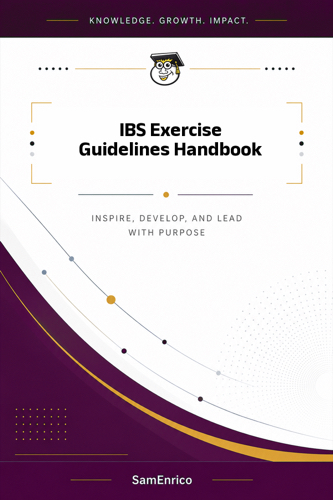
IBS Exercise Guidelines Handbook eBook
Teaches gentle exercise like walking to avoid symp
by Bolin Alisia
Teaches gentle exercise like walking to avoid symptom exacerbation.
Formats
Free sample
Chapter 1: The Broken Promise--–- The treadmill beeped its final congratulatory chime. Sarah, a 34-year-old marketing director, had just completed a 30-minute high-intensity interval training session. Her smartwatch flashed: “500 calories burned. New personal record!” She felt accomplished, proud, even virtuous. She had done everything the fitness influencers promised would lead to health, vitality, and a leaner body.
She had pushed through the burn. She had embraced the “no pain, no gain” mantra.Forty-five minutes later, she was curled on her bathroom floor.Her abdomen was a knot of searing cramps. Bloating distended her stomach so severely she looked six months pregnant. The urgent, explosive diarrhea that followed left her shaking and exhausted. The workout that was supposed to make her feel alive had instead triggered one of the worst IBS flare-ups of her life.
She had spent the rest of the evening cancelling dinner plans, applying a heating pad to her stomach, and silently asking herself one devastating question: What is wrong with me?Nothing is wrong with Sarah. And nothing is wrong with you. The problem is not your body. The problem is a profound, dangerous, and almost universally ignored mismatch between the way modern fitness culture defines “exercise” and the way a sensitized, inflamed, or hyper-reactive gut actually functions.This chapter will dismantle a promise that the fitness industry has sold us for decades—the promise that more effort equals better results, that pain is weakness leaving the body, and that any movement worth doing must leave you breathless, sweaty, and sore. For the estimated 10-15% of the global population living with Irritable Bowel Syndrome, this promise is not just false.
It is actively harmful.The Silent Epidemic of Exercise-Induced Gut Distress Let us begin with a frank admission that most doctors overlook and most fitness trainers refuse to acknowledge: for a significant subset of the population, particularly those with IBS, intense exercise is not a treatment. It is a trigger. Research published in the American Journal of Gastroenterology has shown that up to 50% of IBS patients report exercise as a precipitant of their symptoms. Yet when these same patients go to their physicians and say, “Exercise makes me feel worse,” the most common response is some version of “try harder,” “push through it,” or “you’re probably just out of shape.”This medical gaslighting has consequences. It drives patients away from movement entirely.
It replaces the possibility of therapeutic, gentle, symptom-aware exercise with total avoidance. And it reinforces a shame cycle that goes like this: “Exercise is supposed to be good for me. Exercise makes me feel terrible. Therefore, I must be broken.”You are not broken. Your gut is simply responding to exercise the way any sensitized organ would respond to a perceived threat.
And the first step toward healing is understanding exactly what happens inside your body when you sprint, lift heavy, or engage in high-intensity interval training.The Physiology of a Flare: What Happens Inside Your Gut During Intense Exercise To understand why “no pain, no gain” fails the IBS gut, we must go beneath the skin and into the neuroendocrine battlefield that is your digestive tract during intense physical exertion. Two primary mechanisms explain the connection: sympathetic nervous system overload and a phenomenon known as mesenteric blood shunting.Mechanism One: The Fight-or-Flight Hijack Your nervous system has two main branches. The parasympathetic branch (often called “rest and digest”) is responsible for calm, repair, digestion, and healing. The sympathetic branch (“fight or flight”) is responsible for survival—increased heart rate, dilated pupils, diverted blood flow to muscles, and suppressed digestion.Intense exercise—anything that raises your heart rate above approximately 85% of its maximum or that triggers breath-holding, grunting, or explosive movement—is interpreted by your ancient, reptilian brain as a life-threatening event. You are not actually running from a saber-toothed tiger.
But your nervous system does not know that. All it knows is that your heart is pounding, your muscles are screaming, and your breathing is ragged. The response is immediate and total: full sympathetic activation.When your sympathetic nervous system takes over, it releases a cascade of stress hormones, primarily epinephrine (adrenaline) and cortisol. These hormones have direct effects on the gut. They slow or halt gastric emptying—meaning food sits in your stomach longer, fermenting and producing gas.
They increase colonic motility in some people (leading to urgent diarrhea) and decrease it in others (leading to constipation). They heighten visceral sensitivity, meaning the same normal gas bubble that you would barely notice on a calm day becomes a knife-like pain under sympathetic dominance.In other words, intense exercise does not just happen alongside your IBS symptoms. It actively creates the physiological conditions for a flare.Mechanism Two: The Blood Shunting Effect Your body has a finite supply of blood. During intense exercise, your muscles demand more oxygen. Your heart and lungs demand more flow.
Your brain demands priority perfusion. Something has to give. That something is your splanchnic circulation—the network of blood vessels that supplies your stomach, small intestine, colon, liver, and pancreas.During high-intensity exercise, blood flow to the gut can decrease by 50-80%. This is called mesenteric blood shunting. The body literally steals blood from your digestive system to fuel your muscles.
This is not a minor adjustment. It is a massive, system-wide redirection of resources.What happens when your gut is starved of blood? Several things, none of them pleasant. The cells lining your intestinal wall become hypoxic (oxygen-starved). This weakens the tight junctions between those cells, increasing intestinal permeability—the scientific term for “leaky gut.” Bacteria and partially digested food particles that should remain inside your intestines can now cross into your bloodstream, triggering systemic inflammation.
The smooth muscle of your colon, deprived of oxygen, begins to cramp and spasm. And the migrating motor complex—the “housekeeping wave” that sweeps debris through your small intestine between meals—grinds to a halt, allowing bacterial overgrowth and gas production to flourish.A 2014 study in the journal Medicine & Science in Sports & Exercise found that just 60 minutes of intense running increased intestinal permeability by over 250% in healthy athletes. In individuals with pre-existing gut sensitivity like IBS, the effect is magnified. You are not imagining the connection between your spin class and your subsequent bathroom emergency. You are observing a predictable physiological response.Post-Exertional Malaise: The IBS Version The medical literature has long recognized a phenomenon called post-exertional malaise (PEM) in conditions like chronic fatigue syndrome and fibromyalgia.
PEM describes a worsening of symptoms in the hours or days following physical or cognitive exertion—a flare that is delayed, disproportionate, and debilitating.IBS patients experience their own version of PEM. It often follows a characteristic pattern. Immediately after intense exercise, you may feel fine, perhaps even euphoric from endorphins. One to four hours later, the first signs appear: bloating, mild cramping, or a sense of incomplete evacuation. By the next morning, you are in a full-blown flare: alternating diarrhea and constipation, sharp abdominal pain, nausea, fatigue, and brain fog that lasts anywhere from 12 to 72 hours.This delayed response is particularly insidious because it creates a conditioning paradox.
Your brain learns to associate exercise with pain, but because the pain is delayed, the connection is murky. You may…
This is the end of the free sample. Get the eBook to keep going. Buy now
About this book
Details
- Author
- Bolin Alisia
- Publisher
- SamEnrico
- Language
- English
- Genre
- Non-Fiction, Health & Wellness, Exercise
- Released
- 2026-06-09
- Pages (approx.)
- 160
- Available as
- eBook, Audiobook

Read better in the ZLOADR app
Your eBooks on your phone or tablet. Sign in with your SamEnrico account and start reading.
More by Bolin Alisia
 Resentment in FriendshipsBolin Alisia$11.99
 Francis and the Feast of St. FrancisBolin Alisia$11.99
 Asking for a Raise EffectivelyBolin Alisia$11.99
 Diversity OptimizationBolin Alisia$11.99
 Metabolic Adaptation PodcastBolin Alisia$11.99
 Highway Hassle PreventionBolin Alisia$11.99
 Elizabeth Piracy AuthorizationBolin Alisia$11.99
 The Siege of Nicaea: The Last Byzantine Stronghold Falls (1331 AD)Bolin Alisia$11.99
 The Diamond Dreamers: Australia's Unlikely World Series QuestBolin Alisia$11.99
 Service Providers Guide to Family MedicineBolin Alisia$11.99
 How to Produce Traditional Patented MedicinesBolin Alisia$11.99
 Sales Pipeline Review BlockingBolin Alisia$12.99
You may also like
 Hong Kong Handover 1997Dunn Johnnie$11.99
 Zumba For Postnatal Recovery CourseNeal Christian$11.99
 Zumba for BeginnersLadner Nikia$11.99
 YouTube Comment Mining GuideHumes Pandora$12.99
 Worry Box MeditationCarlin Rudy$11.99
 Workplace Stress MeditationNguyen Lynn$11.99
 Workplace Stress and Sleep RepairHawley Ivory$11.99
 Workplace Perfectionism CureDelaney Jeffry$11.99
 Workplace Injustice Anger GuideWallen Isabelle$11.99
 Work Addiction and Burnout LinkGreenwood Ester$11.99
 Women in Yoga and WellnessBeattie Galina$11.99
 Women in Stand Up ComedyChun Evangeline$11.99