
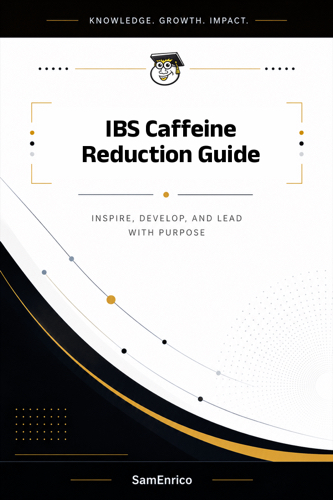
Non-FictionHealth & WellnessCaffeine
IBS Caffeine Reduction Guide eBook
Limit coffee and tea to reduce diarrhea triggers.
Limit coffee and tea to reduce diarrhea triggers.
Formats
Free sample
Chapter 1: The Morning Sprint--It begins the same way every day. You wake up—maybe groggy, maybe well-rested, it doesn't seem to matter. You shuffle to the kitchen, start the coffee maker or boil water for tea, and inhale that first warm, familiar sip. For a few minutes, the world feels normal. Then, somewhere between twelve and twenty minutes later, your gut sends a signal that cannot be ignored.
Not a suggestion. Not a mild urge. A command. Your colon contracts with a force that doubles you over, and you are running—not walking, not waiting—to the nearest bathroom. Sometimes you make it.
Sometimes you don't. And then you spend the next hour wondering: Is this normal? Is this just my "nervous stomach"? Am I the only one who plans their commute around known restrooms, who maps every coffee shop by its bathroom accessibility, who has silently canceled plans because the morning coffee hit too hard?You are not the only one. And no, this is not normal—not in the sense of "this happens to everyone." What you are experiencing has a name, a biological mechanism, and a set of proven solutions.
This chapter will give you that name, explain why your body responds to caffeine differently than other people's bodies do, and—most importantly—validate that your experience is real, physiological, and manageable.The 7:15 AM Panic: A Story You Know Let me tell you about Sarah. She is not a real patient—her name and details have been changed to protect privacy—but her story is a composite of hundreds of emails, clinic visits, and support group posts I have reviewed over the past decade. Sarah is thirty-four years old, a project manager at a marketing firm, and she loves her morning coffee. She loves the ritual: grinding the beans, the sound of the drip machine, the first quiet moments before her children wake up. She also loves what coffee does for her focus and mood.But every morning, without fail, within fifteen minutes of finishing her first cup, she experiences a sudden, explosive urgency to defecate.
Not discomfort. Not a gentle reminder. Urgency. The kind that makes her break out in a cold sweat, the kind that has caused her to exit highway traffic and park at a gas station, the kind that made her miss the opening presentation at a client meeting last quarter. She has tried everything she can think of.
She switched from dark roast to light roast. She tried cold brew. She switched to tea. She tried drinking her coffee after breakfast instead of before. Nothing worked consistently.Her primary care doctor told her she had a "nervous stomach" and suggested she "try to relax." A gastroenterologist diagnosed her with IBS-D—Irritable Bowel Syndrome with diarrhea predominance—prescribed an antispasmodic medication, and sent her on her way.
The medication helped with the cramping but did nothing for the urgency. So Sarah did what millions of people do: she adapted. She wakes up thirty minutes earlier than she needs to, drinks her coffee, and waits for the inevitable bathroom trip before she showers. She never drinks coffee outside her home. She has not ordered a latte at a café in three years.
She has accepted this as her normal.It does not have to be.What Is IBS-D, Exactly?Before we can understand why caffeine triggers diarrhea in some people but not others, we need to understand what IBS-D actually is—and what it is not. Irritable Bowel Syndrome is a functional gastrointestinal disorder. The word "functional" is crucial here. It means that standard medical tests—colonoscopy, endoscopy, CT scan, blood work—come back normal. There is no tumor, no inflammation (as in Crohn's disease or ulcerative colitis), no infection, no structural abnormality.
The plumbing is fine. The problem is in how the plumbing operates.In IBS-D, the dominant symptom is diarrhea: loose or watery stools occurring at least twenty-five percent of the time. But diarrhea alone is not enough for a diagnosis. The Rome IV criteria, which are the international standard for diagnosing IBS, require recurrent abdominal pain—on average, at least one day per week in the last three months—associated with two or more of the following: pain related to defecation, a change in stool frequency, or a change in stool form (appearance). In plain English: you have belly pain that gets better or worse when you poop, and your pooping habits have changed.For Sarah, and for millions of others, the pain is cramping.
The change in stool frequency is urgency—the sudden, overwhelming need to go. The change in stool form is diarrhea. And the trigger is often, but not always, food or drink. Caffeine is one of the most common triggers, but it is far from the only one. Fatty meals, spicy foods, certain carbohydrates (especially the FODMAPs we will discuss in Chapter 9), stress, sleep deprivation, and hormonal fluctuations can all trigger an IBS-D flare.The key point, and the one I want you to carry through this entire book, is this: IBS-D is a disorder of gut function, not gut structure.
Your intestines are not diseased. They are not rotting, bleeding, or falling apart. They are simply overreacting to stimuli that other people's intestines ignore. And caffeine is one of the most potent stimuli available.Visceral Hypersensitivity: Your Gut's Volume Knob Is Stuck on High The single most important concept in understanding your caffeine sensitivity is something called visceral hypersensitivity. Let me explain it in two ways: first the technical version, then the analogy.The technical version: In people with IBS-D, the nerve endings in the wall of the intestine—specifically, the afferent neurons that carry signals from the gut to the brain—have a lower activation threshold than in healthy controls.
This has been demonstrated repeatedly in research studies using a device called a barostat, which inflates a balloon inside the rectum or colon to measure how much distension is required before the person reports feeling pain or discomfort. Healthy individuals typically report discomfort when the balloon is inflated to a volume that stretches the intestinal wall by about 300 milliliters. People with IBS-D report discomfort at half that volume—sometimes less. Their nerves are firing "pain" signals at a level of stretch that most people do not even perceive.The analogy: Imagine two smoke detectors. One is calibrated correctly.
It only sounds the alarm when there is actual smoke from a fire. The other is hypersensitive. It sounds the alarm when you burn toast, when you open the oven too quickly, when you light a candle too close to the ceiling. The hypersensitive detector is not broken. It is functioning exactly as it was designed—the problem is that it was designed with the wrong threshold.
Your gut is the hypersensitive smoke detector. Caffeine is the burnt toast.Here is what this means for your morning coffee: When a healthy person drinks caffeine, the caffeine stimulates the colon to contract (more on the exact mechanism in Chapter 2). Those contractions produce a mild degree of distension—the intestinal wall stretches a little as contents move through. The healthy person's nerves register this distension as, at most, a mild…
This is the end of the free sample. Get the eBook to keep going. Buy now
About this book
Details
- Author
- Emerson Valentin
- Publisher
- SamEnrico
- Language
- English
- Genre
- Non-Fiction, Health & Wellness, Caffeine
- Released
- 2026-06-07
- Pages (approx.)
- 144
- Available as
- eBook, Audiobook

Read better in the ZLOADR app
Your eBooks on your phone or tablet. Sign in with your SamEnrico account and start reading.
More by Emerson Valentin
 Hidden Sugar Trap Elimination GuideEmerson Valentin$11.99
 Shopping Addiction and GriefEmerson Valentin$11.99
 WTO Tariff Bindings ExplainedEmerson Valentin$11.99
 The Silk and the Socratic: Athens' Fashion RevolutionEmerson Valentin$11.99
 How to Start a Dish Washing Machines for Domestic Use (wholesale) Business (Beginners Guide)Emerson Valentin$11.99
 How to Produce an Antiquing GelEmerson Valentin$11.99
 Australian Study Requirement FulfillmentEmerson Valentin$12.99
 TransliteratorEmerson Valentin$11.99
You may also like
 Hong Kong Handover 1997Dunn Johnnie$11.99
 Zumba For Postnatal Recovery CourseNeal Christian$11.99
 Zumba for BeginnersLadner Nikia$11.99
 YouTube Comment Mining GuideHumes Pandora$12.99
 Worry Box MeditationCarlin Rudy$11.99
 Workplace Stress MeditationNguyen Lynn$11.99
 Workplace Stress and Sleep RepairHawley Ivory$11.99
 Workplace Perfectionism CureDelaney Jeffry$11.99
 Workplace Injustice Anger GuideWallen Isabelle$11.99
 Work Addiction and Burnout LinkGreenwood Ester$11.99
 Women in Yoga and WellnessBeattie Galina$11.99
 Women in Stand Up ComedyChun Evangeline$11.99