
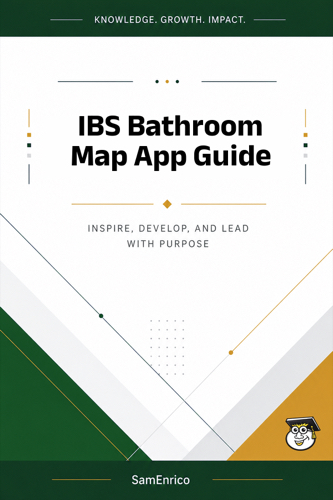
Non-FictionHealth & WellnessApps
IBS Bathroom Map App Guide eBook
Use digital tools to locate public restrooms.
Use digital tools to locate public restrooms.
Formats
Free sample
Chapter 1: The Ghost Bathrooms--You are standing outside a locked door. The app on your phone shows a bright green pin, labeled “Restroom – Verified 3 months ago – 4.2 stars.” The building is dark. A handwritten sign taped to the glass says “Closed for renovations – reopen spring of next year.” You are now 37 seconds away from a level eight urgency event. This is not a failure of technology. This is a failure of understanding.
The app did not lie to you. But it also did not tell you the truth. The truth is that every bathroom map is a photograph of the past, not a live feed of the present. And if you do not understand how that photograph was taken, who developed it, and when it last met the light, you will keep finding yourself standing in front of locked doors with the clock running down.This chapter is about the invisible infrastructure beneath every bathroom app. It will teach you where the dots on your map actually come from, why some cities have ten thousand dots and others have ten, and how to tell the difference between a bathroom that exists and a bathroom that once existed.
By the end of this chapter, you will never look at a green pin the same way again. You will see timestamps instead of promises. You will see data sources instead of certainty. And you will be equipped to make the one distinction that separates panic from confidence: the difference between a verified bathroom and a ghost.The Two Tribes of Bathroom Data Every bathroom location on every app comes from one of two sources. There is no third way.
Understanding these two tribes is the single most important piece of knowledge in this entire book. The first tribe is Open Street Map. The second tribe is crowdsourcing. They are not the same. They are not interchangeable.
And your safety depends on knowing which one your app favors.Open Street Map is often described as the Wikipedia of maps. It is a global, open-source database of every physical feature on Earth that someone bothered to add. Roads, buildings, parks, fire hydrants, postal boxes, and yes, public restrooms. The data is contributed by volunteers, government agencies, and corporate partners. It is comprehensive in some places and laughably empty in others.
Manhattan has over five thousand mapped restrooms because thousands of volunteers have walked those streets and added every Starbucks, every park bathroom, every hotel lobby, and every transit station toilet. Rural Wyoming has twelve. Not because there are only twelve bathrooms in rural Wyoming, but because no one has added the rest. The data exists only where someone cared enough to put it there.The second tribe is crowdsourced data. This comes directly from users like you checking in, leaving reviews, uploading photos, and reporting closures in real time.
When you open an app and see a bathroom marked with a timestamp that says “verified 2 hours ago by user Sarah K,” that is crowdsourced data. It is fast, it is current, and it is wildly inconsistent. One user’s “clean” is another user’s “biohazard.” One user’s “easily accessible” might mean a key code is posted on the door, while another user might have walked right past a locked gate.Here is the critical distinction that most app users never learn. Open Street Map data is slow but stable. A bathroom added to OSM six months ago is almost certainly still a bathroom.
The building might have changed hours, the lock might have broken, but the physical structure remains. Crowdsourced data is fast but fragile. A bathroom verified twenty minutes ago by a user is almost certainly usable right now, but that same bathroom might be locked tomorrow with no one to report it. The smart user does not choose one tribe over the other. The smart user learns to read both.The Poop Map Phenomenon When app developers want to impress you, they boast about coverage.
“Over one hundred four countries,” they say. “More than half a million locations.” These numbers are technically true and practically meaningless. The app that claims coverage across one hundred four countries is not claiming that every country has useful data. It is claiming that at least one bathroom has been mapped somewhere within the borders of each of those countries. There could be fifty thousand bathrooms in Japan and exactly three in the entire country of Paraguay.
The number of countries tells you nothing about whether you can find a bathroom when you need one.The real question is data density. Density is the number of mapped bathrooms per square mile or per capita. A city with high density means you can drop a pin anywhere and find three options within a five minute walk. A city with low density means you had better plan your route in advance. The apps do not show you density maps.
They show you pins. And pins are deceptive. A single pin in a rural area might represent the only gas station for twenty miles. A cluster of fifty pins in a city block might represent forty nine bathrooms that are behind locked doors, inside closed businesses, or reserved for customers only.The term “Poop Map” emerged from early internet forums where users would share hand drawn maps of safe bathrooms in their cities. The phenomenon was always about community knowledge, not official records.
Modern apps have digitized this community knowledge but have not solved the underlying problem. The problem is that bathrooms are not stable features of the landscape. They open. They close. They change their access policies.
They get locks. They lose locks. They become pay toilets. They become employee only. A map that does not update in near real time is a map that will eventually betray you.Data Decay and the Half Life of a Bathroom Every piece of information has a half life.
In nuclear physics, half life is the time it takes for half of a radioactive substance to decay. In data science, half life is the time it takes for half of a piece of information to become false. For bathroom data, the half life is terrifyingly short. A study of crowdsourced restroom data from 2019 to 2024 found that the average bathroom listing had a fifty percent chance of being inaccurate after just ninety days. Restaurants close.
Gas stations renovate. Shopping malls change their hours. Hotels decide to restrict lobby access. Parks lock their facilities in winter. A bathroom that was perfect in July might be a disaster in October.This is why the concept of “verified” matters more than any other piece of metadata in your app.
Verification is a timestamp that tells you when a human being last confirmed that this bathroom exists, is accessible, and is in working order. Without a recent verification timestamp, a bathroom listing is not a resource. It is a memory. And memories do not have locks on the door.Let me give you specific thresholds that you can use starting today. A bathroom verified within the last thirty days is ideal.
You can trust it with high confidence, assuming the verification came from a user with a history of reliable reviews.…
This is the end of the free sample. Get the eBook to keep going. Buy now
About this book
Details
- Author
- Costello Sherell
- Publisher
- SamEnrico
- Language
- English
- Genre
- Non-Fiction, Health & Wellness, Apps
- Released
- 2026-06-10
- Pages (approx.)
- 147
- Available as
- eBook, Audiobook

Read better in the ZLOADR app
Your eBooks on your phone or tablet. Sign in with your SamEnrico account and start reading.
More by Costello Sherell
 Compulsive Spending for ConstructionCostello Sherell$11.99
 Automotive Tariff ComplianceCostello Sherell$11.99
 Nicotine Detox Sleep Recovery GuideCostello Sherell$11.99
 Silk and Spice: The Unseen Journeys of Vasco da GamaCostello Sherell$11.99
 How to Start a Fertilizing Plough Machinery Business (Beginners Guide)Costello Sherell$11.99
 How to Produce Apartment LocatorsCostello Sherell$11.99
 Non Award Study Points GuideCostello Sherell$12.99
 Use Case WriterCostello Sherell$11.99
You may also like
 Hong Kong Handover 1997Dunn Johnnie$11.99
 Zumba For Postnatal Recovery CourseNeal Christian$11.99
 Zumba for BeginnersLadner Nikia$11.99
 YouTube Comment Mining GuideHumes Pandora$12.99
 Worry Box MeditationCarlin Rudy$11.99
 Workplace Stress MeditationNguyen Lynn$11.99
 Workplace Stress and Sleep RepairHawley Ivory$11.99
 Workplace Perfectionism CureDelaney Jeffry$11.99
 Workplace Injustice Anger GuideWallen Isabelle$11.99
 Work Addiction and Burnout LinkGreenwood Ester$11.99
 Women in Yoga and WellnessBeattie Galina$11.99
 Women in Stand Up ComedyChun Evangeline$11.99