
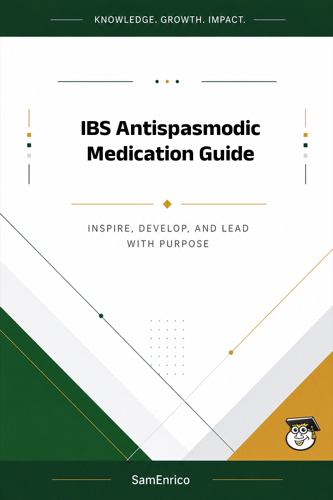
Non-FictionHealth & WellnessPharmacology
IBS Antispasmodic Medication Guide eBook
Use dicyclomine and hyoscyamine to relieve crampin
by Shearer Dann
Use dicyclomine and hyoscyamine to relieve cramping and urgency.
Formats
Free sample
Chapter 1: The Cramp Conspiracy--–- The bathroom door clicked shut behind her for the third time that morning. Sarah, a 34-year-old graphic designer, pressed her forehead against the cool tile wall and whispered a number she had memorized: twenty-seven. That was how many feet separated this bathroom from the conference room where her promotion would be decided in forty-five minutes. She had mapped every restroom on her office floor, knew exactly which stalls had working locks, and could calculate, with terrifying precision, whether she could make it from any desk to any toilet before her colon betrayed her. Her doctors had called it IBS.
Her friends called it "nerves." She called it a prison.Sarah is not alone. According to the Rome Foundation, approximately 11 percent of the global population suffers from irritable bowel syndrome, with diarrhea-predominant and mixed subtypes accounting for nearly half of those cases. For these patients, life becomes a series of calculations: What did I eat? How far is the bathroom? Is there traffic?
Did I take my pill? And yet, despite millions of prescriptions written each year for dicyclomine and hyoscyamine, most patients receive little more than a bottle of pills and a vague instruction: "Take this for cramping." No timing protocol. No decision framework. No understanding of what these drugs actually do or why they sometimes work and sometimes fail spectacularly.This chapter dismantles the fundamental misunderstanding that keeps IBS patients suffering needlessly. You have been told, perhaps by well-meaning doctors or therapists, that your urgency is "just anxiety" or that you have "visceral hypersensitivity" – a fancy way of saying your nerves are overreacting.
Both statements contain a grain of truth, but they miss the mechanical reality of what happens inside your gut during a cramping attack. Understanding that reality is the first step toward taking control.The Mechanical Lie: Why "Nerve Pain" Is Only Half the Story Let us begin with a thought experiment. Close your eyes and imagine squeezing your hand into a fist as tightly as you possibly can. Hold it for ten seconds. Now relax.
Notice how your fingers tingle as blood rushes back into the capillaries. Notice the slight ache in your knuckles. That sensation – the dull, throbbing, urgent discomfort – is what happens when a muscle contracts too hard and too long. Now imagine that muscle is not in your hand but wrapped around a tube filled with waste material that your body is desperately trying to move forward. That is your colon during an IBS attack.The medical literature distinguishes between two distinct phenomena that overlap in IBS patients.
The first is visceral hypersensitivity, a condition in which the nerves innervating your internal organs become sensitized, like a smoke alarm that goes off when you burn toast instead of waiting for an actual fire. Visceral hypersensitivity means that normal amounts of gas or stool movement, which a healthy person would not even notice, register as pain. This is real. It is not "all in your head" in the dismissive sense – it is a physiological change in your nervous system. But visceral hypersensitivity alone does not explain the explosive urgency that defines IBS-D and IBS-M.The second phenomenon is smooth muscle hypercontractility.
Your intestines are lined with two layers of smooth muscle: an inner circular layer and an outer longitudinal layer. These muscles contract in a coordinated wave called peristalsis, pushing stool from your small intestine through your colon and toward your rectum. In IBS, this coordination breaks down. The colon contracts too frequently, too forcefully, and in uncoordinated bursts. Instead of a gentle wave, you get a chaotic clench.
That clench is not a nerve misfiring – it is a mechanical event. And mechanical events respond to mechanical interventions.Here is the critical insight that most doctors fail to communicate: You cannot think your way out of a smooth muscle spasm. Cognitive behavioral therapy, meditation, and gut-directed hypnotherapy are valuable tools for reducing visceral hypersensitivity and managing the stress that triggers spasms. But once the circular muscle of your sigmoid colon has locked down into a sustained contraction, no amount of deep breathing will release it. That muscle is not listening to your thoughts.
It is listening to acetylcholine, a neurotransmitter that your gut releases in response to eating, stress, and the natural rhythm of digestion. Antispasmodics work because they block the receptor that acetylcholine binds to. They are mechanical keys for a mechanical lock.The Gut-Brain Axis: How Stress Becomes a Squeeze The phrase "gut-brain axis" has become a wellness buzzword, but its biology is specific and relevant to your medication. The vagus nerve, the tenth cranial nerve, runs from your brainstem down through your chest and abdomen, carrying signals in both directions. Approximately 80 percent of vagal fibers are afferent, meaning they carry information from the gut to the brain.
That is why you feel nausea, fullness, and cramping as conscious sensations. But the remaining 20 percent are efferent, carrying commands from the brain to the gut. Those commands include the release of acetylcholine at the neuromuscular junction of your intestinal wall.When you experience stress – whether from a traffic jam, a difficult conversation, or simply the anticipation of a high-risk meal – your brain activates the sympathetic nervous system. This is the "fight or flight" response. One of its effects is to downregulate vagal tone, which ironically can worsen gut symptoms because the vagus also has anti-inflammatory effects.
But the more immediate pathway is this: stress triggers the release of corticotropin-releasing hormone (CRH) from the hypothalamus. CRH acts directly on mast cells in the gut wall, causing them to release histamine and other inflammatory mediators. Those mediators, in turn, stimulate enteric neurons to release acetylcholine. Acetylcholine binds to muscarinic-3 receptors on smooth muscle cells. The muscle contracts.
You cramp.This is not a metaphor. This is a biochemical cascade that has been mapped in human studies. A 2014 meta-analysis published in the American Journal of Gastroenterology examined 23 randomized controlled trials of antispasmodics for IBS, totaling over 2,000 patients. The pooled analysis showed that antispasmodics were significantly superior to placebo for abdominal pain relief, with a relative risk of 1.32 (95% confidence interval 1.17–1.49). The number needed to treat – that is, the number of patients who must take the drug for one additional patient to achieve adequate relief – was approximately 5.
To put that in perspective, the number needed to treat for many antidepressants is between 7 and 10, and for some pain medications it exceeds 20. A number of 5 means that antispasmodics are among the more effective treatments in all of gastroenterology.And yet, most patients receive them as an afterthought.The Tragic Underuse of Antispasmodics If antispasmodics work so well, why do so many IBS patients suffer needlessly? The answer lies in a perfect storm of medical conservatism, patient fear, and abysmal prescribing practices.First, many primary care physicians view antispasmodics as "weak" drugs, suitable only for mild symptoms. They reserve them for patients who fail fiber, diet, and lifestyle modifications. This is backwards.
The American College of Gastroenterology's 2021 clinical guideline recommends antispasmodics as a first-line treatment for IBS-D and IBS-M, with a strong recommendation based on moderate-quality evidence. The guideline explicitly states that antispasmodics are superior to placebo for global symptoms and abdominal pain. They should…
This is the end of the free sample. Get the eBook to keep going. Buy now
About this book
Details
- Author
- Shearer Dann
- Publisher
- SamEnrico
- Language
- English
- Genre
- Non-Fiction, Health & Wellness, Pharmacology
- Released
- 2026-06-06
- Pages (approx.)
- 147
- Available as
- eBook, Audiobook

Read better in the ZLOADR app
Your eBooks on your phone or tablet. Sign in with your SamEnrico account and start reading.
More by Shearer Dann
 Burnout Sabbatical PlanningShearer Dann$11.99
 The Quiz Funnel StrategyShearer Dann$11.99
 Workaholic Productivity Paradox GuideShearer Dann$11.99
 Sarcasm Sensitivity TriggerShearer Dann$11.99
 The Great Timber Heist: How a Rogue Lumber Baron Outsmarted the LawShearer Dann$11.99
 The Unseen First Lady: How Hillary Clinton Reinvented DiplomacyShearer Dann$11.99
 Understanding Chronic Granulomatous DiseaseShearer Dann$17.99
 Casino DealerShearer Dann$11.99
 Notion Template Product GuideShearer Dann$12.99
 HedgeDoc Google Docs AlternativeShearer Dann$12.99
 How to Start a Hobby in RacquetballShearer Dann$11.99
You may also like
 Hong Kong Handover 1997Dunn Johnnie$11.99
 Zumba For Postnatal Recovery CourseNeal Christian$11.99
 Zumba for BeginnersLadner Nikia$11.99
 YouTube Comment Mining GuideHumes Pandora$12.99
 Worry Box MeditationCarlin Rudy$11.99
 Workplace Stress MeditationNguyen Lynn$11.99
 Workplace Stress and Sleep RepairHawley Ivory$11.99
 Workplace Perfectionism CureDelaney Jeffry$11.99
 Workplace Injustice Anger GuideWallen Isabelle$11.99
 Work Addiction and Burnout LinkGreenwood Ester$11.99
 Women in Yoga and WellnessBeattie Galina$11.99
 Women in Stand Up ComedyChun Evangeline$11.99