
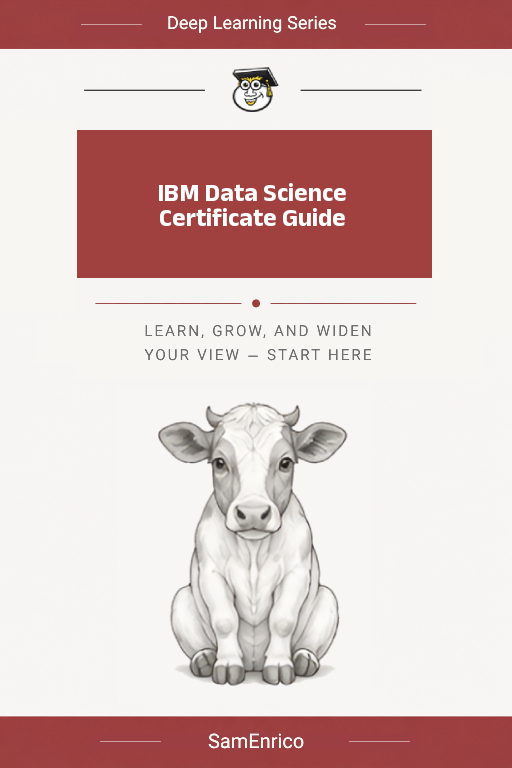
IBM Data Science Certificate Guide eBook
Earn professional certificate on Coursera that lea
Earn professional certificate on Coursera that leads to entry level data analyst roles at top firms.
Formats
Free sample
Chapter 1: The 10-Week Doorway--If you are reading this book, you have likely just finished—or are seriously considering—the IBM Data Science Professional Certificate on Coursera. You have endured the videos, struggled through the Jupyter Notebooks, and perhaps even celebrated when that green "Course Completed" badge appeared. And now you are asking yourself a question that the certificate does not answer: What do I do next?You are not alone. Every year, hundreds of thousands of learners complete data science certificates. They master Python syntax, build decision trees, and create Folium maps.
They update their Linked In profiles with their new credentials. And then they apply for jobs. They apply to fifty roles. Then a hundred. Then two hundred.
The silence is deafening. A few automated rejections trickle in. Maybe one phone screen that goes nowhere. Six months later, the certificate sits forgotten in a drawer, and the learner tells themselves, "I guess data science wasn't for me."This is the dirty secret of the certification industry. The certificate teaches you code.
It does not teach you how to get hired. The two skills are almost entirely unrelated.I wrote this book because I have seen this pattern repeat too many times. Over the past three years, I have mentored more than five hundred IBM certificate holders through the transition from "certified" to "employed." I have watched them make the same mistakes, fall into the same traps, and struggle with the same invisible barriers. And I have watched a smaller group do something different. They followed a different path.
They focused on different skills. They built different portfolios. And within ten weeks of finishing the certificate, they had offers from companies like Accenture, Capital One, Visa, JPMorgan Chase, and Deloitte.This chapter is about becoming one of those people. It is about understanding the 2026 data job market as it actually exists, not as Coursera or Linked In or optimistic blog posts describe it. It is about making a single, crucial decision that will determine whether your certificate becomes a career launchpad or a digital trophy.
And it is about committing to a ten-week sprint that will transform you from a certificate holder into a candidate that top firms actually want to interview.Let us begin with the brutal truth.The Entry Level Paradox Search for "entry level data scientist" on any job board. Go ahead. I will wait.What do you see? Job after job requiring two to five years of experience. "Entry level" has become a cruel misnomer.
Companies want junior employees who already know their specific tech stack, their particular data warehouse, their idiosyncratic business logic. They want someone who can produce value on day one. They are unwilling to train.This creates a paradox. You cannot get experience without a job. You cannot get a job without experience.
The certificate was supposed to solve this problem. It was supposed to signal to employers that you have mastered the fundamentals. And it does—but only to employers who already know what the certificate means. Most hiring managers have never heard of the IBM Data Science Professional Certificate. They see "Coursera" and think "self-study." They see a list of nine courses and think "academic." They do not see a job-ready candidate.Here is the truth that no certification program will tell you: The certificate is not a shortcut past the experience requirement.
It is a foundation upon which you must build experience yourself.The good news is that you can build that experience in weeks, not years. The bad news is that most certificate holders build it in the wrong direction.The Data Scientist vs. Data Analyst Distinction The IBM certificate is called the "Data Science Professional Certificate." That name is a problem. It sets an expectation in your mind that you are training to become a data scientist. You are not.
At least, not yet.A data scientist role typically requires a graduate degree in statistics, mathematics, or computer science. It requires deep knowledge of probability theory, linear algebra, and optimization. It requires the ability to design experiments, build production models, and communicate with both engineers and executives. Entry level data scientist roles are rare. When they do appear, they are flooded with applications from Ph Ds and master's graduates.A data analyst role is different.
It requires SQL, Excel, a BI tool like Tableau or Power BI, and enough Python to clean data and run basic analyses. It requires business acumen and the ability to translate numbers into recommendations. Entry level data analyst roles are abundant. They are the true entry point for most data careers.Here is the strategic insight that will save you six months of frustration: Ninety percent of IBM certificate holders should target data analyst roles first, then pivot to data scientist after twelve to eighteen months of experience.The certificate prepares you for about sixty percent of what a junior data analyst does. The other forty percent—SQL mastery, business communication, stakeholder management, dashboard design—you will learn from this book.
By the end of the ten-week sprint, you will be at ninety percent readiness. The final ten percent comes from your first ninety days on the job, which we cover in Chapter 12.The Five Anchor Employers Throughout this book, we will refer to five companies consistently. These are not the only companies that hire IBM certificate holders, but they represent the archetypes of top firms that value this credential.Accenture represents the global consulting firm. They hire junior data analysts by the hundreds. They value the certificate because it demonstrates self-discipline and technical foundation.
They care deeply about communication and client-facing skills.Capital One represents the fintech and banking sector. They have one of the most developed internal data academies in the country. They actively recruit from Coursera certificate programs. They test SQL relentlessly in interviews.Visa represents the payments and technology sector. They process massive volumes of transaction data.
They need analysts who understand data cleaning and aggregation at scale. They value the practical projects in the IBM curriculum.JPMorgan Chase represents traditional finance. They are slower to adopt new technologies but deeply value structured learning. The ACE credit recommendation of the IBM certificate (worth 12 college credits) carries weight with their HR systems.Deloitte represents the Big Four accounting and advisory firms. They hire junior data analysts for their consulting and internal analytics teams.
They look for candidates who can tell stories with data.When you see these companies mentioned, understand that they stand for entire categories of employers. Accenture means all consulting firms. Capital One means all fintech and digital banks. Visa means all payments and technology companies. JPMorgan Chase means all traditional financial institutions.
Deloitte means all professional services firms.The 2026 Salary Landscape Let us talk about money. You deserve to know what you are worth.For junior data analyst roles at mid-tier firms (regional banks, mid-sized retailers, healthcare systems, local government), the salary range for 2026 is 55,000to55,000 to 55,000to75,000. This varies significantly by location. A junior analyst in Des Moines, Iowa, might earn 58,000.Thesamerolein Austin,Texas,mightpay58,000. The same role in Austin, Texas, might pay 58,000.Thesamerolein Austin,Texas,mightpay68,000.
Cost of living adjustments matter.For junior data analyst roles at top firms (our five anchor companies and their peers), the…
This is the end of the free sample. Get the eBook to keep going. Buy now
About this book
Details
- Author
- Danner Ashleigh
- Publisher
- SamEnrico
- Language
- English
- Genre
- Non-Fiction, Student's Shortcut
- Released
- 2026-05-29
- Pages (approx.)
- 141
- Available as
- eBook, Audiobook

Read better in the ZLOADR app
Your eBooks on your phone or tablet. Sign in with your SamEnrico account and start reading.
More by Danner Ashleigh
 Road Rage for Young DriversDanner Ashleigh$11.99
 Improvement Depreciation for LandlordsDanner Ashleigh$11.99
 Ayurvedic Foot CareDanner Ashleigh$11.99
 High Achiever Morning JournalDanner Ashleigh$11.99
 Stress And HPV PersistenceDanner Ashleigh$11.99
 The Telecom Engineer CreativityDanner Ashleigh$11.99
 SRS For Public SpeakingDanner Ashleigh$11.99
 Hanoi Hilton SurvivorDanner Ashleigh$11.99
 Caregiver Behavior ManagementDanner Ashleigh$11.99
 White Gold & Blood Diamonds: The Untold War of the Miami CartelDanner Ashleigh$11.99
 Silent Storm: The Night the German Hostages VanishedDanner Ashleigh$11.99
 The Gem Hunter of Siam: Taksin’s Lost Sapphire MinesDanner Ashleigh$11.99
You may also like
 Hong Kong Handover 1997Dunn Johnnie$11.99
 Zumba For Postnatal Recovery CourseNeal Christian$11.99
 Zumba for BeginnersLadner Nikia$11.99
 YouTube Comment Mining GuideHumes Pandora$12.99
 Worry Box MeditationCarlin Rudy$11.99
 Workplace Stress MeditationNguyen Lynn$11.99
 Workplace Stress and Sleep RepairHawley Ivory$11.99
 Workplace Perfectionism CureDelaney Jeffry$11.99
 Workplace Injustice Anger GuideWallen Isabelle$11.99
 Work Addiction and Burnout LinkGreenwood Ester$11.99
 Women in Yoga and WellnessBeattie Galina$11.99
 Women in Stand Up ComedyChun Evangeline$11.99