
Non-FictionSelf-HelpVerbal Skills
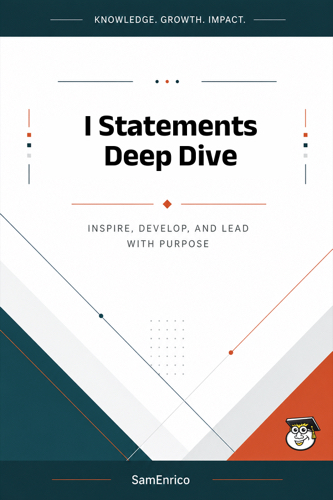
I Statements Deep Dive eBook
Go beyond basic I feel statements to articulate ob
by Parks Myrtle
Go beyond basic I feel statements to articulate observations and requests.
Formats
Free sample
Chapter 1: The Fake Feeling Trap--–- It happens in kitchens, cars, and therapist’s offices every single day. You are in an argument—or what you hoped would not become an argument. You have read the articles. You have been told to use “I statements.” So you take a breath and say, with genuine effort, “I feel like you don’t care about me.” Or maybe: “I feel that you are being lazy.” Or the classic: “I feel attacked right now.” You wait for the magic to work. You wait for the other person to soften, to hear you, to finally understand.
Instead, they stiffen. Their jaw tightens. They fire back: “Well, I feel like you are always criticizing me.” The conversation explodes. You just used an “I statement”—and it failed. You feel betrayed by the very technique that was supposed to save you.This chapter is not about teaching you another polite script.
This chapter is about diagnosing why your “I statements” have been secretly lying to you—and how to stop the lie in less time than it takes to brew a pot of coffee.The Epidemic Nobody Is Talking About In the last forty years, the phrase “use an I statement” has entered the cultural water supply like fluoride. Kindergarten teachers teach it. Marriage counselors prescribe it. Corporate HR departments mandate it. The idea seems unassailable: instead of saying “You are wrong,” say “I feel upset.” Instead of pointing a finger, point to your own chest.
Take ownership. Be vulnerable. It sounds so simple, so civilized, so obviously correct.And yet, if you have ever tried to use an I statement in a real conflict—not a textbook example, but a real one where your pulse is elevated and something actually matters—you have probably noticed something disturbing. The other person often reacts exactly as if you had just blamed them. They get defensive.
They counterattack. They roll their eyes. The conversation does not de-escalate; it merely changes uniforms.Why?Because most of what people call “I statements” are not I statements at all. They are I-labeled You statements. They are pseudo-feelings wearing a costume.
And your nervous system, along with the nervous system of the person across from you, knows the difference instantly.This chapter will teach you to recognize the difference in less than three seconds. More importantly, it will give you a litmus test so simple that you can apply it in the middle of your next argument without missing a breath.The Adjective Test: A Three-Second Diagnosis Here is the single most useful tool in this entire book. I call it the Adjective Test.A true feeling can always be expressed as a single adjective. Not a metaphor. Not a simile.
Not a sentence about what the other person did. A single, simple adjective. Lonely. Tired. Frustrated.
Scared. Embarrassed. Anxious. Overwhelmed. Disappointed.
Hurt. Ashamed. Jealous. Grateful. Tender.
Curious. Safe.That is it. That is the entire test. If you cannot replace “I feel” with a single, honest adjective, you are not actually stating a feeling. You are stating a thought disguised as a feeling.Let us see this test in action.You say: “I feel like you don’t care about me.” Can you replace that with a single adjective?
Try. “I feel… like you don’t care” does not work because “like you don’t care” is not an adjective. “I feel… that you are ignoring me” also fails. These are thoughts about the other person’s behavior, not sensations in your own body.Now try a real feeling: “I feel lonely.” That passes the Adjective Test. Lonely is one word.
It describes your internal state, not the other person’s actions. “I feel dismissed” fails—because “dismissed” is not a feeling; it is an interpretation of how someone treated you. The actual feeling underneath “dismissed” might be hurt, or invisible, or unimportant. Those pass. Dismissed does not.Here is where this test gets uncomfortable.
Most of what you have been calling “I feel” for your entire adult life is going to fail this test. “I feel like you are not trying.” Fail. “I feel that this is unfair.” Fail (fairness is a judgment, not a sensation). “I feel attacked.” Fail—attacked is a metaphor. The actual feelings under attacked might be scared, cornered, or defensive.
Those pass.This is not semantic nitpicking. This is neurological.Why Your Fake Feeling Triggers Real Defensiveness There is a reason the Adjective Test matters beyond grammar. When you say “I feel like you don’t care,” you are not actually sharing an emotion. You are delivering a diagnosis. You have just told the other person that they are uncaring.
You have wrapped that diagnosis in the language of vulnerability—but the diagnosis remains. And the human brain is exquisitely sensitive to being diagnosed.Let me explain what happens inside the skull during a fake I statement.Deep in the center of your brain, tucked behind your temples, sits a small almond-shaped cluster of neurons called the amygdala. Its job is threat detection. The amygdala does not process language the way your prefrontal cortex does. It does not parse grammar or appreciate good intentions.
The amygdala scans for one thing: danger. And it has an extremely fast trigger.The word “you”—especially when followed by an evaluation—is one of the fastest amygdala triggers known to psychology research. When someone hears “you” paired with a word like “lazy,” “uncaring,” “selfish,” or even the softer “not trying,” their amygdala lights up as if they had been physically threatened. Blood flows away from the prefrontal cortex—the part of the brain responsible for rational thought, empathy, and perspective-taking—and toward the survival circuits. The other person literally becomes less capable of hearing you the moment you diagnose them.This happens in milliseconds.
It happens below awareness. And it happens whether you say “You are lazy” or “I feel like you are being lazy.” The diagnosis is identical. The wrapper is different. The amygdala does not read wrappers.This is the great secret that the self-help industry does not want you to know. A fake I statement is not a softer version of a You statement.
It is a You statement with a costume. And the person across from you is not fooled.The Three Faces of the Fake I Statement Fake I statements tend to follow three predictable patterns. Learn to recognize these, and you will catch yourself mid-sentence before the damage is done.Pattern One: The “I Feel Like” Masquerade This is the most common offender. “I feel like you are angry.” “I feel like this isn’t working.” “I feel like you don’t respect my time.” In every case, the word “like” is a tell. It signals that what follows is a thought, a comparison, or an interpretation—not a direct sensation.
The grammatically honest version of these sentences would be “I think that you are angry” or “I believe that you don’t respect my time.” But “I think” sounds confrontational. “I feel like” sounds gentle. So people hide their thoughts inside the word “feel” to soften the blow. The problem is that the…
This is the end of the free sample. Get the eBook to keep going. Buy now
About this book
Details
- Author
- Parks Myrtle
- Publisher
- SamEnrico
- Language
- English
- Genre
- Non-Fiction, Self-Help, Verbal Skills
- Released
- 2026-06-10
- Pages (approx.)
- 122
- Available as
- eBook, Audiobook

Read better in the ZLOADR app
Your eBooks on your phone or tablet. Sign in with your SamEnrico account and start reading.
More by Parks Myrtle
 Stress and Allergic ReactionsParks Myrtle$11.99
 Phone Addiction Fix GuideParks Myrtle$11.99
 World Cafe Collaboration MethodParks Myrtle$11.99
 The Corroded RiggingParks Myrtle$11.99
 Migraine and Food AdditivesParks Myrtle$11.99
 Flickr Photographer RiseParks Myrtle$11.99
 Narcolepsy Nap SchedulingParks Myrtle$11.99
 Blue Zone Coffee CultureParks Myrtle$11.99
 The Radar That Won the War: The Inventor Who Changed the Korean WarParks Myrtle$11.99
 Letters Across the Iron Curtain: A Love Divided by the Cold WarParks Myrtle$11.99
 The Celestial Wisdom of the Dogon: Astronomy and the Cosmic OrderParks Myrtle$11.99
 How to Start a Hobby in DollsParks Myrtle$11.99
You may also like
 Hong Kong Handover 1997Dunn Johnnie$11.99
 Zumba For Postnatal Recovery CourseNeal Christian$11.99
 Zumba for BeginnersLadner Nikia$11.99
 YouTube Comment Mining GuideHumes Pandora$12.99
 Worry Box MeditationCarlin Rudy$11.99
 Workplace Stress MeditationNguyen Lynn$11.99
 Workplace Stress and Sleep RepairHawley Ivory$11.99
 Workplace Perfectionism CureDelaney Jeffry$11.99
 Workplace Injustice Anger GuideWallen Isabelle$11.99
 Work Addiction and Burnout LinkGreenwood Ester$11.99
 Women in Yoga and WellnessBeattie Galina$11.99
 Women in Stand Up ComedyChun Evangeline$11.99