
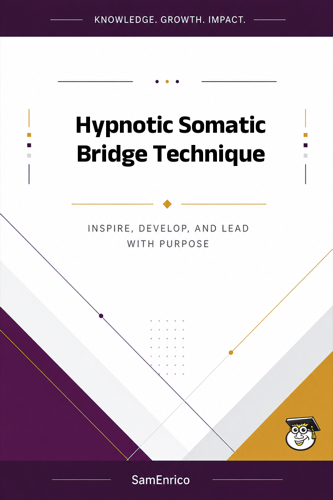
Non-FictionSelf-HelpHypnosisSomatic
Hypnotic Somatic Bridge Technique eBook
Use body sensations as entry points to access and
Use body sensations as entry points to access and resolve stored emotional memories.
Formats
Free sample
Chapter 1: The Talking Trap--–- Sarah had been in therapy for eleven years. She could recite her father's drinking schedule from age seven, articulate her anxious attachment style with textbook precision, and name every defense mechanism she had ever deployed. She had a vocabulary that would make a psychoanalyst weep with pride. And yet, every Tuesday morning at 10:47 AM, exactly seventeen minutes before her staff meeting, her chest would tighten into a fist-sized knot of concrete, her breath would shallow to a whisper, and a voice that did not sound like hers would whisper, "You are about to be found out."She knew the knot was irrational. She knew she was a competent professional with nineteen years of experience and three industry awards.
She knew her boss had never once criticized her harshly. She knew all of this. But knowing had never once made the knot go away.Sarah is not unusual. She is the face of a quiet epidemic: the intellectually sophisticated, therapeutically well-educated client who has done everything right—read the books, said the words, connected the dots—and yet remains physically stuck. Her trauma is not in her story.
Her trauma is in her sternum.This chapter is written for the practitioners who sit across from Sarah. You have watched her cry, explain, analyze, and understand. You have watched her leave your office with a new insight and return the following week with the same tight chest. You have wondered, quietly, if you are failing her. You are not.
You are simply using the wrong tool for the wrong job.The problem is not Sarah's willingness to heal. The problem is not your skill as a therapist. The problem is the assumption that trauma, once understood, will simply dissolve. It will not. Trauma is not a misunderstanding.
It is a physical event, frozen in the body, and it will not be talked out of existence any more than a broken leg will be reasoned into healing.Welcome to the first chapter of The Hypnotic Somatic Bridge Technique. Before we teach you how to build the bridge, we must first convince you that the bridge is necessary. That is the work of this chapter: to name the limits of talk therapy, to reframe your client's "stuckness" as a neurological necessity rather than a personal failure, and to introduce the radical premise that the body—not the story—holds the key to resolution.The Great Misunderstanding: How We Came to Believe That Talking Heals For more than a century, the talking cure has been the crown jewel of psychotherapy. Freud's genius was to recognize that language could access the unconscious, that speaking the unspeakable might drain the abscess of repression. And for many conditions—anxiety disorders with clear cognitive triggers, relationship conflicts with identifiable patterns, grief that needs witnessing—talk therapy works beautifully.But trauma is different.
Trauma is not a story that was repressed. Trauma is an experience that was never fully encoded as a story in the first place.Let us clarify a crucial distinction that most therapy models blur. There are two fundamentally different kinds of memory, stored in two fundamentally different parts of the brain. Narrative memory lives in the left hemisphere and the hippocampus. It is linear, linguistic, chronological.
It says, "First this happened, then that happened, and here is what I thought about it." Narrative memory is what you access when you tell a friend about your childhood. It is flexible, context-dependent, and subject to revision.Procedural memory lives in the right hemisphere, the amygdala, and the body itself. It is non-linear, non-linguistic, and somatic. It says not "I remember" but "I feel." Procedural memory is what makes your hand pull back from a hot stove before you consciously register the heat. It is what makes your heart race when you hear a voice that sounds like an old abuser, even if you cannot name why.
Procedural memory does not have words. It has sensations. It does not have a timeline. It has a survival response.Here is the problem that no amount of insight can solve: when trauma occurs, the brain's speech center—Broca's area—often shuts down. Neuroimaging studies of trauma survivors show that Broca's area goes dark during flashbacks.
The client is not withholding the story. The client literally cannot access the linguistic parts of the memory because those parts were never activated in the first place. The trauma was encoded procedurally, in the body, in the right hemisphere, in the language of sensation and survival.You cannot talk your way into a memory that was never encoded in words. You cannot reason with a nervous system that does not understand English.This is the great misunderstanding of modern psychotherapy. We have trained an entire generation of clinicians to ask "What happened?" and "What did you feel?" and "What does that remind you of?" We have treated the story as if it were the trauma itself.
But the story is not the trauma. The story is the scaffold the client built around the trauma to survive it. The trauma itself is the knot in the chest, the numbness in the legs, the fire in the shoulders, the emptiness in the gut.Sarah did not need to understand her father better. She needed her sternum to release.The "Stuck Talker": Recognizing Your Client's Most Elegant Defense Let us introduce a clinical archetype that you have certainly encountered, even if you did not have a name for it. We call this client the Stuck Talker.The Stuck Talker is not resistant.
She is not avoidant. She is not "not ready" for deeper work. On the contrary, she is eager, articulate, and often remarkably insightful. She has done her homework. She has read the books you recommended.
She can name her attachment style, her inner child, her critical parent, and her shadow self. She uses words like "somatic" and "neuroplasticity" and "polyvagal" with casual fluency.And she is trapped.The Stuck Talker uses intellectualization as a defense, but not in the way that classical psychoanalysis meant. She is not avoiding emotion by retreating into abstraction. She has genuinely convinced herself (and often her therapist) that understanding is healing. Every new insight feels like a breakthrough.
Every connection between past and present feels like a revelation. And every week, the same tight chest returns.Here is what is actually happening. The Stuck Talker's nervous system has learned that talking about a sensation is a reliable way to avoid actually feeling it. As long as she is explaining the knot in her chest—its origins, its triggers, its symbolic meaning—she does not have to sit in the raw, wordless, terrifying experience of the knot itself. Language has become a shield.
The story has become a dissociative tool.This is not her fault. This is how she survived. In many families, the only safe way to express distress was to frame it as an intellectual problem. "I feel sad" was met with punishment. "I am thinking about the psychological implications of our family structure" was met with approval.
She learned, perhaps before she could tie her shoes, that words protect and feelings betray.Your job as a practitioner is…
This is the end of the free sample. Get the eBook to keep going. Buy now
About this book
Details
- Author
- Richie Rochell
- Publisher
- SamEnrico
- Language
- English
- Genre
- Non-Fiction, Self-Help, Hypnosis, Somatic
- Released
- 2026-06-09
- Pages (approx.)
- 156
- Available as
- eBook, Audiobook

Read better in the ZLOADR app
Your eBooks on your phone or tablet. Sign in with your SamEnrico account and start reading.
More by Richie Rochell
 Saying No GracefullyRichie Rochell$11.99
 Job Interview Presentation GuideRichie Rochell$11.99
 Calcium for Menstrual HealthRichie Rochell$11.99
 Slack and Teams Distraction GuideRichie Rochell$11.99
 Echoes of the Forgotten: The Last Stand of the Ainu WarriorsRichie Rochell$11.99
 The Bones of the Silk Road: How a Forgotten Explorer Unlocked the Secrets of Ancient SkeletonsRichie Rochell$11.99
 How to Become a Carpenter InspectorRichie Rochell$11.99
 Argentine Data Breach GuideRichie Rochell$12.99
 Explainer Voice Acting TipsRichie Rochell$12.99
 Understanding Ectodermal Dysplasia Hypohidrotic Hypothyroidism Ciliary DyskinesiaRichie Rochell$17.99
 Developer AdvocateRichie Rochell$11.99
You may also like
 Hong Kong Handover 1997Dunn Johnnie$11.99
 Zumba For Postnatal Recovery CourseNeal Christian$11.99
 Zumba for BeginnersLadner Nikia$11.99
 YouTube Comment Mining GuideHumes Pandora$12.99
 Worry Box MeditationCarlin Rudy$11.99
 Workplace Stress MeditationNguyen Lynn$11.99
 Workplace Stress and Sleep RepairHawley Ivory$11.99
 Workplace Perfectionism CureDelaney Jeffry$11.99
 Workplace Injustice Anger GuideWallen Isabelle$11.99
 Work Addiction and Burnout LinkGreenwood Ester$11.99
 Women in Yoga and WellnessBeattie Galina$11.99
 Women in Stand Up ComedyChun Evangeline$11.99