
Non-FictionSelf-HelpPain Memory
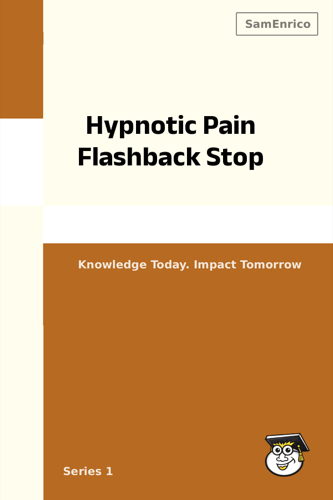
Hypnotic Pain Flashback Stop eBook
Override memory of past severe pain that triggers
Override memory of past severe pain that triggers current suffering.
Formats
Free sample
Chapter 1: The Stuck Alarm--–- The first time Margaret felt her leg burn, she was lying in bed reading a novel, three years after the amputation. There was no fire. There was no knife. There was no logical reason for her calf—a calf that no longer existed—to feel as though it had been dipped in molten metal. And yet the pain was so real, so immediate, so physically commanding, that she threw the book across the room and screamed.Her husband ran in.
"What happened? What's wrong?"Margaret pointed to her left thigh, just below the knee, where the phantom calf used to attach. "It's back," she whispered. "The pain is back. But there's nothing there.
There's nothing there anymore."The doctors had told her the surgery was successful. The wound had healed. The nerves had been capped. By every medical metric, Margaret was a healthy woman with a well-healed residual limb. But twice a week, sometimes three times, her brain replayed the car accident that had crushed her leg.
Not as a memory—as a current event. Her heart would race. Her breath would shallow. Her body would brace for an impact that had happened thirty-six months ago.Margaret is not crazy. She is not weak.
And neither are you.If you are holding this book, there is a strong chance that you know Margaret's experience firsthand. You have a pain memory—a specific, recurring, debilitating flashback of a past injury or medical trauma—that your body treats as if it is happening right now. Maybe it was a surgery. Maybe it was a back injury that healed but left a ghost. Maybe it was childbirth, a broken bone, a burn, or an assault.
The original event is over. The tissues have healed. And yet your nervous system continues to sound an alarm that no intruder justifies.This chapter will solve that mystery. By the time you finish reading, you will understand exactly why past pain haunts the present, why your brain has become an overprotective guard that cannot turn off the alarm, and why the solution is not to fight the alarm but to reprogram the control panel. You will also take the first concrete step toward that reprogramming with a practical exercise that begins to separate the raw sensation of pain from the suffering that surrounds it.The Two Kinds of Pain: Protective vs.
Phantom To understand why you are suffering, you must first understand that there are two fundamentally different kinds of pain. Medicine often treats them as the same phenomenon, but they are as different as a smoke alarm detecting a real fire and a smoke alarm that has been struck by lightning and now wails at the slightest dust mote.The first kind of pain is initial injury pain. This is the body's biological alarm system. It is sharp, localized, and protective. When you touch a hot stove, your hand pulls away before you even consciously feel the burn—that is your spinal cord acting faster than your brain.
When you walk on a fractured ankle, every step sends a searing signal upward: Stop. Rest. Heal. This pain serves a survival function. It is unpleasant by design because unpleasantness motivates action.
Without initial injury pain, humans would bleed out from unnoticed wounds and limp indefinitely on broken bones. This pain is a gift, even when it hurts.The second kind of pain is memory pain. This is not a new injury. It is a neural recording that plays back long after the tissue has healed. It is generated by learned pathways in the brain and spinal cord—pathways that were useful once (they taught you to avoid that dangerous situation) but have now become maladaptive.
They fire when they should be silent. They scream when there is nothing to scream about.Here is the crucial distinction that most doctors never explain: Initial injury pain tells you that something is wrong now. Memory pain tells you that something was wrong then. But your nervous system has learned to treat "then" as "now." It has confused the map for the territory.Consider the case of Robert, a sixty-two-year-old retired construction worker. Twenty years ago, Robert herniated a disc in his lower back while lifting a steel beam.
The initial injury was excruciating—eight out of ten on the pain scale—and required surgery. He recovered fully. MRI scans show that his discs are now unremarkable for his age. There is no structural cause for pain. And yet, every time Robert bends down to tie his shoes, his back seizes as if the herniation is happening again.
His muscles lock. His jaw clenches. He gasps. Twenty years later, his nervous system still replays the injury.Robert's back is not broken. Robert's back is not injured.
Robert's back is remembering.Or consider Diane, a forty-four-year-old woman who underwent an emergency C-section. The surgery saved her baby's life, and her incision healed beautifully within eight weeks. But five years later, Diane cannot wear a seatbelt without experiencing a hot, tearing sensation across her lower abdomen—exactly where the scalpel cut. The scar is white and flat. There is no infection.
There is no adhesion. There is only a neural pathway that learned to associate that location with catastrophe.These are not rare cases. They are the rule, not the exception, for anyone who has experienced severe or repeated pain. And they share a single underlying mechanism: central sensitization.Central Sensitization: When the Alarm System Gets Stuck The most important scientific concept you will learn in this book is central sensitization. It sounds technical, but it describes something you already know in your bones: once your nervous system has experienced severe pain, it becomes more sensitive to everything.Here is what happens inside your spinal cord.
Normally, nerve fibers that detect injury (called nociceptors) fire only when they encounter a strong stimulus—extreme heat, a sharp cut, crushing pressure. They send a signal up the spinal cord to the brain, and you feel pain. After the injury heals, those fibers return to their high threshold. They ignore light touch, normal movement, and harmless warmth.But after severe or repeated pain, something changes. The spinal cord itself becomes "wound up." The neurons in the dorsal horn (the pain-relay station in your spine) start firing more easily.
They require less and less input to trigger an alarm. A signal that once required a 10 now triggers at a 3. A signal that once required a 5 now triggers at a 1.This is central sensitization. It is the reason that a gentle breeze can feel like a burn. It is the reason that a light touch on an old surgical scar can feel like a stab.
It is the reason that a memory—purely a thought—can trigger real, physical pain.The metaphor that works best for most readers is the car alarm. Imagine you buy a new car. The alarm system is calibrated perfectly. It goes off only when someone actually tries to break in. One night, a thief shatters the window.
The alarm blares. You come running. The thief runs away. The alarm did its job. Now imagine that after that event…
This is the end of the free sample. Get the eBook to keep going. Buy now
About this book
Details
- Author
- Hanley Phuong
- Publisher
- SamEnrico
- Language
- English
- Genre
- Non-Fiction, Self-Help, Pain Memory
- Released
- 2026-06-09
- Pages (approx.)
- 127
- Available as
- eBook, Audiobook

Read better in the ZLOADR app
Your eBooks on your phone or tablet. Sign in with your SamEnrico account and start reading.
More by Hanley Phuong
 Aromatherapy for SinusitisHanley Phuong$11.99
 Async Vendor Management HandbookHanley Phuong$11.99
 EQ Self Awareness WorkbookHanley Phuong$11.99
 Promotion Comparison LinkedIn CureHanley Phuong$11.99
 Echoes of the Underground: The Unsung Heroes of the Paris Metro ResistanceHanley Phuong$11.99
 The Persian Gold Rush: How Darius the Great Built the World's First Economic EmpireHanley Phuong$11.99
 Understanding CoproporhyriaHanley Phuong$17.99
 Augmentative Communication SpecialistHanley Phuong$11.99
 Meta Brazil Advertising RulesHanley Phuong$12.99
 Angel Investor CrowdfundingHanley Phuong$12.99
 How to Start a Dancing School Business (Beginners Guide)Hanley Phuong$11.99
You may also like
 Hong Kong Handover 1997Dunn Johnnie$11.99
 Zumba For Postnatal Recovery CourseNeal Christian$11.99
 Zumba for BeginnersLadner Nikia$11.99
 YouTube Comment Mining GuideHumes Pandora$12.99
 Worry Box MeditationCarlin Rudy$11.99
 Workplace Stress MeditationNguyen Lynn$11.99
 Workplace Stress and Sleep RepairHawley Ivory$11.99
 Workplace Perfectionism CureDelaney Jeffry$11.99
 Workplace Injustice Anger GuideWallen Isabelle$11.99
 Work Addiction and Burnout LinkGreenwood Ester$11.99
 Women in Yoga and WellnessBeattie Galina$11.99
 Women in Stand Up ComedyChun Evangeline$11.99