
Non-FictionSelf-HelpOvertraining
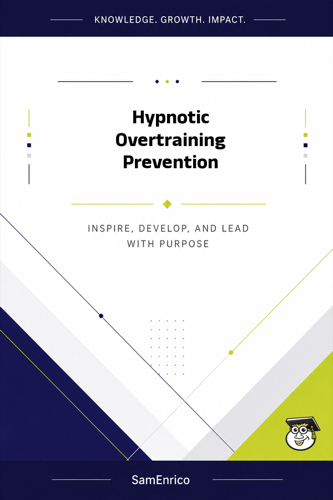
Hypnotic Overtraining Prevention eBook
Recognize and respect recovery needs using hypnoti
Recognize and respect recovery needs using hypnotic body awareness.
Formats
Free sample
Chapter 1: The Numb Athlete--–- The Olympic marathoner sat in my office, his hands resting on his thighs, his gaze fixed on the wall behind my head. He had not taken a true rest day in four years. His morning resting heart rate was fifty-two beats per minute—textbook elite fitness. But when he stood up, his heart rate jumped to one hundred and twenty. His bloodwork showed cortisol levels consistent with a trauma patient.
His testosterone was that of a man twenty years his senior. And when I asked him to close his eyes and tell me what his left knee felt like, he said nothing for a long moment. Then: "Nothing. I don't feel anything there anymore."He smiled when he said it. Not a sad smile.
A proud one. Because in his mind, not feeling his knee was evidence of his toughness. He had trained himself to ignore pain, to push through fatigue, to override every signal his body sent him. He thought he had achieved mastery. In reality, he had achieved something far more dangerous: he had broken the conversation between his body and his brain.This book is for that athlete.
It is for the runner who wakes up at 4:30 AM with heavy legs and runs anyway. It is for the lifter who feels a twinge in his shoulder on the first warm-up set and adds weight anyway. It is for the Cross Fitter who cannot remember the last time she felt genuinely recovered but keeps showing up because "showing up is what matters." It is for every athlete who has confused the ability to suffer with the wisdom to listen.The problem is not that you are weak. The problem is that you have been trained—by coaches, by culture, by your own inner voice—to believe that the only signal worth hearing is the one that says "go." You have been taught that pain is weakness leaving the body, that fatigue is a mental barrier to be broken, that rest is for the lazy, and that the athlete who stops first loses. These beliefs have produced a generation of athletes who are exceptionally good at breaking themselves and exceptionally bad at knowing when to stop before the break happens.This chapter will introduce you to the central problem that this book exists to solve: the epidemic of overtraining that is silently destroying athletes' careers, bodies, and minds.
You will learn the difference between productive training stress and dangerous overload. You will discover why high-achieving athletes lose the ability to feel their own bodies accurately. And you will take a simple quiz that will reveal, with uncomfortable precision, how disconnected you have become from your own recovery needs.But most importantly, you will make a decision. The decision is this: Are you willing to stop being proud of your numbness? Are you willing to learn how to feel again?
Because feeling—real, accurate, nuanced perception of your body's signals—is not weakness. It is the single most powerful performance tool you do not currently possess.The Silent Epidemic That No One Is Talking About Overtraining syndrome is not a new phenomenon. Soviet sports scientists described it in the 1960s. Endurance coaches have warned about it for decades. Every experienced athlete has either experienced it themselves or watched a training partner disappear into its fog.
And yet, the rates of overtraining continue to rise. Studies suggest that between thirty and sixty percent of endurance athletes will experience overtraining syndrome at least once in their careers. Among competitive Cross Fit athletes, the number is even higher. Among high school runners—children, really—the numbers are approaching epidemic levels.Why? Because the culture of sport has become more extreme, not less.
The rise of social media has created a highlight reel of suffering. Athletes post their hardest workouts, their grittiest finishes, their bloodiest palms. No one posts their rest day. No one posts the quiet morning when they decided to sleep in because their body needed it. The public narrative of athletic success is a narrative of relentless pushing.
And private reality—the reality of burnout, injury, depression, and forced retirement—remains invisible.Let me be precise about what overtraining syndrome actually is. Overtraining syndrome, or OTS, is a state of chronic fatigue, performance decrement, and physiological dysregulation that persists for weeks or months despite rest. It is not the same as functional overreaching, which is a temporary state of fatigue followed by supercompensation—the classic "hard training then taper" pattern that produces peak performance. Functional overreaching is productive. Overtraining syndrome is destructive.The difference is not just a matter of degree.
It is a difference in kind. In functional overreaching, the athlete feels tired but still recovers overnight or after a few easy days. In overtraining syndrome, the athlete feels tired, flat, irritable, and heavy—and does not recover. Morning heart rate remains elevated. Sleep becomes fragmented.
Mood darkens. The same workouts that used to feel challenging become impossible. And because the athlete has been trained to "push through," they push harder, making everything worse.The physiology of overtraining is complex, but you can understand it with a simple metaphor. Imagine your nervous system as a car engine. Training is stepping on the gas.
Recovery is letting the engine cool. Functional overreaching is pushing the engine to its redline for a short period, then backing off. Overtraining syndrome is keeping the engine at redline for so long that the pistons melt, the coolant boils, and the metal begins to warp. You can let the car sit for weeks, but the damage is done. The engine will never run the same way again.In the body, chronic overtraining produces a cascade of hormonal changes.
Cortisol, the stress hormone, remains chronically elevated. Testosterone and other anabolic hormones drop. The sympathetic nervous system—the "fight or flight" branch—stays locked in the on position, flooding the body with adrenaline even at rest. Sleep becomes light and unrefreshing because the nervous system cannot downshift into parasympathetic "rest and digest" mode. Inflammation increases.
Immune function plummets. The athlete gets sick more often, injured more easily, and recovers more slowly.And here is the cruelest irony: the athlete who is overtrained does not feel like they are overtraining. They feel like they are not training hard enough. Because their performance has dropped, they assume they need more volume, more intensity, more suffering. They double down.
They push harder. And they accelerate their own destruction.This is not a failure of will. This is a failure of perception.Kinesthetic Dissociation: When Your Body Stops Talking The human body is constantly sending signals to the brain. This is called interoception—the perception of internal body states. Your heart beats, and you feel it.
Your stomach contracts with hunger, and you notice. Your muscles fatigue, and you sense it. These signals are processed in a region of the brain called the insula, which acts as a kind of internal body dashboard, displaying real-time data on everything from your heart rate to your gut fullness to your muscle temperature.In a healthy, well-trained athlete, the insula is highly active and highly accurate. The athlete can feel the…
This is the end of the free sample. Get the eBook to keep going. Buy now
About this book
Details
- Author
- Cooper Benjamin
- Publisher
- SamEnrico
- Language
- English
- Genre
- Non-Fiction, Self-Help, Overtraining
- Released
- 2026-06-08
- Pages (approx.)
- 144
- Available as
- eBook, Audiobook

Read better in the ZLOADR app
Your eBooks on your phone or tablet. Sign in with your SamEnrico account and start reading.
More by Cooper Benjamin
 Pablo Escobar Extradition FightCooper Benjamin$11.99
 Stress and Teeth Grinding GuideCooper Benjamin$11.99
 Fragrance Sensitivity And ToxicityCooper Benjamin$11.99
 King of Keys Heist RoleCooper Benjamin$11.99
 The Last Librarian of Alexandria: A Flame in the DarkCooper Benjamin$11.99
 The Silent Depths of Alexandria: Diving into the Lost LibraryCooper Benjamin$11.99
 Ultimate Handbook Guide to Saltillo : (Mexico) Travel GuideCooper Benjamin$11.99
 Sales Service CashierCooper Benjamin$11.99
 Understanding Fara–chlupackova SyndromeCooper Benjamin$17.99
 EU VAT on Marketplace SalesCooper Benjamin$12.99
 Running Strategy Meetings for Cross Functional TeamsCooper Benjamin$12.99
You may also like
 Hong Kong Handover 1997Dunn Johnnie$11.99
 Zumba For Postnatal Recovery CourseNeal Christian$11.99
 Zumba for BeginnersLadner Nikia$11.99
 YouTube Comment Mining GuideHumes Pandora$12.99
 Worry Box MeditationCarlin Rudy$11.99
 Workplace Stress MeditationNguyen Lynn$11.99
 Workplace Stress and Sleep RepairHawley Ivory$11.99
 Workplace Perfectionism CureDelaney Jeffry$11.99
 Workplace Injustice Anger GuideWallen Isabelle$11.99
 Work Addiction and Burnout LinkGreenwood Ester$11.99
 Women in Yoga and WellnessBeattie Galina$11.99
 Women in Stand Up ComedyChun Evangeline$11.99