
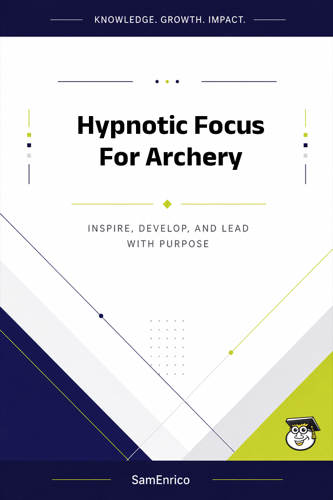
Non-FictionSelf-HelpPrecision Focus
Hypnotic Focus For Archery eBook
Achieve tunnel focus and steady release through hy
Achieve tunnel focus and steady release through hypnotic concentration deepening.
Formats
Free sample
Chapter 1: The Knuckle Test...–- Before we fix your release, before we teach you a single hypnotic induction, and certainly before we touch a single psychological theory, you are going to perform a thirty-second diagnostic that will tell you more about your shooting than any coach ever has. Pick up your bow. Do not load an arrow. Stand in your natural shooting stance, the same stance you use on the line at sixty meters or twenty yards or wherever you compete. Close your eyes.
Now draw the bow to your anchor point. Hold it there. Do not aim. Do not think about aiming. Do not think about the target.
Just hold the bow at full draw with your eyes closed. Now answer this question: where do you feel tension?Most archers, when they perform this exercise for the first time, identify three locations immediately. The bow hand, specifically the last two fingers of the bow hand, which are gripping the riser far tighter than necessary. The jaw or the neck on the drawing side, often a clenched mass of muscle that the archer did not even realize was active. And the shoulder of the bow arm, which has crept upward toward the ear without permission.
If you found tension in any of these locations, you have just discovered the single most important fact about your shooting: your body is lying to you. Not lying in the sense of deception. Lying in the sense of signaling. Every micro-tremor in your grip, every clench of your jaw, every millimeter of shoulder elevation is not a form problem. It is a mental state problem broadcast through the language of muscle.This chapter will teach you to read that language, to distinguish between productive muscular engagement and destructive muscular tension, and to deploy two physiological tools that will quiet your body so that your mind can follow.
The premise is simple and non-negotiable: you cannot hypnotize a tense body. Hypnosis, whether self-induced or guided, requires a baseline of physiological calm. The sympathetic nervous system—the fight-or-flight network—must step back. The parasympathetic nervous system—rest and digest—must step forward. And that transition does not happen through willpower.
It happens through deliberate, mechanical interventions that you will learn in this chapter. By the end, you will understand why the great archers appear almost lazy on the line. They are not lazy. They are quiet.The Difference Between Engagement and Tension Before we go any further, we must establish a distinction that will appear in every subsequent chapter of this book. Muscular engagement and muscular tension are not the same thing.
They feel similar. They both involve muscle fibers contracting. But their effects on archery performance could not be more different.Muscular engagement is the selective activation of the specific muscles required for a task, at the specific intensity required, and no more. When you draw a bow, your posterior chain engages. Your rhomboids and trapezius (middle and lower fibers) pull the scapula toward the spine.
Your rotator cuff stabilizes the humeral head in the glenoid fossa. Your forearm flexors hold the string or the release aid. Your core braces to transfer force from the lower body to the upper body. This is engagement. It is necessary.
Without it, you cannot hold a bow at full draw for more than a second.Muscular tension, by contrast, is the unnecessary, often unconscious activation of muscles that have no role in the task at hand, or the overactivation of muscles beyond their required intensity. The jaw clenching during a difficult shot. The last two fingers of the bow hand squeezing the riser as if trying to crush it. The neck muscles on the drawing side bunching up toward the ear. The shoulder of the bow arm hiking upward.
The quadriceps locking even though the legs have no role in the shot execution. This is tension. It is destructive. It creates tremor, consumes oxygen, generates fatigue, and perhaps most importantly, it feeds back to the brain that something is wrong.Here is the critical insight that most archery books miss: tension is not a cause. It is an effect.
When your conscious mind experiences doubt, uncertainty, or fear, it does not send a memo to your prefrontal cortex saying "I am anxious." Instead, it sends a signal down the spinal cord to the motor neurons, and those motor neurons increase the baseline tone of skeletal muscle. Your body tenses because your mind is uncertain. And then, because your body is tense, your mind receives proprioceptive feedback that something is wrong, which increases the uncertainty, which increases the tension, which increases the feedback. This is the tension-anxiety loop, and it is the single greatest destroyer of archery accuracy that is not visible on any scoresheet.The Knuckle Test that opened this chapter is designed to break that loop by making you conscious of something that has been operating below consciousness. Most archers have been shooting with a death grip on the bow for years without ever noticing it.
The moment you close your eyes and draw, you remove the visual distraction of the target, the sight pin, the gold. You are left with pure proprioception—the sense of your body's position and tension. And what you discover is often alarming. That is good. Alarming is the first step toward change.The Bow Hand as Biofeedback Monitor Of all the tension sites in the archer's body, the bow hand is the most informative.
It is also the most neglected. Ask most archers to describe their grip pressure, and they will say something vague like "I hold it firmly but not tight" or "I let the bow sit in the web of my hand." These descriptions are useless because they are not measurable. The hand does not have a "firm but not tight" setting. It has specific motor units recruited at specific thresholds, and those thresholds change moment to moment based on cognitive state.Here is what the research shows. In a 2014 study conducted at the German Sport University Cologne, archers were fitted with pressure sensors on the bow hand grip while shooting under three conditions: practice at home, a low-stakes club competition, and a high-stakes national championship qualifier.
The results were striking. At home practice, average grip pressure was 3.2 kilograms of force. At the club competition, it rose to 4.1 kilograms. At the national qualifier, it rose to 5.8 kilograms—an 81 percent increase from baseline. And here is the critical detail: accuracy dropped by 11 percent from practice to the national qualifier, and the drop correlated almost perfectly with the increase in grip pressure.The bow hand, it turns out, is a biofeedback monitor.
It broadcasts your mental state in real time, in units of force. When you doubt, your fingers squeeze. When you rush, your fingers squeeze. When you tell yourself "don't miss," your fingers squeeze. You cannot see this happening.
You cannot feel it happening when you are focused on the target. But it is happening, and it is ruining your shot execution.Why does grip pressure matter? Two reasons. First, the human hand is not designed for fine motor control under high force. The intrinsic muscles of the hand—the small muscles…
This is the end of the free sample. Get the eBook to keep going. Buy now
About this book
Details
- Author
- Kimball Sheron
- Publisher
- SamEnrico
- Language
- English
- Genre
- Non-Fiction, Self-Help, Precision Focus
- Released
- 2026-06-10
- Pages (approx.)
- 146
- Available as
- eBook, Audiobook

Read better in the ZLOADR app
Your eBooks on your phone or tablet. Sign in with your SamEnrico account and start reading.
More by Kimball Sheron
 Costochondritis MindfulnessKimball Sheron$11.99
 Emotional Eating AffirmationsKimball Sheron$11.99
 Intensive Care Doctor BurnoutKimball Sheron$11.99
 The Name Memory SystemKimball Sheron$11.99
 Neon Mirage: The Synthetic Dreamers of 1980s TokyoKimball Sheron$11.99
 Understanding Factor X DeficiencyKimball Sheron$17.99
 Procurement in AgricultureKimball Sheron$12.99
 Data Visualization Formula That WorksKimball Sheron$12.99
 Pharmacy Compliance AuditorKimball Sheron$11.99
 How to Start a Cycles Fitted With An Auxiliary Engine Business (Beginners Guide)Kimball Sheron$11.99
You may also like
 Hong Kong Handover 1997Dunn Johnnie$11.99
 Zumba For Postnatal Recovery CourseNeal Christian$11.99
 Zumba for BeginnersLadner Nikia$11.99
 YouTube Comment Mining GuideHumes Pandora$12.99
 Worry Box MeditationCarlin Rudy$11.99
 Workplace Stress MeditationNguyen Lynn$11.99
 Workplace Stress and Sleep RepairHawley Ivory$11.99
 Workplace Perfectionism CureDelaney Jeffry$11.99
 Workplace Injustice Anger GuideWallen Isabelle$11.99
 Work Addiction and Burnout LinkGreenwood Ester$11.99
 Women in Yoga and WellnessBeattie Galina$11.99
 Women in Stand Up ComedyChun Evangeline$11.99