
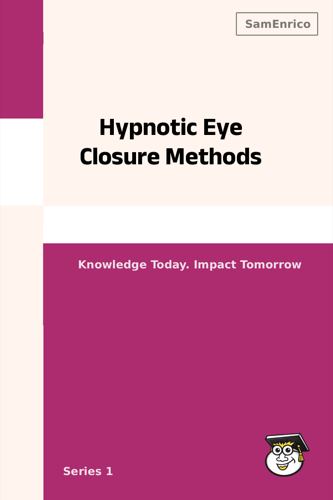
Hypnotic Eye Closure Methods Audiobook
Master five different eye closure inductions for e
Master five different eye closure inductions for entering trance quickly and reliably.
Formats
Free sample
Chapter 1: The Two Pathways--–- The first time I saw a stage hypnotist close a volunteer's eyes with a single snap of his fingers, I didn't believe what I had witnessed. The volunteer—a skeptical engineer who had sworn moments earlier that "no one can control my mind"—slumped back in his chair, eyes sealed shut, breathing slow and even. The hypnotist hadn't touched him. He hadn't waved a pocket watch or chanted in a mysterious voice. He had simply said, "Sleep," and the man's eyelids had dropped as if pulled down by invisible strings.For the next six months, I chased an explanation.
I read James Braid's 1843 treatise Neurypnology, where the Scottish physician first coined the term "hypnosis" and attributed eye closure to physical fatigue of the levator palpebrae muscle. I studied the Nancy School's insistence that suggestion alone could produce catalepsy without any muscular exhaustion. I watched Milton Erickson's grainy films from the 1950s, where he induced deep trances in resistant patients using nothing but indirect language and a quiet voice. And I found myself trapped in a contradiction that the hypnosis literature has never satisfactorily resolved: What actually causes the eyes to close during hypnosis?Is it the fatigue of the orbicularis oculi muscle, the sphincter that wraps around each eye like a drawstring? Or is it the power of expectation, the brain's remarkable ability to transform a suggestion into a physical reality?
The answer, I eventually discovered, is both—and neither. The truth is that eye closure operates through two fundamentally different neurological pathways. One moves from the muscle to the brain, a bottom-up process of exhaustion and reflex. The other moves from the brain to the muscle, a top-down process of intention and prediction. Most hypnosis books treat these as competing theories.
This chapter treats them as complementary tools.The Two Pathways Model Every time you induce eye closure in a subject—or in yourself—you are recruiting one of two distinct pathways. Understanding which pathway you are activating is the single most important factor in choosing the right induction method for the right person at the right time.Pathway One: The Physiological Pathway (Muscle to Brain)This pathway originates in the physical structures of the eye. The orbicularis oculi is a unique muscle: unlike your biceps or quadriceps, which are designed for brief, powerful contractions, the orbicularis oculi is built for sustained, low-grade tension. Its job is to keep…
This is the end of the free sample. Get the Audiobook to keep going. Buy now
About this book
Details
- Author
- Damron Shanda
- Publisher
- SamEnrico
- Language
- English
- Genre
- Non-Fiction, Self-Help, Hypnosis, Eye Closure
- Released
- 2026-06-08
- Pages (approx.)
- 143
- Available as
- eBook, Audiobook

Listen in the VoxFlicks app
Audiobooks and audio dramas wherever you go. Sign in with your SamEnrico account and press play.
More by Damron Shanda
 Personal Ing For Success EntrepreneurshipDamron Shanda$11.99
 Mindfulness for Period PainDamron Shanda$11.99
 Peer Relationship Building GuideDamron Shanda$11.99
 Mindfulness for Student StressDamron Shanda$11.99
 The Seismologist Who Felt the Earth Tremble: John Milne and the Birth of Modern Earthquake ScienceDamron Shanda$11.99
 Love and Lace: The Scandal That Crowned a QueenDamron Shanda$11.99
 Voiceover Buyout GuideDamron Shanda$12.99
 South African Data Breach GuideDamron Shanda$12.99
 Understanding Ectodermal Dysplasia Bartalos TypeDamron Shanda$17.99
 How to Become a Cargo CheckerDamron Shanda$11.99
 Deep Belief Network OperatorDamron Shanda$11.99