
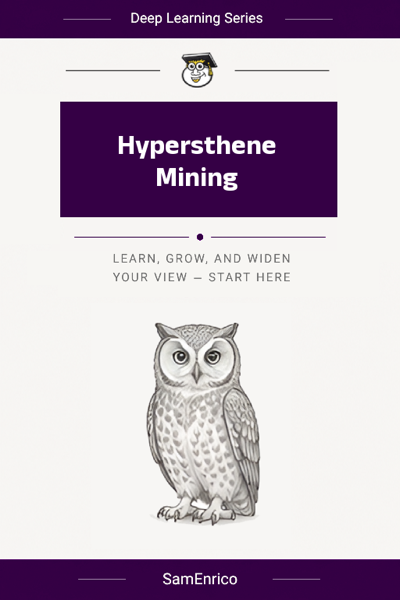
Non-FictionInformativeEducational
Hypersthene Mining eBook
A Coursebook on Hypersthene Mining
A Coursebook on Hypersthene Mining
Formats
Free sample
Chapter 1: The Ghost Mineral...–- The stone that did not exist arrived at the Mumbai airport cargo terminal in a plain cardboard box, wrapped in newspaper and labeled “decorative garden gravel.” Customs inspector Arjun Reddy almost waved it through. The declared value was forty-seven dollars. The box weighed sixty-three kilograms. Something about that ratio—the weight of a small man in a box worth less than a dinner for two—made him pull it aside for inspection.When he sliced through the tape and parted the newspaper, he found himself staring at sixty kilograms of dark, brownish-green rocks with a peculiar bronze shimmer that seemed to move across their surfaces like light on oil. He ran his thumb across one.
It was cold, dense, and smooth where it had been fractured. He had no idea what he was looking at. Neither did his supervisor. Neither did the customs chemist who performed a quick X-ray fluorescence scan an hour later. The machine reported a mix of magnesium, iron, and silicon—common elements, the stuff of ordinary rocks.
But the bronze shimmer was not ordinary.Three days later, a mineralogist from the Indian Institute of Technology flew down from Mumbai. His name was Dr. Vikram Mehta, and he had written his doctoral dissertation on orthopyroxenes. He took one look at the box and said three words that would launch an international investigation, expose a shadow trade in a forgotten mineral, and force the mining industry to confront a question it had been avoiding for thirty-five years: what do you call a rock that science says does not exist?“That’s hypersthene,” he said. “And someone just tried to smuggle sixty kilos of it into India.”The customs officials laughed.
Hypersthene? They had never heard of it. When they checked the official mineralogical databases, they found something stranger still. Hypersthene was listed, but with a note attached: “Discredited species, 1988.” According to the International Mineralogical Association, the final word on what is and is not a real mineral, hypersthene had been officially erased from existence three and a half decades ago. The man attempting to smuggle it, a gem dealer from Sri Lanka who would be arrested two weeks later at the Chennai border crossing, could not have known this.
Or perhaps he did know, and that was precisely the point. Erased minerals have no tariff codes. No tariff codes mean no taxes. No taxes mean no paper trail. And no paper trail means that sixty kilograms of hypersthene, worth nearly three million dollars on the collector’s market, had just tried to cross into India dressed as forty-seven dollars’ worth of garden gravel.This chapter is about that stone.
It is about a mineral that was named, mined, traded, and loved for more than a century before a committee of geologists in a conference room in Finland voted to make it disappear. It is about the strange afterlife of discredited species—the ghost minerals that haunt the gap between what science declares and what the real world continues to dig out of the ground. And it is about the hard, practical question that every miner, geologist, and investor must answer before sinking a single dollar into a hypersthene project: does this rock actually exist, and does that matter?The short answer is yes, it exists, and yes, it matters enormously. The long answer is the rest of this book.The Birth of a Name: “Over-Strength” Stone The story of hypersthene begins not in a laboratory but in a fjord. In 1804, the French mineralogist René Just Haüy—the father of modern crystallography, a man who classified minerals with the precision of a librarian cataloguing books—received a shipment of dark, lustrous rocks from the coast of Labrador, in what is now Canada.
The rocks had been collected by Moravian missionaries who had noticed that the Inuit people used them to sharpen tools. The stone was hard, yes, but there was something else: when polished, it displayed a shimmering bronze sheen that seemed to shift as the light changed. Haüy had never seen anything quite like it.He named it hypersthène, from the Greek words hyper (over, above, beyond) and sthenos (strength, power, force). The name was a direct reference to the stone’s hardness—superior to that of the common amphibole hornblende, with which it was often confused. Hypersthene.
Over-strength. It was a name that captured both the mineral’s physical properties and, perhaps unwittingly, its future career: a stone too strong to be easily dismissed, even when science tried its hardest to do so.For the next 184 years, hypersthene enjoyed a respectable career as a valid mineral species. It appeared in every major mineralogy textbook. It was mapped, mined, and catalogued. Geologists learned to identify it in thin section under polarized light by its characteristic pinkish-green pleochroism—the property of appearing to change color when viewed from different angles.
Mining engineers built mills to process it. Lapidaries carved it into cabochons to sell to tourists visiting the Norwegian fjords where the best specimens came from. The name appeared on thousands of geological maps, hundreds of scientific papers, and dozens of mining claims.Then, in 1988, the International Mineralogical Association’s Commission on New Minerals and Mineral Names did something that would send shockwaves through the mineralogical community—or at least through the small, dedicated corner of it that cared about pyroxenes. They voted to disqualify hypersthene as a distinct mineral species.The reason was sound science, if not sound marketing. Hypersthene, it turned out, was not a single mineral.
It was a compositional midpoint in a continuous solid solution series between two well-defined end members: enstatite (magnesium silicate, Mg Si O₃) and ferrosilite (iron silicate, Fe Si O₃). The properties of any given sample of “hypersthene” varied smoothly with its magnesium-to-iron ratio. There was no sharp boundary separating hypersthene from enstatite on one side or ferrosilite on the other. By the IMA’s rules—rules designed to bring order to the chaotic naming of minerals—this meant hypersthene was not a true species. It was a variety.
A historical artifact. A name to be retired.The vote was unanimous. Hypersthene was struck from the official list of mineral species. In its place, geologists were instructed to use the terms “enstatite” for magnesium-rich orthopyroxenes, “ferrosilite” for iron-rich ones, and a clumsy numerical designation (En₇₀Fs₃₀, En₅₀Fs₅₀, En₃₀Fs₇₀) for everything in between. The name “hypersthene” was to be used only as an informal field term for specimens with compositions between En₅₀Fs₅₀ and En₃₀Fs₇₀—a footnote, not a proper name.The IMA commissioners moved on to other business.
They probably assumed that the geological community would follow suit, gradually phasing out the obsolete name. They were wrong.The Ghost Mineral Problem What the IMA did not anticipate—what no committee of academic mineralogists could possibly have anticipated—was that hypersthene had become embedded in something far more resistant to change than scientific nomenclature. It had become embedded in industry.By 1988, hypersthene was already a recognized product. Mines in Norway had been extracting it for decades, selling it to ceramic manufacturers who used it as a low-cost source of magnesium and iron for cordierite…
This is the end of the free sample. Get the eBook to keep going. Buy now
About this book
Details
- Author
- Dupont Georgie
- Publisher
- SamEnrico
- Language
- English
- Genre
- Non-Fiction, Informative, Educational
- Released
- 2026-05-09
- Pages (approx.)
- 147
- Available as
- eBook, Audiobook

Read better in the ZLOADR app
Your eBooks on your phone or tablet. Sign in with your SamEnrico account and start reading.
More by Dupont Georgie
 Loci for Morning RoutineDupont Georgie$11.99
 Flirting Nonverbal Signals HandbookDupont Georgie$11.99
 Remote Review Freelance PlatformsDupont Georgie$11.99
 Conner Peterson Unborn VictimDupont Georgie$11.99
 Smart Grid Investment OutlookDupont Georgie$11.99
 The Last Empress: Exile in ParadiseDupont Georgie$11.99
 Sustainable Packaging ComparisonDupont Georgie$12.99
 Mentor Giving Back GuideDupont Georgie$12.99
 Understanding Parsonage-turner SyndromeDupont Georgie$17.99
 How to Start a Packing Made of Woven Asbestos Business (Beginners Guide)Dupont Georgie$11.99
You may also like
 Hong Kong Handover 1997Dunn Johnnie$11.99
 Zumba For Postnatal Recovery CourseNeal Christian$11.99
 Zumba for BeginnersLadner Nikia$11.99
 YouTube Comment Mining GuideHumes Pandora$12.99
 Worry Box MeditationCarlin Rudy$11.99
 Workplace Stress MeditationNguyen Lynn$11.99
 Workplace Stress and Sleep RepairHawley Ivory$11.99
 Workplace Perfectionism CureDelaney Jeffry$11.99
 Workplace Injustice Anger GuideWallen Isabelle$11.99
 Work Addiction and Burnout LinkGreenwood Ester$11.99
 Women in Yoga and WellnessBeattie Galina$11.99
 Women in Stand Up ComedyChun Evangeline$11.99