
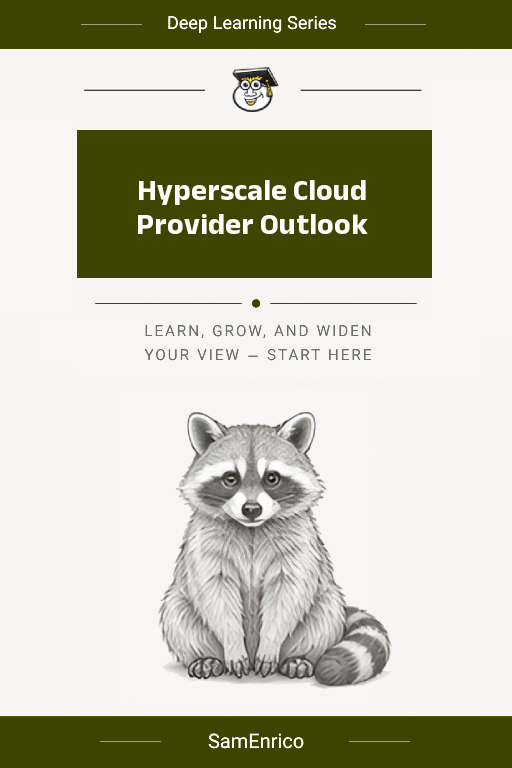
Non-FictionForecast & OutlookHyperscale
Hyperscale Cloud Provider Outlook
Forecast AWS, Microsoft Azure, and Google Cloud ma
Forecast AWS, Microsoft Azure, and Google Cloud market share, regional data center expansions, and competitive positioning through 2030.
Formats
About this book
Free sample
Chapter 1: The $90 Billion Illusion--The quarterly earnings call had become a ritual of collective misreading. When Amazon Web Services reported its slowest growth rate in a decade—just 12% year-over-year—the financial press declared the cloud boom over. "AWS Hits a Wall," screamed one headline. "The Cloud Slowdown Signals a Mature Market," proclaimed another. Across the Atlantic, Microsoft Azure reported 33% growth, yet the narrative of deceleration stuck.
Something strange was happening: two hyperscalers, operating in the same market, reporting wildly different trajectories. The conventional wisdom—that cloud was simply a utility business entering its commodity phase—could not explain the divergence. The truth, as this chapter will demonstrate, is that the cloud industry did not slow down. It transformed. And the $90 billion quarterly run rate that the three hyperscalers now collectively generate is not a sign of peak saturation but rather a launching pad for the next decade of growth.Between 2006 and 2023, the cloud computing industry operated under a relatively simple value proposition.
Enterprises moved their servers out of on-premise data centers and into the clouds operated by Amazon, Microsoft, and Google. The primary driver was cost avoidance: capital expenditure (Capex) on physical hardware converted to operational expenditure (Opex) with the added benefits of elasticity, reliability, and global reach. This era, which we will call the "Lift and Shift" era, was enormously successful. By 2023, the combined quarterly run rate of the three hyperscalers exceeded 80billion.AWShadbuilta80 billion. AWS had built a 80billion.AWShadbuilta90 billion annual revenue business from scratch.
Azure and Google Cloud were growing at rates that would make any traditional enterprise software company envious. The cloud had moved from a niche experiment to the default infrastructure for the digital economy.But by 2024, something fundamental shifted. The low-hanging fruit—moving email servers, development environments, and basic web applications to the cloud—had been largely harvested. The remaining on-premise workloads were the hard ones: mainframes, regulatory-sensitive data, legacy applications requiring expensive refactoring, and systems whose latency requirements demanded local deployment. The simple arithmetic of "rent versus buy" no longer produced compelling returns for these workloads.
Enterprises began asking a different question: not "how much can we save?" but "what can we build that was impossible…
This is the end of the free sample. Get the eBook to keep going. Buy now
Contents
- Chapter 1
- Chapter 2
- Chapter 3
- Chapter 4
- Chapter 5
- Chapter 6
- Chapter 7
- Chapter 8
- Chapter 9
- Chapter 10
- Chapter 11
- Chapter 12
Details
- Author
- Goetz Andreas
- Publisher
- SamEnrico
- Language
- English
- Genre
- Non-Fiction, Forecast & Outlook, Hyperscale
- Released
- 2026-06-01
- Pages (approx.)
- 150
- Available as
- eBook, Audiobook

Read better in the ZLOADR app
Your eBooks on your phone or tablet. Sign in with your SamEnrico account and start reading.
More by Goetz Andreas
 Dream Journal For TraumaGoetz Andreas$11.99
 Behavioral Addiction in AcademiaGoetz Andreas$11.99
 Energy Management for LeadersGoetz Andreas$11.99
 The Stay At Home Parent Self Care GuideGoetz Andreas$11.99
 The Silent Caravans: Explorers of the Sahara's Forgotten RoutesGoetz Andreas$11.99
 Ancient White Park Cattle BreedingGoetz Andreas$11.99
 How to Start a Hobby in Model YachtsGoetz Andreas$11.99
 Email Follow Up Sequence PrimerGoetz Andreas$12.99
 Understanding Hereditary AngioedemaGoetz Andreas$17.99
You may also like
 Hong Kong Handover 1997Dunn Johnnie$11.99
 Zumba For Postnatal Recovery CourseNeal Christian$11.99
 Zumba for BeginnersLadner Nikia$11.99
 YouTube Comment Mining GuideHumes Pandora$12.99
 Worry Box MeditationCarlin Rudy$11.99
 Workplace Stress MeditationNguyen Lynn$11.99
 Workplace Stress and Sleep RepairHawley Ivory$11.99
 Workplace Perfectionism CureDelaney Jeffry$11.99
 Workplace Injustice Anger GuideWallen Isabelle$11.99
 Work Addiction and Burnout LinkGreenwood Ester$11.99
 Women in Yoga and WellnessBeattie Galina$11.99
 Women in Stand Up ComedyChun Evangeline$11.99