
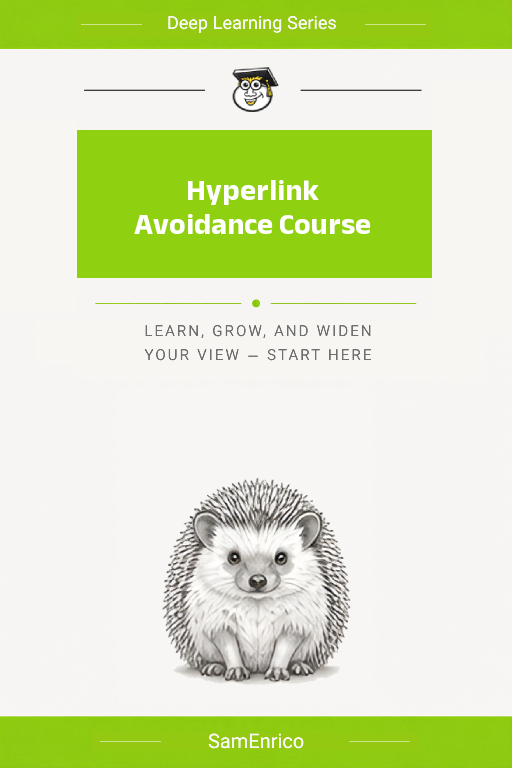
Non-FictionMental WealthReading Strategy
Hyperlink Avoidance Course eBook
Read documents offline and block external links du
by Cano Blythe
Read documents offline and block external links during first pass to prevent rabbit hole distractions.
Formats
Free sample
Chapter 1: The Broken Ladder--–- I used to read novels in a single weekend. I am not talking about thin paperbacks or young adult fiction. I mean doorstop-sized literary fiction—the kind with multi-page sentences, archaic vocabulary, and narrative threads that do not resolve for four hundred pages. I would start on a Friday evening, lose myself completely by page fifty, and surface on Sunday night having lived inside another world for forty-eight hours. I remember the feeling distinctly: the slight disorientation when looking up from the final page, the sense that my own living room was somehow less real than the fictional one I had just left, the phantom weight of a book that was no longer in my hands.Today, I struggle to read a two-page memo.Not because the memo is difficult.
Not because I am lazy. Not because I have lost my intelligence or my curiosity or my love of words. I struggle because somewhere in the past fifteen years, my brain was quietly, systematically, and deliberately rewired. The blue underlined words did it. The little clickable portals to elsewhere.
The promise of something better just one finger-tap away.This book is the story of how I got my brain back. But before I tell you about the solution, I need to show you the problem in all its humiliating detail. Because if you are reading this, you already know the feeling I am about to describe. You just have not had a name for it yet.The Six-Hour Paper Let me tell you about a Tuesday. It was not a special Tuesday.
It was not the worst Tuesday of my life. It was simply the Tuesday when I decided to keep a log of every single click, every tab opening, and every moment of distraction during what was supposed to be forty-five minutes of focused reading.I had a fifteen-page academic paper open on my laptop. The paper was about attention residue—ironically enough. It was a PDF, which should have been safe. PDFs do not have blinking ads or autoplaying videos or algorithmic recommendations.
PDFs are supposed to be the last bastion of linear reading in a hyperlinked world.I opened the PDF at 9:00 AM.At 9:03, I encountered a reference to a study I had not heard of. The citation was in parentheses, not even a live link, but my cursor drifted toward the author's name anyway. I caught myself and pulled my hand back. Good. Self-awareness.
I kept reading.At 9:07, I encountered a term I did not fully understand: "attentional blink." I knew roughly what it meant, but I wanted the precise definition. My hand moved toward the browser's address bar. I stopped myself again. I wrote the term on a sticky note instead. Progress.At 9:12, my phone buzzed.
An email from a colleague. I ignored it. Strong.At 9:14, my phone buzzed again. A news alert about something completely unimportant. I turned the phone face-down.At 9:18, I finished the first page.
Eighteen minutes for one page. But I was still reading. Still on task. Still winning.At 9:21, I encountered a footnote. Footnote number seven.
It was not clickable—again, this was a PDF—but footnote number seven contained a citation that looked promising. I did not click anything because there was nothing to click. But I felt the urge. The small, electric itch at the base of my skull that says: you could know more right now if you just looked.I wrote "fn7" on the sticky note.At 9:24, I realized I had been staring at the same sentence for ninety seconds without reading it. My eyes were moving across the words, but my brain was somewhere else—specifically, it was wondering whether the study cited in footnote seven was available for free online.
I had not looked it up. I had merely thought about looking it up, and that thought had been enough to derail my comprehension.At 9:27, I closed the PDF. I did not close it consciously. My fingers simply did it. I opened a new tab and searched for the study from footnote seven.
I found it. I opened the PDF of that study. I read the abstract. I closed it. I reopened the original PDF.It was now 9:32.
I had read four pages.At 9:35, I checked my email. Just for a second. Just to see if anything urgent had arrived. Nothing had.At 9:38, I checked Twitter. I told myself I was looking for a specific thread about attention and distraction, which was technically related to the paper.
I spent seven minutes scrolling. I did not find the thread.At 9:45, I returned to the PDF. I could not remember what I had read on page four. I went back to page two and started over.At 10:00 AM, exactly one hour after I began, I had read five pages and retained approximately forty percent of them. I had opened twelve tabs.
I had looked at my phone six times. I had checked email twice, Twitter once, and a news site once. I had learned nothing of value that was not already in the original paper, which I had still not finished.I kept reading until 3:00 PM. Six hours total. At the end of six hours, I had finished the fifteen-page paper, clicked through to seven other documents, opened forty-three tabs at the peak of my session, and retained almost nothing.
When I closed my laptop, I felt not accomplished but hollow. I had worked for six hours and produced nothing. I had not written an email. I had not written a summary. I had not learned anything I could explain to another person.
I had simply... clicked.That Tuesday was not exceptional. That Tuesday was every Tuesday.The Lie We Have Been Told Here is what I believed for years: my inability to read long documents online was a personal failing. I was not disciplined enough. I did not care enough.
I lacked willpower. If I just tried harder, if I just focused more, if I just deleted my social media accounts and meditated every morning and woke up at 5:00 AM like all the productivity gurus on You Tube, I would be able to sit down and read a PDF without opening forty-three tabs.I tried all of those things. I deleted Twitter. I woke up at 5:00 AM. I meditated.
I used website blockers. I tried the Pomodoro Technique. I tried the Pomodoro Technique with longer intervals. I tried the Pomodoro Technique with shorter intervals. I tried reading on a Kindle.
I tried printing everything. I tried reading on a desktop computer with no internet connection. I tried reading in a library. I tried reading in a park. I tried reading in a room with no windows.None of it worked for more than a few days.
I would have three good days, feel triumphant, and then on day four, I would open a PDF, encounter a citation, click through to the cited paper, click through to a paper cited in that paper, and three hours later I would be reading about the mating habits of deep-sea anglerfish while the original PDF sat forgotten in a tab I had closed without…
This is the end of the free sample. Get the eBook to keep going. Buy now
About this book
Details
- Author
- Cano Blythe
- Publisher
- SamEnrico
- Language
- English
- Genre
- Non-Fiction, Mental Wealth, Reading Strategy
- Released
- 2026-05-30
- Pages (approx.)
- 142
- Available as
- eBook, Audiobook

Read better in the ZLOADR app
Your eBooks on your phone or tablet. Sign in with your SamEnrico account and start reading.
More by Cano Blythe
 Growth Mindset Affirmations CourseCano Blythe$11.99
 Walking Meditation for BeginnersCano Blythe$11.99
 The SMART for Financial GoalsCano Blythe$11.99
 Virtual Whiteboard GuideCano Blythe$11.99
 Highway Rage Prevention GuideCano Blythe$11.99
 Financial Stress And Sleep HygieneCano Blythe$11.99
 Assertiveness for Legal SituationsCano Blythe$11.99
 Outsourcing for Software DevsCano Blythe$11.99Outsourcing for Software DevsCano Blythe$11.99
 Starlight Sages: The African Skykeepers of NubiaCano Blythe$11.99
 The Iron Discipline: Prussia's March to GreatnessCano Blythe$11.99
 Salsify: Oyster PlantCano Blythe$11.99
You may also like
 Hong Kong Handover 1997Dunn Johnnie$11.99
 Zumba For Postnatal Recovery CourseNeal Christian$11.99
 Zumba for BeginnersLadner Nikia$11.99
 YouTube Comment Mining GuideHumes Pandora$12.99
 Worry Box MeditationCarlin Rudy$11.99
 Workplace Stress MeditationNguyen Lynn$11.99
 Workplace Stress and Sleep RepairHawley Ivory$11.99
 Workplace Perfectionism CureDelaney Jeffry$11.99
 Workplace Injustice Anger GuideWallen Isabelle$11.99
 Work Addiction and Burnout LinkGreenwood Ester$11.99
 Women in Yoga and WellnessBeattie Galina$11.99
 Women in Stand Up ComedyChun Evangeline$11.99