
Non-FictionForecast & OutlookHydroponics
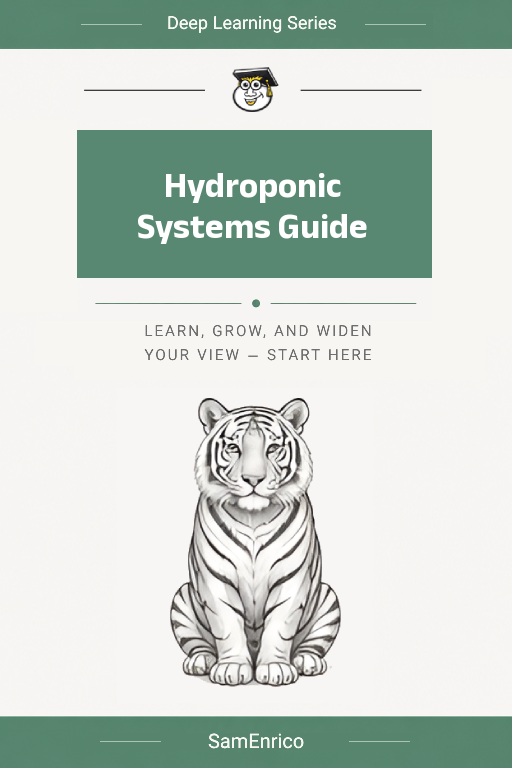
Hydroponic Systems Guide eBook
Learn nutrient film technique, deep water culture,
Learn nutrient film technique, deep water culture, and drip systems for soilless cultivation.
Formats
Free sample
Chapter 1: The Water Paradigm--–- In a windowless warehouse on the outskirts of Chicago, millions of kale and arugula plants grow under magenta-tinted LED lights, stacked eighteen feet high on vertical towers. They have never seen sunlight. They have never touched soil. Their roots hang in a thin mist of nutrient solution that cycles for thirty seconds, then pauses for ninety, then cycles again. The facility produces 2.5 million pounds of greens per year using ninety-seven percent less water than field farming.
The entire operation is monitored by two full-time employees and a network of sensors that track p H, electrical conductivity, temperature, and humidity in real time. If a sensor detects a p H drift above 6.2, a dosing pump releases a few milliliters of acid. If the humidity drops below sixty-five percent, ultrasonic humidifiers activate. The plants do not care that they are inside a concrete box. They are fed, watered, and lit with mathematical precision.
They grow faster, cleaner, and more reliably than any field-grown crop could.This is not science fiction. This is agriculture as it will increasingly be practiced in a world with diminishing topsoil, dwindling freshwater, and an expanding global population. The facility in Chicago is one of hundreds of commercial vertical farms now operating across North America, Europe, and Asia. But the same principles that drive those million-dollar operations also work in a five-gallon bucket under a fifty-dollar LED grow light. The scale changes.
The fundamentals do not. Whether you are growing a single basil plant on a kitchen counter or forty thousand lettuce heads in a former steel mill, you are engaging with the same core idea: water, not soil, is the medium of life. The dirt is optional.Most people, when they first hear about hydroponics, assume it is complicated, expensive, or unnatural. They imagine laboratory conditions, white coats, and beakers of mysterious green liquid. They worry about the taste.
They wonder if it is safe. These are reasonable questions, and they deserve honest answers. Hydroponic produce tastes like the plant it comes from because it is the same plant. A hydroponic tomato contains the same sugars, acids, and volatile compounds as a soil-grown tomato. In blind taste tests, hydroponic tomatoes often score higher because they can be harvested at peak ripeness rather than picked green for shipping.
As for safety, hydroponic systems are inherently cleaner than soil. There is no manure, no runoff from neighboring farms, no soil-borne pathogens like E. coli or salmonella. The controlled environment means fewer pesticides. The recirculating water means no agricultural runoff polluting rivers and streams.
Far from being unnatural, hydroponics is simply a more efficient way of doing what plants have always done: absorbing dissolved minerals through their roots.The barrier to entry is not technology. The barrier is understanding. Hydroponics demands that you shift your mental model from "gardening" to "system management." In a soil garden, you plant seeds, water them, pull weeds, and hope for rain. The soil does most of the work. It buffers overwatering.
It stores nutrients. It hosts a complex food web of bacteria, fungi, and worms that recycle organic matter. In a hydroponic system, you are that ecosystem. You are the buffer. You are the storage.
You are the nutrient cycler. This sounds intimidating, but it is actually liberating. You are no longer at the mercy of weather, soil quality, or pests. You are in control. Every variable can be measured, adjusted, and optimized.
When something goes wrong, you can trace it to a specific cause. When something goes right, you can replicate it exactly.The first variable you need to master is p H. The term stands for "potential hydrogen," but what matters is the number. The p H scale runs from 0 to 14, with 7 being neutral. Below 7 is acidic.
Above 7 is alkaline. Most plants prefer a slightly acidic environment, between 5.5 and 6.5. In this narrow window, all fourteen essential plant nutrients are soluble and available. Drift above 6.5, and iron, manganese, and phosphorus become inaccessible. The plant starves even though the food is present.
Drift below 5.5, and calcium and magnesium lock out, leading to blossom end rot in tomatoes and curled, distorted leaves in peppers. The p H of your nutrient solution will change over time. Plants take up different nutrients at different rates. As they pull in ammonium ions, the p H drops. As they pull in nitrate ions, the p H rises.
Your tap water has its own p H and alkalinity. Your growing media may buffer or alter p H. You cannot set it once and forget it. You must test and adjust, typically every day or every other day.Testing p H requires a meter or test strips. Digital meters are more accurate and easier to read, but they need calibration every few weeks with buffer solutions.
A good meter costs thirty to sixty dollars. Cheap meters are worse than useless because they give false confidence. If you cannot afford a quality meter, use liquid p H test drops. They are less precise but perfectly adequate for small systems. To adjust p H, you need p H Up and p H Down solutions.
p H Down is usually phosphoric acid, though some brands use citric or nitric acid. p H Up is potassium hydroxide or potassium carbonate. Add a few milliliters at a time, stir, wait a minute, and test again. Never add both at once. Never add concentrated acid or base directly to your reservoir without diluting it first in a cup of water.
A sudden swing of more than one full point can shock your plants.The second variable is electrical conductivity, or EC, which measures the total concentration of dissolved salts in your water. In hydroponics, those salts are your nutrients. EC tells you how much food is in the solution. Pure water has an EC of zero. A light nutrient solution for lettuce might read 1.2 m S/cm.
A heavy solution for tomatoes in peak production might read 3.5 m S/cm. If EC is too low, your plants starve. They turn pale, grow slowly, and drop lower leaves. If EC is too high, your plants burn. Leaf tips turn brown and curl upward.
The plant cannot take up water because the osmotic gradient is reversed. You can measure EC with the same meter that measures p H, or with a dedicated EC meter. Many combination meters do both. The relationship between EC and plant health is not linear. Young seedlings need low EC, around 0.5 to 1.0.
Rapidly growing leafy greens need 1.2 to 1.8. Fruiting vegetables need 2.0 to 3.5. As your plants grow, their appetite changes. You must adjust your nutrient concentration accordingly.The third variable is dissolved oxygen, or DO. Roots are aerobic organisms.
They need oxygen to convert sugars into energy. In soil, oxygen fills the pore spaces between particles. In hydroponics, you must introduce oxygen artificially. In deep water culture, you use an air pump and air stone to bubble air through the solution. In nutrient film technique, the shallow flow leaves most of the root surface exposed to the humid air inside the channel.
In drip systems, the wet-dry cycle of the media pulls fresh oxygen into the root zone each time the water…
This is the end of the free sample. Get the eBook to keep going. Buy now
About this book
Details
- Author
- Portillo Sarina
- Publisher
- SamEnrico
- Language
- English
- Genre
- Non-Fiction, Forecast & Outlook, Hydroponics
- Released
- 2026-05-28
- Pages (approx.)
- 122
- Available as
- eBook, Audiobook

Read better in the ZLOADR app
Your eBooks on your phone or tablet. Sign in with your SamEnrico account and start reading.
More by Portillo Sarina
 OKRs for Gardening ProjectsPortillo Sarina$11.99
 Lost Object Dream Symbols CoursePortillo Sarina$11.99
 Munch Content Repurposing GuidePortillo Sarina$11.99
 The Sober Athletes Training ManualPortillo Sarina$11.99
 Caregiver Partner Self EsteemPortillo Sarina$11.99
 Orpheus and Eurydice: A Love Song Through HadesPortillo Sarina$11.99
 Tool MakerPortillo Sarina$11.99
 UK Annual General Meeting WorkbookPortillo Sarina$12.99
 Understanding Immotile Cilia Syndrome, Due to Excessively Long CiliaPortillo Sarina$17.99
 How to Start a Britannia Metal Founding Business (Beginners Guide)Portillo Sarina$11.99
You may also like
 Hong Kong Handover 1997Dunn Johnnie$11.99
 Zumba For Postnatal Recovery CourseNeal Christian$11.99
 Zumba for BeginnersLadner Nikia$11.99
 YouTube Comment Mining GuideHumes Pandora$12.99
 Worry Box MeditationCarlin Rudy$11.99
 Workplace Stress MeditationNguyen Lynn$11.99
 Workplace Stress and Sleep RepairHawley Ivory$11.99
 Workplace Perfectionism CureDelaney Jeffry$11.99
 Workplace Injustice Anger GuideWallen Isabelle$11.99
 Work Addiction and Burnout LinkGreenwood Ester$11.99
 Women in Yoga and WellnessBeattie Galina$11.99
 Women in Stand Up ComedyChun Evangeline$11.99