
Non-FictionMental WealthHydrationWater
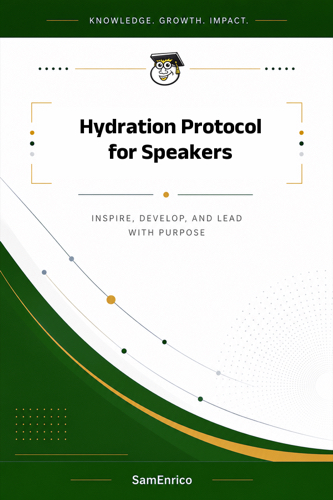
Hydration Protocol for Speakers eBook
Drink optimal fluids to prevent dry mouth before a
by Reich Vonnie
Drink optimal fluids to prevent dry mouth before and during talks.
Formats
Free sample
Chapter 1: The Mucosal Lie--–- The first time my throat closed on stage, I was thirty-two years old, standing in front of eight hundred people at a technology conference in Austin. I had prepared for six weeks. I had memorized every slide, rehearsed every transition, and practiced my opening joke until it landed with the precision of a Swiss watch. I had done everything right—except one thing. I had ignored my hydration until the last possible moment.Thirty seconds into my talk, my tongue stuck to the roof of my mouth.
Not metaphorically. Physically. The sound that came out of my next word was not a crisp consonant but a wet, clicking noise, like a boot pulled from mud. I paused. I swallowed.
Nothing happened. I reached for the water bottle on the podium, unscrewed the cap with fingers that had begun to tremble, and took a desperate gulp. The water was cold and shocking. I swallowed. And then, impossibly, my mouth felt even drier than before.I finished the talk.
I got through it. But I will never forget the sensation of fighting my own body for the right to speak. And I will never forget the look on the face of the man in the third row, who leaned over to his colleague and whispered something I could read on his lips: "He's nervous."I was not nervous. I was dehydrated. And I did not know until that moment that those two things are not as different as they seem.This chapter is called The Mucosal Lie because the lie is everywhere.
It is in the advice columns telling you to "stay hydrated" before a big presentation. It is in the wellness influencers selling you overpriced alkaline water. It is even in your own body, which sends you thirst signals that are always, always too late. The truth—the truth that professional vocal coaches, laryngologists, and opera singers have known for centuries—is that the quality of your mucus matters more than the quantity of your water. And the window for fixing that quality is not measured in minutes.
It is measured in days.By the end of this chapter, you will understand why your throat can feel perfectly fine thirty minutes before a talk and turn to sandpaper the moment you say your first word. You will learn the difference between systemic hydration (how much water is in your blood) and local laryngeal hydration (how slippery the mucus is on your vocal folds). And you will be introduced to a concept that will change everything about how you prepare to speak: the mucosal wave.The Anatomy of a Vibration Before we can understand why your mouth goes dry, you need to understand what happens inside your throat when you speak. The human voice is not produced by the lips, the tongue, or the teeth, though all of those structures shape the sound into recognizable words. The voice begins much deeper, in a small, delicate structure called the larynx, or voice box, located at the top of the trachea, just behind the Adam's apple.Inside the larynx are two bands of tissue called the vocal folds.
They are not cords, despite the common misnomer. Cords are ropelike and taut. Vocal folds are more like lips: soft, pliable, and capable of incredibly precise movement. They open to let you breathe, close to protect your airway when you swallow, and vibrate to produce sound when you speak.The vibration is the key. When you exhale while your vocal folds are brought together, the air rushing past them creates a phenomenon called the Bernoulli effect.
The same physics that makes airplane wings lift causes the vocal folds to be sucked together, then blown apart, then sucked together again, dozens or hundreds of times per second. A typical speaking voice vibrates at around 100 to 150 times per second for men and 180 to 250 times per second for women. A soprano singing a high C can exceed 1000 vibrations per second.That is an astonishing amount of friction. Two surfaces slapping together a thousand times per second, rubbing against each other with every cycle, would destroy almost any material in minutes. Think of two pieces of sandpaper grinding together.
Think of the soles of your shoes after a thousand miles of walking. The vocal folds are made of tissue—living, fragile tissue—and yet they withstand this abuse for decades. How?The answer is mucus. The vocal folds are coated in a thin, transparent layer of mucus, typically just 50 to 100 microns thick—about the width of a human hair. This mucus is not just a wet blanket.
It is a precision lubricant, engineered by your body to have exactly the right viscosity: thin enough to allow effortless sliding, but thick enough to stay in place between vibrations. When the vocal folds are properly lubricated, they do not actually touch each other. They glide across a film of mucus, like ice skaters on fresh ice. The friction is negligible. The wear is minimal.This sliding film is called the mucosal wave.
It is visible under strobe light during a laryngeal examination, traveling across the surface of the vocal folds like a ripple across a pond. The mucosal wave is the single best predictor of vocal health. When it is strong and smooth, the voice sounds effortless. When it is weak or absent, the voice sounds strained, breathy, or rough. And the mucosal wave depends entirely on the quality of the mucus that creates it.The Thirst Trap Here is where the lie begins.
Your body has a sophisticated system for sensing dehydration, but that system is not designed for the needs of a public speaker. It is designed for survival. Thirst is triggered by two main mechanisms: an increase in blood osmolality (the concentration of salt and other solutes in your blood) and a decrease in blood volume. Both of these are late signals. By the time you feel thirsty, your body has already lost a significant amount of water—typically one to two percent of your body weight.For a 150-pound person, one percent dehydration is 1.5 pounds of water loss, or approximately 24 ounces.
You can lose that much water through normal respiration and sweat over the course of a few hours without ever feeling thirsty. Your blood osmolality creeps up. Your blood volume drops slightly. And your brain, which is exquisitely sensitive to even tiny changes in its own hydration status, begins to conserve water by reducing saliva production.Saliva is not a priority for a dehydrated body. From an evolutionary perspective, your brain cares about keeping your heart pumping and your neurons firing.
Saliva is a luxury. The production of thin, watery saliva from the parotid glands—the large salivary glands located near your ears—is one of the first functions to be downregulated when water is scarce. Your body says, in effect, "We can chew and swallow dry food just fine. What we cannot do is let the brain shrink."So your mouth becomes dry. But here is the crucial point: your mouth can be bone-dry while your vocal folds are still perfectly lubricated.
And conversely—and far more dangerously for the speaker—your mouth can feel fine while your vocal folds are already parched. The…
This is the end of the free sample. Get the eBook to keep going. Buy now
About this book
Details
- Author
- Reich Vonnie
- Publisher
- SamEnrico
- Language
- English
- Genre
- Non-Fiction, Mental Wealth, Hydration, Water
- Released
- 2026-06-08
- Pages (approx.)
- 155
- Available as
- eBook, Audiobook

Read better in the ZLOADR app
Your eBooks on your phone or tablet. Sign in with your SamEnrico account and start reading.
More by Reich Vonnie
 High Conflict Divorce GuideReich Vonnie$11.99
 Anger Management for Toxic WorkplacesReich Vonnie$11.99
 Alcohol Withdrawal Vital SignsReich Vonnie$11.99
 The Zinc Immune Support GuideReich Vonnie$11.99
 Whispers of the Thunderbird: The Great Feathered StormReich Vonnie$11.99
 Understanding Polymicrogyria Turricephaly HypogenitalismReich Vonnie$17.99
 Cabinet DesignerReich Vonnie$11.99
 YouTube Behind the Scenes GuideReich Vonnie$12.99
 Regional US Travel Spending RecoveryReich Vonnie$12.99
 How to Become a ColorerReich Vonnie$11.99
You may also like
 Hong Kong Handover 1997Dunn Johnnie$11.99
 Zumba For Postnatal Recovery CourseNeal Christian$11.99
 Zumba for BeginnersLadner Nikia$11.99
 YouTube Comment Mining GuideHumes Pandora$12.99
 Worry Box MeditationCarlin Rudy$11.99
 Workplace Stress MeditationNguyen Lynn$11.99
 Workplace Stress and Sleep RepairHawley Ivory$11.99
 Workplace Perfectionism CureDelaney Jeffry$11.99
 Workplace Injustice Anger GuideWallen Isabelle$11.99
 Work Addiction and Burnout LinkGreenwood Ester$11.99
 Women in Yoga and WellnessBeattie Galina$11.99
 Women in Stand Up ComedyChun Evangeline$11.99