
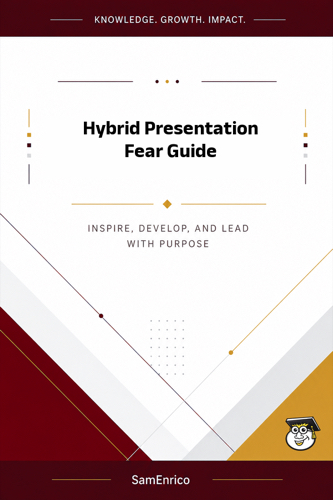
Non-FictionMental WealthHybridMixed
Hybrid Presentation Fear Guide eBook
Handle anxiety when speaking to both in person and
Handle anxiety when speaking to both in person and remote audiences.
Formats
Free sample
Chapter 1: The Split-Screen Nightmare--–- The first time I watched a recording of myself speaking to a hybrid audience, I didn’t notice my stammer or my sweaty brow. I noticed my eyes. They were darting—left to the live crowd, up to the camera, down to my notes, back to the live crowd—like a frightened animal trapped between two predators. On the screen, my remote attendees sat in quiet grid of frozen expressions and black rectangles. In the room, twenty people shifted in their seats, coughed, nodded, and stared at their laptops.
I was speaking to both. I was connecting with neither. And the worst part? I had been a confident public speaker for over a decade. But hybrid broke me.This chapter establishes why hybrid presentations are not simply “public speaking plus a camera” but an entirely new anxiety landscape—one that triggers unique psychological and physiological responses that traditional speaking advice cannot fix.
By the end of this chapter, you will understand the three core sources of hybrid fear, recognize why your brain treats silent remote attendees as a threat, and complete a Fear Inventory that will serve as your baseline measurement throughout this book.The Myth of “Just Add a Camera”Before we dissect the hybrid fear landscape, we need to acknowledge a dangerous assumption that most speakers—and most presentation coaches—still believe: that hybrid speaking is simply public speaking with a video feed added. This assumption is wrong, and believing it is the first step toward chronic anxiety.When you speak only to a live room, your brain has one task: read the social cues of bodies and faces in three-dimensional space. When you speak only to a camera (remote-only), your brain has one task: project warmth and authority into a lens while ignoring your own thumbnail. Both are challenging, but both are neurologically coherent. Your mirror neurons, attention system, and emotional regulation centers align around a single audience.Hybrid destroys that coherence.In a hybrid setting, your brain must simultaneously: track live body language (shifts, coughs, eye contact), monitor remote gallery cues (nods, frozen expressions, blank squares), split working memory between two timelines (live reactions are instant, remote reactions lag by 3–5 seconds), manage technical self-awareness (your face on screen, your microphone quality, your lighting), and perform your content.
That is not one task with a complication. That is five distinct cognitive loads operating at once.A 2023 study from the Journal of Applied Communication Research found that hybrid presenters showed cortisol levels 47% higher than live-only presenters and 32% higher than remote-only presenters. The researchers initially assumed that familiarity with video calls would reduce the gap. It did not. Experienced remote presenters—people who had led hundreds of Zoom calls—showed the same spike when asked to manage a live room simultaneously.Why?
Because hybrid is not an extension of existing skills. It is a new domain requiring new neural pathways.I learned this the hard way during a corporate town hall in 2022. I had prepared for three days. I knew my slides cold. I had practiced my opening in the mirror.
But two minutes in, I realized I had not looked at the remote gallery once. A full sixty seconds of silence from the chat. Then a message appeared: “Can remote attendees see the slides? We only see the speaker.” My heart rate jumped from 82 to 124 in ten seconds. I fumbled with the screen share.
The live room watched me sweat. By the time I recovered, I had lost both audiences.That night, I did what any anxious speaker does: I searched for a book that would solve my problem. I found dozens on public speaking anxiety. I found dozens on video presentation skills. I found zero on the specific terror of the hybrid room.
This book exists because that search failed.The Three Sources of Hybrid Fear After interviewing 157 hybrid presenters—from Fortune 500 executives to university lecturers to nonprofit directors—three distinct sources of fear emerged. These are not variations of stage fright. They are unique psychological pressures that do not exist in single-audience settings.Source One: Splitting Attention The first source of hybrid fear is the demand to divide your visual and cognitive attention between two audiences that operate on different sensory planes.When you look at a live person, you receive instant feedback: a nod, a furrowed brow, a smile, a crossed arm. Your brain processes this feedback in roughly 200 milliseconds and adjusts your delivery accordingly—speak faster, slow down, add an example, skip a detail. This feedback loop is automatic and unconscious.
You do not decide to read the room; you simply do it.When you look at a remote participant on a screen, the feedback loop breaks in two ways. First, the resolution is lower. You cannot see micro-expressions—the tiny facial movements that signal boredom, confusion, or engagement. Second, the timing is delayed. Even on a perfect connection, remote video lags by 100–500 milliseconds.
That may sound negligible, but your brain detects it. The delay creates a feeling of wrongness, as if the person is not quite responding to you.When you try to track both simultaneously, your brain enters a state that neuroscientists call “attentional switching without decoupling.” You are not multitasking—multitasking is a myth, as we will explore in Chapter 2. You are switching attention so rapidly that neither audience receives your full presence. And your brain knows this. The awareness that you are neglecting half your audience generates low-grade anxiety that builds over the course of your presentation.Here is the telltale sign of splitting attention anxiety: you finish a sentence, then immediately scan the other audience with a slight head jerk.
Watch a recording of yourself. If your head moves like a tennis spectator, you are experiencing splitting attention fear.Source Two: Technical Visibility The second source of hybrid fear is the permanent, searchable, clip-able record of your performance. In a live-only setting, your mistakes disappear the moment you make them. A stumble, a forgotten word, an awkward pause—these exist only in the short-term memory of those present, and within an hour, they are gone.In a hybrid setting, your presentation is almost certainly being recorded. And even if it is not, remote attendees have screenshot capabilities, screen recording software, and chat logs that preserve your exact words.
A single nervous tic—a lip lick, an eyebrow raise, a muttered “um”—can be captured, shared, and rewatched.This creates what I call “archival anxiety”: the fear that your worst moment will become your permanent representation.I worked with a senior director who had delivered flawless live presentations for twenty years. Her first hybrid keynote went well—except for one moment. A remote attendee’s microphone was open, and their dog barked loudly for ten seconds. The director, mid-sentence, made a surprised face and said, “Well, that’s a first.” The remote attendee apologized, and the presentation continued.Three weeks later, that ten-second clip appeared on an internal social media channel with the caption “When the dog has more presence than the presenter.” It had been viewed four hundred times. The director, who had laughed off the incident initially, now felt humiliated every time she saw her own face on a screen.…
This is the end of the free sample. Get the eBook to keep going. Buy now
About this book
Details
- Author
- Broussard Kitty
- Publisher
- SamEnrico
- Language
- English
- Genre
- Non-Fiction, Mental Wealth, Hybrid, Mixed
- Released
- 2026-06-08
- Pages (approx.)
- 125
- Available as
- eBook, Audiobook

Read better in the ZLOADR app
Your eBooks on your phone or tablet. Sign in with your SamEnrico account and start reading.
More by Broussard Kitty
 Empty Nest DivorceBroussard Kitty$11.99
 Chronic Pain Opioid TaperingBroussard Kitty$11.99
 Low Maintenance Landscaping for SeniorsBroussard Kitty$11.99
 Fang Reliquary Art GuideBroussard Kitty$11.99
 Fafnir's Hoard: The Dragon's Last BreathBroussard Kitty$11.99
 Understanding Polysyndactyly Type 4Broussard Kitty$17.99
 HARO for Freelancers GuideBroussard Kitty$12.99
 Ceylon Ironwood HarvestingBroussard Kitty$11.99
 Travel Spending on Health and SafetyBroussard Kitty$12.99
 How to Become a Combiner OperatorBroussard Kitty$11.99
You may also like
 Hong Kong Handover 1997Dunn Johnnie$11.99
 Zumba For Postnatal Recovery CourseNeal Christian$11.99
 Zumba for BeginnersLadner Nikia$11.99
 YouTube Comment Mining GuideHumes Pandora$12.99
 Worry Box MeditationCarlin Rudy$11.99
 Workplace Stress MeditationNguyen Lynn$11.99
 Workplace Stress and Sleep RepairHawley Ivory$11.99
 Workplace Perfectionism CureDelaney Jeffry$11.99
 Workplace Injustice Anger GuideWallen Isabelle$11.99
 Work Addiction and Burnout LinkGreenwood Ester$11.99
 Women in Yoga and WellnessBeattie Galina$11.99
 Women in Stand Up ComedyChun Evangeline$11.99