
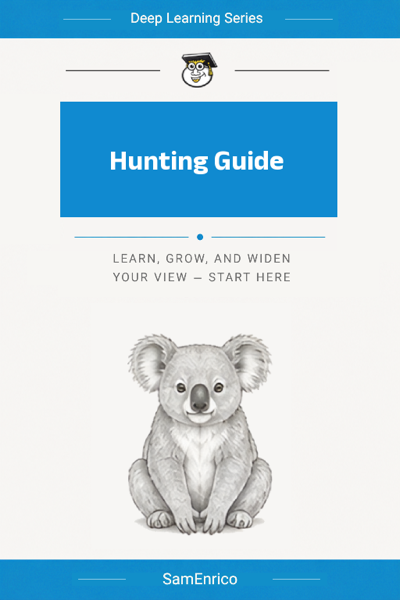
Non-FictionInformativeEducational
Hunting Guide eBook
A Coursebook on Hunting Guide
A Coursebook on Hunting Guide
Formats
Free sample
Chapter 1: The Mirror Test...--–- Before you learn where to place a bullet, before you learn how to read wind or age a track or butcher a quarter, you must first answer a question that has nothing to do with the woods and everything to do with the space between your ribs. The question is this: Why are you here? Not why are you reading this book, though that matters. Why are you standing in front of the mirror, holding a weapon, and calling yourself a hunter? If you cannot answer that question with an honesty that hurts, put this book down and walk away.
There are easier ways to fill a freezer. There are cheaper ways to buy antlers. There are faster ways to feel powerful. Hunting offers none of these things efficiently. What hunting offers is something rarer and far more demanding: a relationship with mortality that most humans spend their entire lives running from.The hunting world is full of people who have never actually hunted.
They have killed, yes. They have pulled triggers and released arrows and watched animals fall. But killing is not hunting, just as typing is not writing and pressing a shutter is not photography. Hunting is everything that surrounds the kill. Hunting is the February afternoon when you first pull out a map and start scouting a drainage you have never seen.
Hunting is the August morning when you hike eight miles to hang a treestand in the dark. Hunting is the November dawn when you sit motionless for four hours and see nothing but frost forming on your boot laces. Hunting is the December evening when you gut a deer by headlamp with your fingers so cold you cannot feel the knife. Hunting is the January weekend when you grind the last of the trimmings into sausage and realize you have not bought beef in six months. The kill is a single moment, maybe thirty seconds of your entire season.
If you are only here for those thirty seconds, you are not a hunter. You are a collector of final moments, and you will burn out within three years.I have watched it happen dozens of times. A new hunter buys all the gear, watches all the You Tube videos, spends opening weekend in a blind, kills a deer on Saturday morning, and by Tuesday is posting on a forum about where to mount the antlers. Then the next season, they kill another deer—but the feeling is different. Diminished.
The season after that, they wound one and lose it and feel something they did not expect: guilt, heavy and permanent. Then they stop hunting. They tell themselves they are too busy, or the pressure is too high, or the land access dried up. But the real reason is that they were never hunting in the first place. They were killing, and killing without the rest of the hunting experience is a thin and unsatisfying thing that cannot sustain a lifetime of practice.This chapter is called The Mirror Test because before you learn anything else, you must look at yourself and decide what kind of hunter you want to become.
There are three kinds. The first is the Trophy Hunter, who hunts for antlers or horns or skulls and measures success by inches of bone. The second is the Meat Hunter, who hunts to fill a freezer and measures success by pounds of venison. The third is the Ecological Hunter, who hunts as an act of participation in the natural world and measures success by the quality of the pursuit, the depth of the learning, and the integrity of the kill. I am not going to tell you that the first two are wrong.
I am going to tell you that only the third will keep you in the woods for forty years. Only the third will survive the inevitable seasons when you see nothing, hit nothing, and come home empty-handed. Only the third will transform hunting from something you do into something you are.The Blood Sport Lie The single most destructive phrase in all of hunting culture is "blood sport." Anti-hunters use it as an insult. Hunters have unfortunately adopted it as a defense. You have heard it a hundred times: "Hunting is a sport, like football or baseball, just with higher stakes." This is a lie, and it is a cowardly lie because it allows the hunter to avoid the moral weight of what she is doing.
In a sport, both parties consent to participate. In a sport, the rules are designed to create fair competition. In a sport, when the game ends, everyone goes home to try again another day. The animal you hunt does not consent. The animal does not know the rules.
The animal goes home only if you fail. To call hunting a sport is to pretend that the animal is a willing participant in its own death, and that is a kind of self-deception that rots the conscience from the inside.The Spanish philosopher José Ortega y Gasset destroyed this lie eighty years ago in his slim masterpiece Meditations on Hunting. Ortega argued that hunting is not a sport but what he called a "vital act"—a temporary return to the state of full alertness that our Paleolithic ancestors lived in every moment of every day. The modern human, Ortega wrote, lives in a world of abstractions. We look at screens, sign contracts, trade pieces of paper that represent money that represents labor that represents survival.
We are three or four layers removed from anything real. The hunter, by contrast, steps out of that abstraction and into a world of direct consequences. When the hunter misreads the wind, the animal smells her and flees. When the hunter steps on a dry stick, the animal hears it and vanishes. When the hunter makes a clean shot, the animal dies.
There is no abstraction. There is only action and result, cause and effect, life and death.Here is the key insight that most hunters miss. Ortega argued that the hunter does not seek the death of the animal. The hunter seeks the experience of being fully alive, and the death is simply the price of admission. Consider that.
If Ortega is right—and I believe he is—then the kill is not the purpose of the hunt. The purpose is the hunt itself: the stalking, the waiting, the reading of sign, the delicate negotiation between predator and prey that has been unfolding on this continent for fifteen thousand years. The kill is the moment when that negotiation ends, but it is not the reason the negotiation began. If you hunt only to kill, you are like a person who reads mysteries only to learn the identity of the murderer. You have missed everything that matters.This reframing is not philosophy for its own sake.
It is practical ethics with direct implications for how you hunt. If you believe hunting is a sport, you will focus on efficiency, speed, and success rates. You will take marginal shots because you want to go home with meat or antlers. You will use technology that removes the…
This is the end of the free sample. Get the eBook to keep going. Buy now
About this book
Details
- Author
- Edmonds Ashanti
- Publisher
- SamEnrico
- Language
- English
- Genre
- Non-Fiction, Informative, Educational
- Released
- 2026-05-04
- Pages (approx.)
- 150
- Available as
- eBook, Audiobook

Read better in the ZLOADR app
Your eBooks on your phone or tablet. Sign in with your SamEnrico account and start reading.
More by Edmonds Ashanti
 Housing Cooperative FormationEdmonds Ashanti$11.99
 Self Talk For WomenEdmonds Ashanti$11.99
 Walking Meditation For JealousyEdmonds Ashanti$11.99
 Walking Meditation in the WoodsEdmonds Ashanti$11.99
 Assertiveness for Customer Service RolesEdmonds Ashanti$11.99
 Xochiquetzal’s Fall: The Flower Goddess and the Cosmic BetrayalEdmonds Ashanti$11.99
 A Beginners Guide to Floorball (Volume 1)Edmonds Ashanti$11.99
 Pricing for Retailers During InflationEdmonds Ashanti$12.99
 Coding Bootcamp Outcomes WorldwideEdmonds Ashanti$12.99
 Understanding Onychonychia Hypoplastic Distal PhalangesEdmonds Ashanti$17.99
You may also like
 Hong Kong Handover 1997Dunn Johnnie$11.99
 Zumba For Postnatal Recovery CourseNeal Christian$11.99
 Zumba for BeginnersLadner Nikia$11.99
 YouTube Comment Mining GuideHumes Pandora$12.99
 Worry Box MeditationCarlin Rudy$11.99
 Workplace Stress MeditationNguyen Lynn$11.99
 Workplace Stress and Sleep RepairHawley Ivory$11.99
 Workplace Perfectionism CureDelaney Jeffry$11.99
 Workplace Injustice Anger GuideWallen Isabelle$11.99
 Work Addiction and Burnout LinkGreenwood Ester$11.99
 Women in Yoga and WellnessBeattie Galina$11.99
 Women in Stand Up ComedyChun Evangeline$11.99