
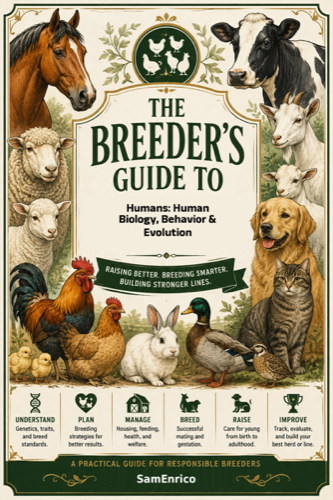
Non-FictionInformativeEducational
Humans: Human Biology, Behavior & Evolution eBook
This wildlife publication, published by SamEnrico,
This wildlife publication, published by SamEnrico, covers Humans: Human Biology, Behavior & Evolution
Formats
Free sample
Chapter 1: The Invisible Inheritance...--– Every time you flinch at a snake coiled on a hiking trail, your heart hammering before your conscious mind has even registered what your eyes saw, you are experiencing an inheritance older than language, older than fire, older than the genus Homo itself. That involuntary gasp, that primal jolt of cortisol, that sudden urge to leap backward—none of it was taught to you by your parents. No school drilled it into you. No culture inscribed it onto your blank slate. That fear was already there, waiting, written into the architecture of your nervous system by millions of years of ancestral encounters with legless venomous predators.
Your distant primate ancestors who failed to flinch did not live long enough to become your ancestors. You are descended from the flinchers. And so you flinch.This simple, almost trivial observation—that we are born with biases, fears, desires, and learning predispositions that were shaped by natural selection long before we drew our first breath—is one of the most radical and misunderstood ideas in all of science. For most of the twentieth century, the dominant view across the social sciences, humanities, and even large portions of psychology was exactly the opposite: the human mind arrives in the world as a blank slate, a tabula rasa, waiting to be written upon exclusively by experience. According to this model, which the anthropologist Donald Brown would later call the Standard Social Science Model, virtually all meaningful human behaviour—from gender roles to moral values, from romantic preferences to violent impulses—is a product of culture, socialisation, and historical contingency.
Biology, at best, sets trivial constraints: we need food, water, and sleep. Everything else is culture.This chapter argues that the blank slate is not merely incomplete. It is fundamentally, demonstrably, and dangerously wrong. The human mind is not a general‑purpose computer. It is a collection of specialised, evolved modules—each designed by natural selection to solve a specific problem that recurred in our ancestral environment.
These modules operate largely below conscious awareness, generating our emotions, intuitions, and impulses. We do not decide to feel anxious on a dark street. We do not choose to find a symmetrical face attractive. These reactions just happen, because they are the output of neural circuits that helped our ancestors survive and reproduce. And they still run, every day, in your skull.But—and this is equally important—neither are we prisoners of our biology.
The alternative to the blank slate is not genetic determinism. Genes do not cause behaviour directly, any more than piano keys cause a sonata. Genes build brains. Brains respond to environments. But brains do not respond to all environments equally or with infinite flexibility.
The mind is not a blank slate. It is a prepared slate, with certain things written in faint but real pencil, waiting for the environment to trace over them. That crucial middle ground—between the fantasy of infinite plasticity and the nightmare of biological fate—is the core principle of this entire book: interactionism. Nature and nurture are not alternatives. They are partners, locked in a dance that began long before our species existed and will continue long after we are gone.This chapter lays the foundation for everything that follows.
We will examine the blank slate model and its intellectual history. We will introduce the alternative framework of evolutionary psychology. We will confront the dark history of evolutionary ideas being misused for social and political oppression—and establish a clear ethical firewall between explaining why something evolved and justifying it. We will review three powerful lines of evidence that the blank slate is false. And we will establish the interactionist principle that will guide the rest of the book.The Standard Social Science Model and Its Influence To understand why a biological perspective on human behaviour remains controversial more than 150 years after Darwin, you must first understand the intellectual orthodoxy that dominated the twentieth century.
The anthropologist George Peter Murdock wrote in his 1949 classic Social Structure that human behaviour is "almost entirely the product of social conditioning, and the differences between peoples are due almost entirely to differences in their cultural environment." The psychologist John Watson, founder of behaviourism, famously boasted: "Give me a dozen healthy infants, well‑formed, and my own specified world to bring them up in, and I'll guarantee to take any one at random and train him to become any type of specialist I might select—doctor, lawyer, artist, merchant‑chief and, yes, even beggar‑man and thief, regardless of his talents, penchants, tendencies, abilities, vocations, and race of his ancestors."These were not fringe statements. They were the confident assertions of flagship figures in their fields. By the 1970s, this consensus had hardened into what Brown called the Standard Social Science Model (SSSM) , an informal but powerful set of assumptions that structured research across anthropology, sociology, and much of psychology. The SSSM rested on three core tenets.First tenet: The mind at birth is a blank slate. Or, in a slightly more sophisticated version, it is a general‑purpose learning machine with no built‑in content—only the ability to form associations between stimuli and responses.
Any apparent regularities in human behaviour must therefore be explained by regularities in the environment, not by any innate structure of the mind.Second tenet: Human behaviour is almost entirely determined by culture, socialisation, and historical context. Culture is not merely a thin veneer over a universal human nature; it is the primary, overwhelming determinant of who we become. Change the culture, and you can change the person fundamentally.Third tenet: Biology sets only the most minimal constraints. We need oxygen, water, food, and sleep. We have a few reflexes (sucking, grasping, startling).
Beyond that, biology is irrelevant to understanding the meaningful differences between human societies or individuals.The SSSM was never merely an academic hypothesis. It was also a political and moral project. If the mind is a blank slate, then racism, sexism, class inequality, homophobia, and xenophobia are purely the products of bad socialisation. Change the socialisation—through education, media, legal reforms, and cultural engineering—and you can eliminate prejudice entirely. There are no inherent limits to human equality.
There are no inherent differences between groups that cannot be erased by enough environmental intervention. The blank slate promised that utopia was just a few generations of proper conditioning away.The problem, as we shall see, is that the blank slate is not true. And the gap between its promise and reality has caused enormous suffering—not because the blank slate itself is evil, but because believing in it leads us to treat human nature as infinitely malleable, and when it refuses to bend, we blame the victims.Evolutionary Psychology: The Mind as a Swiss Army Knife The most systematic alternative to the SSSM emerged in the late 1980s and early 1990s under the name Evolutionary Psychology (capitalised to distinguish it from the broader, older field of evolutionary psychology). The leading figures—Leda Cosmides, John Tooby, David Buss, Steven Pinker, and others—did not invent the idea that evolution shapes behaviour. Charles Darwin himself had speculated about the evolutionary origins of human morality, sympathy, and sexual desire…
This is the end of the free sample. Get the eBook to keep going. Buy now
About this book
Details
- Author
- Isaacs Vickey
- Publisher
- SamEnrico
- Language
- English
- Genre
- Non-Fiction, Informative, Educational
- Released
- 2026-05-09
- Pages (approx.)
- 156
- Available as
- eBook, Audiobook

Read better in the ZLOADR app
Your eBooks on your phone or tablet. Sign in with your SamEnrico account and start reading.
More by Isaacs Vickey
 Vitamin B6 Hormone Balance GuideIsaacs Vickey$11.99
 Creative Habits for PilotsIsaacs Vickey$11.99
 NuvaRing Benefits And RisksIsaacs Vickey$11.99
 Elder Abuse Survivor EsteemIsaacs Vickey$11.99
 Sailor Moon English VoiceIsaacs Vickey$11.99
 Boomer Luxury SpendingIsaacs Vickey$11.99
 Parent Child AssertiveIsaacs Vickey$11.99Parent Child AssertiveIsaacs Vickey$11.99
 Difficult Conversations with TeensIsaacs Vickey$11.99
 The Silk Road Kingpin: How a Pakistani Smuggler Built a Global EmpireIsaacs Vickey$11.99
 The Fall of Ayutthaya: Siam's Last Stand Against the Burmese (1767)Isaacs Vickey$11.99
 A Collector's Handbook to the Tvr Vixen S2Isaacs Vickey$11.99
You may also like
 Hong Kong Handover 1997Dunn Johnnie$11.99
 Zumba For Postnatal Recovery CourseNeal Christian$11.99
 Zumba for BeginnersLadner Nikia$11.99
 YouTube Comment Mining GuideHumes Pandora$12.99
 Worry Box MeditationCarlin Rudy$11.99
 Workplace Stress MeditationNguyen Lynn$11.99
 Workplace Stress and Sleep RepairHawley Ivory$11.99
 Workplace Perfectionism CureDelaney Jeffry$11.99
 Workplace Injustice Anger GuideWallen Isabelle$11.99
 Work Addiction and Burnout LinkGreenwood Ester$11.99
 Women in Yoga and WellnessBeattie Galina$11.99
 Women in Stand Up ComedyChun Evangeline$11.99