
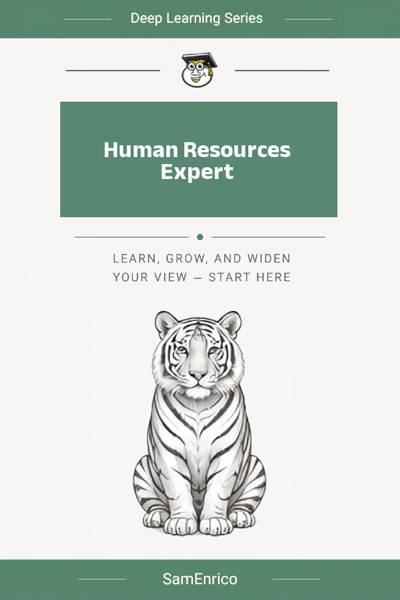
Non-FictionInformativeEducational
Human Resources Expert eBook
A Coursebook on Human Resources Expert
by Weems Fae
A Coursebook on Human Resources Expert
Formats
Free sample
Chapter 1: The HR Delusion...–- Most HR professionals enter the field wanting to help people. They leave wanting to help themselves to a different career. The gap between these two impulses is where this book begins.Let me tell you something no one says at SHRM conferences: the human resources profession is suffering from a collective identity crisis, and most practitioners are too busy processing paperwork to notice. We have convinced ourselves that we are strategic partners while behaving like administrative lifeguards—sitting in high chairs, blowing whistles when someone runs near the pool, but never asking why the pool was built in the shallow end of the business in the first place.This chapter is not a gentle warm-up. It is an intervention.
Before we can build the skills of an HR expert, we must first demolish the myths that keep most HR professionals trapped in roles they never intended to occupy. The HR delusion is the belief that process equals impact, that compliance equals value, and that being busy equals being strategic. It is a comfortable lie, and it is costing you your credibility, your influence, and quite possibly your sanity.The Origins of the Delusion: A Very Short History of Why HR Hates Itself Every profession has an origin story. Medicine began with leeches and bloodletting. Law began with duels and dusty precedents.
HR began with welfare work and time clocks, and unlike our colleagues in scrubs and robes, we never fully shed our origins.In the late nineteenth century, as factories swallowed whole communities and workers died in numbers that would spark riots today, a small group of industrialists discovered something unexpected: treating workers slightly better than livestock actually improved production. The "welfare secretaries" of the 1890s—almost always women, almost always underpaid—were the first HR professionals. Their job was not to empower employees. Their job was to keep them calm enough to return to their machines.By the 1920s, welfare work had evolved into personnel management. The Hawthorne Studies famously demonstrated that workers performed better when someone paid attention to them—a finding so embarrassingly obvious that it took academics another fifty years to admit they had discovered nothing more than basic human decency.
But the personnel department's role remained administrative: hiring, firing, and keeping the records that kept the government from shutting down the factory.The great leap forward—or backward, depending on your perspective—came in the 1960s and 1970s. The Civil Rights Act, the Age Discrimination in Employment Act, the Occupational Safety and Health Act, the Employee Retirement Income Security Act—a cascade of federal legislation transformed personnel management into human resources. Overnight, HR became the department of "no." No, you cannot ask that interview question. No, you cannot fire her for that reason. No, you cannot ignore that complaint.Compliance saved the profession from irrelevance, but it also trapped it in amber.
For fifty years, HR has defined itself primarily by what it prevents rather than what it creates. We are the brakes, not the accelerator. The emergency brake, at that—pulled only when something has already gone wrong.The HR delusion was born in this moment. We began to believe that our value was proportional to the number of problems we caught, the number of lawsuits we avoided, the number of policies we wrote. We confused risk reduction with value creation.
And we never looked up.The Four Lies You Were Taught (And Probably Still Believe)Let me be direct. If you have spent more than three years in HR, you have absorbed four fundamental lies about your profession. You did not invent these lies. They were handed to you by well-meaning mentors, reinforced by certification courses, and cemented by organizational cultures that prefer order over impact.Lie Number One: HR exists to protect the company.This is the granddaddy of all HR delusions, and it is almost entirely backward. HR exists to protect the company by protecting the people inside it.
The distinction matters enormously.When you frame your job as protecting the company, you become a defensive function. You say no. You hide information. You treat employees as threats to be managed rather than assets to be developed. You become the department that employees whisper about, the one they visit only when they have no other choice.When you reframe your job as protecting people, everything changes.
You become an architect of systems that prevent problems before they start. You advocate for transparency because transparency reduces fear, and fear is the root of most lawsuits. You fire bad managers not because they create legal risk—though they do—but because they destroy human beings, and destroyed human beings cannot do good work.The most successful HR leaders I have observed understand this distinction instinctively. They do not ask "Is this legal?" as their first question. They ask "Is this fair?" and "Is this humane?" Legal review comes third, not first.
This sequence reversal is the single most practical thing you can do to escape the HR delusion.Lie Number Two: HR is a cost center.Finance departments love this lie because it makes budgeting simple. Employees repeat it because they have never seen HR do anything other than process paperwork. But it is a lie, and believing it has led HR to underinvest in its own capabilities for decades.A cost center is a function that consumes resources without generating measurable economic return. The mailroom is a cost center. The cafeteria is a cost center.
HR is not a cost center any more than research and development is a cost center—which is to say, they are both investments whose returns are real but difficult to measure poorly.Every time HR helps a manager have a difficult conversation instead of avoiding it, value is created. Every time HR designs a hiring process that selects for performance instead of pedigree, value is created. Every time HR investigates a complaint fairly instead of sweeping it under the rug, value is created—not just in lawsuit avoidance, but in the retention of employees who would have left a less functional culture.The problem is not that HR creates no value. The problem is that HR has historically done a terrible job of measuring and communicating that value. We have accepted the cost center label because we lacked the data to refute it.
Chapter 3 of this book will give you that data. For now, simply recognize that the label is an accusation, not a fact.Lie Number Three: Our job is to enforce the rules.This lie is seductive because it is partially true. HR does enforce rules. We administer leave policies, investigate harassment claims, and ensure that pay practices comply with labor laws. Enforcement is part of the job.
It is not the whole job.The problem with casting yourself as an enforcer is that enforcers are not trusted. They are feared, resented, and avoided. When employees see HR as the rule police, they hide problems instead of surfacing them. They wait until a situation explodes before seeking help. They treat you as the opposition rather than the ally you could be.The alternative—and this will feel uncomfortable if you have internalized…
This is the end of the free sample. Get the eBook to keep going. Buy now
About this book
Details
- Author
- Weems Fae
- Publisher
- SamEnrico
- Language
- English
- Genre
- Non-Fiction, Informative, Educational
- Released
- 2026-05-08
- Pages (approx.)
- 141
- Available as
- eBook, Audiobook

Read better in the ZLOADR app
Your eBooks on your phone or tablet. Sign in with your SamEnrico account and start reading.
More by Weems Fae
 Keto For Type 2 Diabetes ReversalWeems Fae$11.99
 Service Level Agreements IndiaWeems Fae$11.99
 The Mountain Walking MeditationWeems Fae$11.99
 Legal Professional FlowWeems Fae$11.99
 The Timbuktu Taste: Where Math Meets Mastery in the KitchenWeems Fae$11.99
 How to Produce Camera Digital BacksWeems Fae$11.99
 Bond Pricing and Amortization Study GuideWeems Fae$12.99
 How to Start a Lubricating Products for Motor Vehicles Business (Beginners Guide)Weems Fae$11.99
You may also like
 Hong Kong Handover 1997Dunn Johnnie$11.99
 Zumba For Postnatal Recovery CourseNeal Christian$11.99
 Zumba for BeginnersLadner Nikia$11.99
 YouTube Comment Mining GuideHumes Pandora$12.99
 Worry Box MeditationCarlin Rudy$11.99
 Workplace Stress MeditationNguyen Lynn$11.99
 Workplace Stress and Sleep RepairHawley Ivory$11.99
 Workplace Perfectionism CureDelaney Jeffry$11.99
 Workplace Injustice Anger GuideWallen Isabelle$11.99
 Work Addiction and Burnout LinkGreenwood Ester$11.99
 Women in Yoga and WellnessBeattie Galina$11.99
 Women in Stand Up ComedyChun Evangeline$11.99