

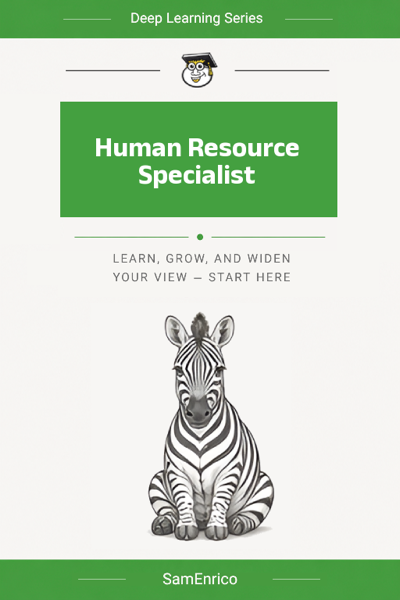
Non-FictionInformativeEducational
Human Resource Specialist eBook
A Coursebook on Human Resource Specialist
by Caro Kiyoko
A Coursebook on Human Resource Specialist
Formats
Free sample
Chapter 1: The Great Unlearning...–- Every year, thousands of well-intentioned professionals enter the field of human resources carrying a dangerous set of assumptions. They believe that HR is about being nice, about keeping everyone happy, about planning birthday parties and ordering catering for the holiday lunch. They believe that their value lies in how many employees call them “approachable” or “friendly.” They believe that the path to career success is memorizing the employee handbook and never making anyone uncomfortable. These beliefs are not merely wrong. They are professionally fatal.This chapter is called “The Great Unlearning” because before you can become an impact-driven human resource professional, you must actively strip away everything popular culture, bad managers, and outdated textbooks have taught you about this field.
You must unlearn the myth that HR is administrative support. You must unlearn the myth that your job is to protect the company from its employees. And most critically, you must unlearn the myth that being liked is more important than being effective.The HR professional who matters to the business is not the one who brings donuts on Friday. It is the one who can look the CEO in the eye and say, “Your management team is causing a retention crisis, and here is the data to prove it.” It is the one who can sit with a struggling manager and coach them through a difficult conversation without taking over. It is the one who understands that their job is not to carry the emotional weight of the organization but to build the systems, skills, and culture that allow others to carry it themselves.This book is not written for the HR professional who wants to stay comfortable.
It is written for the one who wants to be indispensable.The Origins of the Paper Pusher To understand why so many HR professionals remain trapped in administrative roles, we must first travel back in time. The function we now call human resources did not emerge from a vision of strategic partnership. It emerged from the grim, transactional needs of the industrial revolution.In the late nineteenth and early twentieth centuries, factories grew from small workshops to massive enterprises employing thousands of workers. Owners faced a problem they had never encountered before: how to track which workers showed up, how to record their hours, how to process payroll, and how to handle the constant stream of injuries, complaints, and disputes that arose from dangerous working conditions. The solution was the “personnel department,” a clerical function staffed mostly by women, whose job was to keep paper records and enforce rules.This origin story matters because it embedded a set of assumptions that persist to this day.
The personnel department was not invited to the strategy table. It was not asked for its opinion on product decisions or market expansion. It was told to file paperwork, investigate complaints when they became too loud to ignore, and make sure the company did not get sued into bankruptcy. Personnel was a cost center, a necessary evil, a place where companies parked administrative work they did not want line managers to waste their time on.The transformation from “personnel” to “human resources” began in the 1980s, driven by three forces. First, Japanese manufacturing companies demonstrated that actively engaging workers in quality improvement could produce dramatically better results than the adversarial, top-down American model.
Second, technology companies like Intel and Microsoft showed that in knowledge industries, the people were literally the only asset that mattered—the building, the furniture, the computers were all replaceable, but the engineers who wrote the code were not. Third, management thinkers like Dave Ulrich began publishing research that quantified what many had long suspected: companies that invested in their people consistently outperformed those that treated labor as a commodity.The term “human resources” was intended to signal a shift. These were not costs to be minimized. These were resources to be developed, deployed, and leveraged for competitive advantage. But old habits die hard, and many organizations simply rebranded their personnel departments without changing a single process.
The people who had been hired as clerks remained in place. The assumption that HR was administrative remained embedded in corporate culture. And to this day, the vast majority of HR professionals spend the majority of their time on tasks that could be automated or outsourced—tasks that add no strategic value whatsoever.The Four Myths That Keep You Stuck Before we can build a new model, we must systematically demolish the old one. Across hundreds of interviews and thousands of survey responses, four myths emerge as the primary barriers keeping HR professionals trapped in transactional roles.Myth One: HR is responsible for employee happiness.This is the most seductive and destructive myth in the field. It sounds noble.
It sounds caring. It sounds like exactly what a “people person” should believe. It is also completely wrong. HR is not responsible for employee happiness. HR is responsible for creating the conditions under which employees can do their best work.
Those are two different things.Happiness is an emotional state that depends on countless factors outside any employer’s control. An employee may be going through a divorce, struggling with a health issue, or worrying about a child’s struggles in school. No amount of wellness programs or flexible hours will make that employee happy. But that employee can still do excellent work if given clarity, autonomy, support, and fair compensation. The goal of HR is not to manufacture happiness.
The goal is to remove unnecessary friction, to ensure that the work environment does not actively make people miserable, and to equip managers with the skills to support their teams effectively.When HR believes it is responsible for happiness, it falls into a trap of overfunctioning. It starts planning social events that nobody asked for. It starts sending surveys asking “How happy are you?” and then panics when the scores drop. It starts treating every complaint as a crisis because any unhappy employee feels like a personal failure. This is not strategic.
This is codependency dressed up as corporate policy.Myth Two: The employee handbook is your most important tool.The employee handbook is not your most important tool. It is not even in the top ten. The employee handbook is a legal document designed to protect the organization from lawsuits. It has its place. But it is reactive, backward-looking, and fundamentally defensive.
It tells employees what they cannot do. It does not help them figure out what they should do.The most important tools in HR are not documents at all. They are skills: the ability to analyze data, to coach a manager through a difficult conversation, to design a process that reduces bias, to translate business goals into talent strategies. A professional who memorizes the handbook is replaceable. A professional who can reduce turnover in a critical department by improving manager behavior is indispensable.Myth Three: Protecting the company means protecting managers from accountability.This myth is the source of more organizational dysfunction than perhaps any other.
Many HR professionals, particularly those who came up through compliance-heavy roles, believe that their job is to protect the company from legal exposure.…
This is the end of the free sample. Get the eBook to keep going. Buy now
About this book
Details
- Author
- Caro Kiyoko
- Publisher
- SamEnrico
- Language
- English
- Genre
- Non-Fiction, Informative, Educational
- Released
- 2026-05-11
- Pages (approx.)
- 135
- Available as
- eBook, Audiobook

Read better in the ZLOADR app
Your eBooks on your phone or tablet. Sign in with your SamEnrico account and start reading.
More by Caro Kiyoko
 Paleo For Athletes Performance GuideCaro Kiyoko$11.99
 The Urban Walking MeditationCaro Kiyoko$11.99
 Flow For ArchitectsCaro Kiyoko$11.99
 Expedition Leader In Papua New GuineaCaro Kiyoko$11.99
 The Bitcoin Heist: How a Banker’s Bet Birthed a Financial RevolutionCaro Kiyoko$11.99
 How to Produce Camera Body Replacement Panels and DoorsCaro Kiyoko$11.99
 Return on Investment Calculation WorkbookCaro Kiyoko$12.99
 How to Start a After Shave Lotion Business (Beginners Guide)Caro Kiyoko$11.99
You may also like
 Hong Kong Handover 1997Dunn Johnnie$11.99
 Zumba For Postnatal Recovery CourseNeal Christian$11.99
 Zumba for BeginnersLadner Nikia$11.99
 YouTube Comment Mining GuideHumes Pandora$12.99
 Worry Box MeditationCarlin Rudy$11.99
 Workplace Stress MeditationNguyen Lynn$11.99
 Workplace Stress and Sleep RepairHawley Ivory$11.99
 Workplace Perfectionism CureDelaney Jeffry$11.99
 Workplace Injustice Anger GuideWallen Isabelle$11.99
 Work Addiction and Burnout LinkGreenwood Ester$11.99
 Women in Yoga and WellnessBeattie Galina$11.99
 Women in Stand Up ComedyChun Evangeline$11.99