
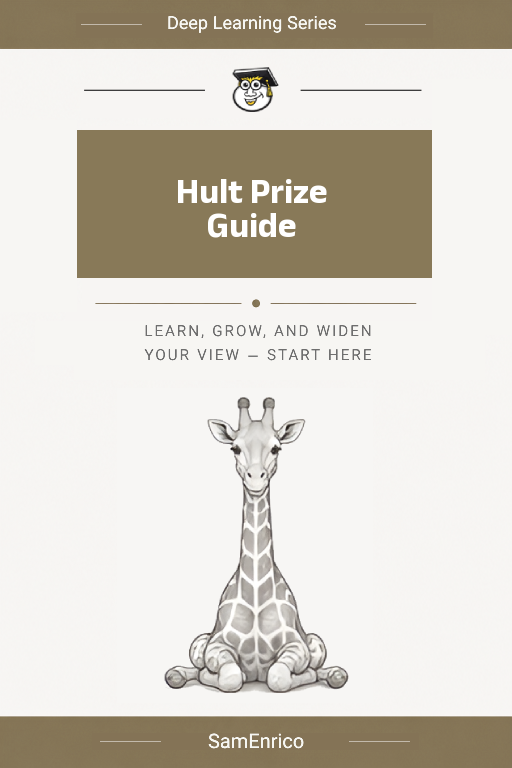
Non-FictionStartup GuideNon-Dilutive Grants
Hult Prize Guide eBook
Compete in Hult Prize for social enterprise startu
by Sosa Yelena
Compete in Hult Prize for social enterprise startups. 1M prize for student founders.
Formats
Free sample
Chapter 1: The $1M Illusion--–- Most people believe the Hult Prize is a business plan competition. They are wrong. It is actually a venture capital audition disguised as a contest, and the $1 million prize money is the least valuable thing you will win.If you are reading this book, you have likely seen the glossy marketing materials. You have watched the You Tube videos of past winners hugging on stage. You have imagined your own name called as confetti falls.
That vision is powerful, and it should be. But before you write a single word of your application, you need to understand what you are actually signing up for.The Hult Prize Foundation describes itself as the world's largest student competition for social enterprise startups. Every year, over 100,000 students from more than 2,000 universities submit ideas. They compete in five stages: on-campus rounds, regional summits, a digital incubator, a one-year accelerator, and finally, a live global finals event where six teams pitch for the $1 million prize. The numbers are staggering.
The pressure is immense. And the failure rate exceeds 99.9 percent.Yet thousands of students apply every single year. Why? Because the Hult Prize is not just a competition. It is a launchpad.
Alumni have gone on to raise hundreds of millions in venture capital. They have been featured on Forbes 30 Under 30. They have built companies that have touched millions of lives. The prize money, as transformative as it sounds, is often the smallest check they ever receive.But here is the secret that no one tells you at the information session: winning the Hult Prize has almost nothing to do with having a "good heart" or a "world-changing idea." The judging panel is not composed of social workers or nonprofit grant officers. They are venture capitalists, serial entrepreneurs, and impact investors.
They are looking for one thing above all else: bankability.Bankability is the quality of being worthy of investment. It means your idea can generate financial returns while creating measurable social impact. It means your team can execute. It means your market is real, your solution is scalable, and your business model is defensible. In other words, the Hult Prize is not asking you to save the world.
It is asking you to build a company that saves the world while making money.This chapter will tear down the myths surrounding the competition and rebuild your understanding from the ground up. You will learn exactly what the $1 million prize actually looks like when it arrives. You will understand the full ecosystem of support that comes with winning. You will see why the Hult Prize is fundamentally different from a case competition or a fellowship. And perhaps most importantly, you will discover why preparing for this competition will make you a better founder, regardless of whether you ever set foot on the finals stage.Let us begin with the most dangerous misconception of all.The Prize Is Not What You Think The headline is seductive: "Win $1,000,000 for your social enterprise." But the reality is more complex and, in many ways, more valuable than a single wire transfer.The 1millionprizeisstructuredastwocomponents.First,1 million prize is structured as two components.
First, 1millionprizeisstructuredastwocomponents.First,500,000 in cash. Second, 500,000inin−kindsupport.Thecashportionisnotdeliveredasalumpsumonthenightofyourvictory.Instead,itisdisbursedinmilestone−basedtranchesoveraperiodof12to18months.Youwillreceiveaninitialtrancheshortlyafterwinning,typicallybetween500,000 in in-kind support. The cash portion is not delivered as a lump sum on the night of your victory. Instead, it is disbursed in milestone-based tranches over a period of 12 to 18 months. You will receive an initial tranche shortly after winning, typically between 500,000inin−kindsupport.Thecashportionisnotdeliveredasalumpsumonthenightofyourvictory.Instead,itisdisbursedinmilestone−basedtranchesoveraperiodof12to18months.Youwillreceiveaninitialtrancheshortlyafterwinning,typicallybetween100,000 and $150,000.
Subsequent tranches are released as you meet specific operational and impact milestones agreed upon with the Hult Prize Foundation and their partner network.Why does this matter? Because it changes how you think about your post-win plan. Many winning teams assume they will have immediate access to the full $1 million. They budget for aggressive hiring, large-scale marketing campaigns, and rapid geographic expansion. Then they run out of money within six months because the next tranche was contingent on metrics they had not yet achieved.
The teams that succeed treat the prize as a series of funding rounds, not a single windfall.The in-kind portion of the prize is equally misunderstood. $500,000 in legal, accounting, cloud credits, and software subscriptions sounds impressive, but its value depends entirely on your ability to use it. For example, legal services credits might cover incorporation, intellectual property filings, and basic contracts. But if your startup needs specialized international tax advice or complex patent litigation, the credits will run out quickly. Cloud credits from providers like AWS or Google Cloud are generous, but they typically expire within 12 to 24 months.
You need a technical roadmap that can consume those credits before they vanish.The most valuable component of the prize is not cash or credits. It is admission to the one-year accelerator at Ashridge House in Hertfordshire, United Kingdom. Ashridge House is a sprawling Gothic revival mansion set on 190 acres of woodlands, about 40 miles north of London. It is not a coworking space or a university conference center. It is a dedicated leadership and innovation campus with private rooms, professional kitchens, meeting spaces, and a staff trained to support high-growth startups.During the accelerator year, your team will live and work at Ashridge House for multiple intensive sessions.
You will receive mentorship from entrepreneurs, venture capitalists, and corporate executives. You will participate in workshops on fundraising, product development, marketing, and impact measurement. You will be surrounded by the five other finalist teams, creating a peer environment that pushes everyone to improve. And you will have access to the Hult Prize Foundation's global network of alumni, judges, and corporate partners.Many winning founders have said that the accelerator was worth more than the cash prize. One past winner put it bluntly: "The $500,000 cash kept us alive for a year.
The accelerator network kept us alive for a decade."The Funnel: From 100,000 to 6To understand why preparation matters so much, you must understand the competition's structure as a funnel. Each year, the Hult Prize receives applications from over 100,000 students across more than 2,000 universities. These applications are submitted through the Hult Prize website during an open call period that typically runs from September to December.The first cut is brutal. From those 100,000 applications, approximately 10 to 15 percent advance to the on-campus or regional round. This means that 85 to 90 percent of all applicants are eliminated at the very first stage based on their written application alone.
No pitch. No video. No second chance. Just a few pages of text and a short abstract.From the remaining 10,000 to 15,000 teams, the competition narrows to approximately 300 to 500 teams that participate in regional summits held around the world. These summits are held in cities like Boston, London, Dubai, Shanghai, and Nairobi.
At each summit, teams pitch in front of judges, participate in workshops, and compete for a spot in the next round.The regional summits advance approximately 50 to 100 teams to the digital incubator. This is a virtual program lasting several weeks, during which teams refine their pitch decks, business models, and financial projections. They receive feedback from mentors and complete assignments designed to stress-test their assumptions.From the digital incubator, approximately…
This is the end of the free sample. Get the eBook to keep going. Buy now
About this book
Details
- Author
- Sosa Yelena
- Publisher
- SamEnrico
- Language
- English
- Genre
- Non-Fiction, Startup Guide, Non-Dilutive Grants
- Released
- 2026-06-01
- Pages (approx.)
- 148
- Available as
- eBook, Audiobook

Read better in the ZLOADR app
Your eBooks on your phone or tablet. Sign in with your SamEnrico account and start reading.
More by Sosa Yelena
 The Cortisol Circadian Rhythm GuideSosa Yelena$11.99
 Lonely Online Student GuideSosa Yelena$11.99
 The Diabetes Dementia LinkSosa Yelena$11.99
 Remote Lunch Break GuideSosa Yelena$11.99
 Empty Quarter Desert LeaderSosa Yelena$11.99
 The Rhythm of America: The Birth of Jazz in New OrleansSosa Yelena$11.99
 Learn to Play the CimbassoSosa Yelena$11.99
 How to Start a Carbon Black Business (Beginners Guide)Sosa Yelena$11.99
 EE for Self Employed GradsSosa Yelena$12.99
 Balsa HarvestingSosa Yelena$11.99
You may also like
 Hong Kong Handover 1997Dunn Johnnie$11.99
 Zumba For Postnatal Recovery CourseNeal Christian$11.99
 Zumba for BeginnersLadner Nikia$11.99
 YouTube Comment Mining GuideHumes Pandora$12.99
 Worry Box MeditationCarlin Rudy$11.99
 Workplace Stress MeditationNguyen Lynn$11.99
 Workplace Stress and Sleep RepairHawley Ivory$11.99
 Workplace Perfectionism CureDelaney Jeffry$11.99
 Workplace Injustice Anger GuideWallen Isabelle$11.99
 Work Addiction and Burnout LinkGreenwood Ester$11.99
 Women in Yoga and WellnessBeattie Galina$11.99
 Women in Stand Up ComedyChun Evangeline$11.99