
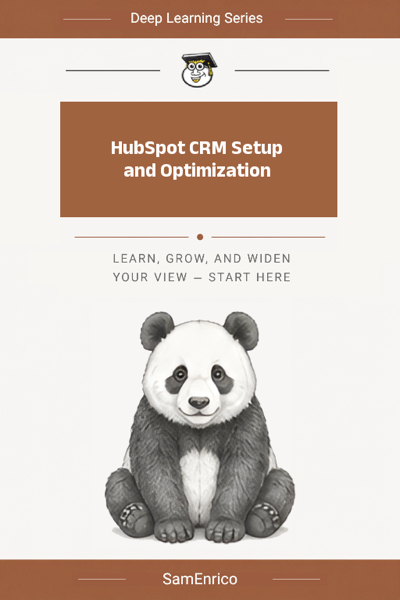
Non-FictionInformativeEducational
HubSpot CRM Setup and Optimization eBook
A Coursebook on HubSpot CRM Setup and Optimization
A Coursebook on HubSpot CRM Setup and Optimization
Formats
Free sample
Chapter 1: Beyond the Rolodex...--Every failed CRM implementation begins with the same innocent mistake. Someone in leadership decides the company needs “a single source of truth.” They purchase Hub Spot, or Salesforce, or whichever platform the consultant recommended. They spend weeks migrating data from spreadsheets, old CRMs, and sticky notes. They configure fields, build reports, and set permissions. Then they roll it out with a triumphant email announcing that “starting Monday, everything goes in the system.”And then nothing happens.
Nothing good, anyway.Sales reps find creative ways to enter fake activity data. Marketing continues using their own spreadsheets. Customer support keeps tickets in a shared inbox. Within ninety days, the shiny new CRM contains less accurate information than the chaotic mess it replaced. Within six months, leadership stops looking at the reports because they know the data is garbage.
Within a year, someone proposes buying a different CRM. The cycle repeats.If this story makes you uncomfortable, good. That discomfort is the first step toward a different outcome.Here is the truth that software vendors will never tell you: a CRM does not create trust. It reveals trust. Or, more often, it reveals the absence of trust.
When your team avoids the system, games the system, or ignores the system, they are not being lazy or rebellious. They are responding rationally to a system that has not earned their trust.This book is not about buttons and fields. It is not about workflows and automation. It is not about dashboards and reports. Those things matter, and we will spend hundreds of pages on them.
But they matter only as means to an end. The end is a system that your team actually wants to use. A system that makes them faster, not slower. A system that surfaces opportunity instead of burying it in administrative overhead.Welcome to The Growth Engine: A Coursebook on Hub Spot CRM Setup and Optimization. This is not a reference manual.
It is a transformation guide. By the time you finish these twelve chapters, you will have built a CRM that your team will fight to use—not because you forced them, but because it makes their work easier and their results better.The System of Record Trap To understand why most CRMs fail, we need to understand how most leaders think about them. Ask any executive what a CRM is for, and they will likely say something like “it’s where we keep all our customer information.” This seems reasonable. Of course you need a central database for customer data. But this seemingly innocent definition contains the seed of failure.Think about what happens when you define a CRM as a system of record—a place to store information.
You are telling your team that their primary job, as far as the CRM is concerned, is data entry. Every call needs to be logged. Every email needs to be tracked. Every field needs to be filled. The CRM becomes a tax on their time, not a tool for their success.
They will comply only as much as necessary to avoid punishment. They will never embrace the system.Now consider an alternative definition. What if a CRM were a system of action—a platform that triggers the next right step at exactly the right moment? What if, instead of asking your team to enter data, the CRM delivered intelligence? What if it told each rep exactly which lead to call next, what to say, and what follow-up to schedule?This is not science fiction.
This is what Hub Spot was designed to do. But you cannot get there by focusing on data storage. You can only get there by focusing on process, automation, and—above all—your team’s success.Let me give you a concrete example. In a system of record, when a lead fills out a form, the data sits in the database until someone remembers to check. Maybe a manager runs a report the next day and assigns the lead.
Maybe the rep calls two days later. By then, the lead has already engaged with three competitors.In a system of action, that same form submission triggers an immediate cascade. The lead routes to the correct owner based on territory, industry, or round-robin logic. The rep receives a mobile notification. An automated email goes out immediately, acknowledging the submission and setting expectations.
A task appears on the rep’s calendar to call within one hour. If the rep does not complete that task, a manager gets an alert. If the lead opens the automated email, the rep gets another alert. If the lead visits the pricing page, the deal priority updates in real time.The difference is not magic. It is simply automation applied to a well-designed process.
But that difference transforms how your team experiences the CRM. Instead of a burden, it becomes a competitive advantage.The Inbound Foundation Before we touch a single setting in Hub Spot, we need to understand the philosophy that drives the platform’s design. Hub Spot was not created as a generic CRM. It was built to operationalize a specific methodology called inbound.Inbound inverts the traditional outbound approach. Outbound is interruptive—it buys attention through cold calls, mass emails, and display ads.
Inbound is attractive—it earns attention through helpful content, solving problems before asking for the sale, and meeting customers where they already are. Outbound assumes that the seller’s job is to push messages into the marketplace. Inbound assumes that the seller’s job is to pull customers in through value.Consider how these philosophies play out in daily work. An outbound sales development representative might spend their day dialing one hundred random numbers from a purchased list, delivering the same script to everyone who answers, and celebrating if one person agrees to a meeting. An inbound SDR spends their day reviewing which leads have downloaded white papers, attended webinars, or visited pricing pages, then reaching out with personalized context: “I saw you spent ten minutes on our case study about supply chain optimization.
Are you facing similar challenges with inventory forecasting?”Which approach creates better relationships? Which one yields higher close rates? Which one does your customers prefer?Hub Spot’s objects, properties, workflows, and reporting tools all assume that you are using an inbound methodology. If you try to force outbound processes into Hub Spot, you will fight the platform at every turn. If you embrace inbound, the platform will feel like it was built for you—because it was.The Four Hubs and the Shared Database Most people think of Hub Spot as one product.
In reality, it is an ecosystem of interconnected hubs, each designed for a specific function. Understanding how these hubs relate is essential for correct setup.The Marketing Hub is where strangers become visitors and visitors become leads. It handles email campaigns, landing pages, forms, blog posts, social media scheduling, and lead nurturing workflows. When someone fills out a form on your website, the Marketing Hub creates a contact record and captures the source of that lead.The Sales Hub is where leads become customers. It manages deals, pipelines, quotes, sequences, meeting scheduling, and sales analytics.…
This is the end of the free sample. Get the eBook to keep going. Buy now
About this book
Details
- Author
- Thomson Margit
- Publisher
- SamEnrico
- Language
- English
- Genre
- Non-Fiction, Informative, Educational
- Released
- 2026-05-11
- Pages (approx.)
- 123
- Available as
- eBook, Audiobook

Read better in the ZLOADR app
Your eBooks on your phone or tablet. Sign in with your SamEnrico account and start reading.
More by Thomson Margit
 Kunwar Singh LeadershipThomson Margit$11.99
 The Assertiveness for New ManagersThomson Margit$11.99
 Arthur Rock FairchildThomson Margit$11.99
 Persuasive Sustainability PlanThomson Margit$11.99
 Diosmin Hemorrhoid GuideThomson Margit$11.99
 The Playful Parent Anger AntidoteThomson Margit$11.99
 Rhodesia Unilateral DeclarationThomson Margit$11.99
 Emotion Success StoriesThomson Margit$11.99
 Intuitive Eating Body TrustThomson Margit$11.99
 Wings Over the Arctic: The Arctic Tern's Epic 44,000-Mile JourneyThomson Margit$11.99
 The Timbuktu Tandem: A Love Story Written in NumbersThomson Margit$11.99
 The Colossal Builders: Olmec Engineering and the Birth of Mesoamerican MarvelsThomson Margit$11.99
You may also like
 Hong Kong Handover 1997Dunn Johnnie$11.99
 Zumba For Postnatal Recovery CourseNeal Christian$11.99
 Zumba for BeginnersLadner Nikia$11.99
 YouTube Comment Mining GuideHumes Pandora$12.99
 Worry Box MeditationCarlin Rudy$11.99
 Workplace Stress MeditationNguyen Lynn$11.99
 Workplace Stress and Sleep RepairHawley Ivory$11.99
 Workplace Perfectionism CureDelaney Jeffry$11.99
 Workplace Injustice Anger GuideWallen Isabelle$11.99
 Work Addiction and Burnout LinkGreenwood Ester$11.99
 Women in Yoga and WellnessBeattie Galina$11.99
 Women in Stand Up ComedyChun Evangeline$11.99