
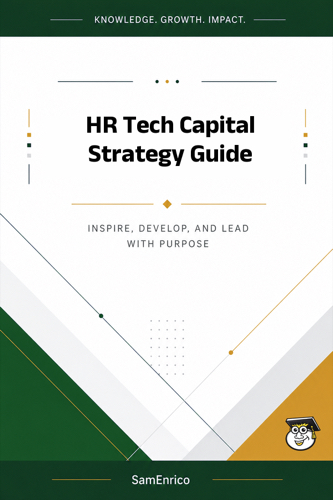
Non-FictionForecast & OutlookHuman Resources Tech
HR Tech Capital Strategy Guide
Directs to talent acquisition platforms, performan
Directs to talent acquisition platforms, performance management, and payroll AI.
Formats
About this book
Free sample
Chapter 1: The Capital Trap--–- For most of corporate history, the chief financial officer has looked at the human resources department the same way a ship captain looks at the gift shop on the promenade deck. Nice to have. Occasionally useful. Absolutely not mission-critical. When CFOs thought about capital, they envisioned factories, server racks, patents, and oil rigs.
They did not envision job descriptions, performance reviews, or payroll runs. But something strange began happening between 2020 and 2026. The same CFOs who once dismissed HR as a cost center started approving eight-figure budgets for AI recruitment engines. They began demanding quarterly reviews of "human capital efficiency ratios." They asked their CHROs to present talent technology ROIs alongside supply chain automation proposals. What changed?
The simple answer is artificial intelligence. The real answer is that AI transformed human capital from an opaque expense into a quantifiable, optimizable, and tradable asset class. This chapter explains how that transformation happened, why most companies are still trapped in outdated thinking, and how the Talent Capital Asset Pricing Model (TCAPM) finally gives HR leaders the language and math to compete for capital against any other business function.The Historical Mistake: Treating People as an Operating Expense Every accounting textbook divides corporate spending into two buckets. Operating expenses are consumed in the current period – electricity, office supplies, marketing campaigns. Capital expenditures are investments that produce value over multiple years – a new factory, a software platform, a patent.
For generations, companies treated nearly everything related to employees as an operating expense. Salaries were Op Ex. Recruiting fees were Op Ex. Training programs were Op Ex. Even HR technology, when it was approved at all, was justified as a necessary cost of doing business, not as an asset that would appreciate in value.This classification was never logical.
When a company spends $50,000 to recruit and train a software engineer, that engineer produces code for five or six years. That is not an expense consumed in one quarter; it is a multi-year asset. When the same company spends $200,000 on an AI performance management system that improves productivity across 500…
This is the end of the free sample. Get the eBook to keep going. Buy now
Contents
- Chapter 1
- Chapter 2
- Chapter 3
- Chapter 4
- Chapter 5
- Chapter 6
- Chapter 7
- Chapter 8
- Chapter 9
- Chapter 10
- Chapter 11
- Chapter 12
Details
- Author
- Parsons Joshua
- Publisher
- SamEnrico
- Language
- English
- Genre
- Non-Fiction, Forecast & Outlook, Human Resources Tech
- Released
- 2026-06-06
- Pages (approx.)
- 159
- Available as
- eBook, Audiobook

Read better in the ZLOADR app
Your eBooks on your phone or tablet. Sign in with your SamEnrico account and start reading.
More by Parsons Joshua
 Remote Review for AI TeamsParsons Joshua$11.99
 Peg System for BirthdaysParsons Joshua$11.99
 Medical Patient Nonverbal GuideParsons Joshua$11.99
 Grief and Loss TriggersParsons Joshua$11.99
 The Opium Wars of the Warring States: China's First Drug Cartel BattlesParsons Joshua$11.99
 How to Start a Painting and Wall Covering Contractor BusinessParsons Joshua$11.99
 Glassblower (demonstration)Parsons Joshua$11.99
 LinkedIn Endorsements for MentorsParsons Joshua$12.99
 Lobbying and Political Spending GuideParsons Joshua$12.99
 Understanding Paris-trousseau ThrombopeniaParsons Joshua$17.99
You may also like
 Hong Kong Handover 1997Dunn Johnnie$11.99
 Zumba For Postnatal Recovery CourseNeal Christian$11.99
 Zumba for BeginnersLadner Nikia$11.99
 YouTube Comment Mining GuideHumes Pandora$12.99
 Worry Box MeditationCarlin Rudy$11.99
 Workplace Stress MeditationNguyen Lynn$11.99
 Workplace Stress and Sleep RepairHawley Ivory$11.99
 Workplace Perfectionism CureDelaney Jeffry$11.99
 Workplace Injustice Anger GuideWallen Isabelle$11.99
 Work Addiction and Burnout LinkGreenwood Ester$11.99
 Women in Yoga and WellnessBeattie Galina$11.99
 Women in Stand Up ComedyChun Evangeline$11.99