
Non-FictionInformativeEducational
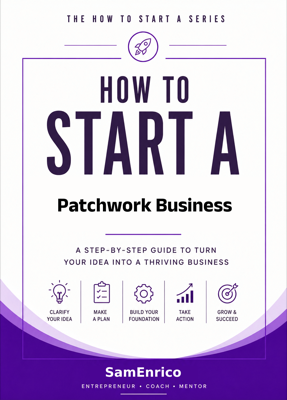
How to Start a Patchwork Business eBook
How to Start a Patchwork Business
by Weber Debbie
How to Start a Patchwork Business
Formats
Free sample
Chapter 1: Beyond the Stitch…--– The first time someone offers you money for something you made with your own hands, two opposing voices will fight for control of your future. The first voice says, “I could never charge for this. It’s just a hobby. It’s not professional work.” The second voice, quieter but more honest, whispers, “You spent forty hours on this quilt. The materials cost eighty dollars.
Someone is willing to pay three hundred. That means something.”Which voice wins will determine everything about your patchwork business before you cut a single piece of fabric.I have watched hundreds of quilters and patchwork artists begin this journey. The ones who succeed are not necessarily the most talented sewists. They are not the ones with the fanciest longarm machines or the largest fabric stashes. The ones who succeed are the ones who learn to silence the first voice and amplify the second.
They learn to treat their craft as a business, not as a guilty pleasure. They learn that loving to sew is beautiful, but loving to sew is not a business plan.This chapter is about that transformation. It is about moving from what I call the “Busy Crafter” mindset to the “Profitable Entrepreneur” mindset. It is about understanding why most patchwork businesses never make more than pocket money, and why a small handful grow into sustainable, life-changing enterprises. And it begins with a story that should give every reader hope: the story of two Stanford graduates who knew nothing about sewing, yet built a patchwork clothing brand that sold out in thirty seconds and generated an eight-thousand-person waitlist.The Myth of the Natural Entrepreneur Before we dive into the Oddli story, we need to clear away a dangerous myth.
The myth is this: successful business owners are born with some special gene. They are naturally confident about pricing. They never feel imposter syndrome. They wake up each morning excited to do spreadsheets.This is nonsense.Every successful patchwork entrepreneur I have ever met started exactly where you are right now. They felt foolish asking for money.
They worried their work was not good enough. They gave away their first several projects to friends and family because charging felt rude. The difference is not that they lacked fear. The difference is that they acted despite the fear.Consider Sarah Locascio of Caravan Quilts. Before she became known for selling quilts for over a thousand dollars each, she was a teacher who sewed in her spare time.
She was terrified to list her first quilt. She priced it at what felt like an outrageous amount—and it sold within hours. That moment changed her. She realized that her fear was not a signal that she was doing something wrong. It was a signal that she was finally doing something right.The same pattern appears again and again.
Fear of pricing too high. Fear of being seen as a “real” business. Fear of investing in supplies. Fear of failure. Fear of success.
These fears are normal. They are not obstacles to overcome before you start. They are the terrain you walk through as you start.The Oddli Phenomenon: What Ten Pieces of Clothing Can Teach Us In 2020, two Stanford University graduates named Ivy and Julianna launched a brand called Oddli. Neither of them had professional sewing experience. Neither had run a fashion brand before.
What they had was an idea: patchwork clothing made from deadstock fabrics, sold in extremely limited quantities, marketed through storytelling and scarcity.Their first launch consisted of exactly ten hand-sewn pieces. Ten. Not one hundred. Not fifty. Ten.Those ten pieces sold out in thirty seconds.Thirty seconds.Eight thousand people joined the waitlist for the next drop.Let me pause here because this number—eight thousand—is almost impossible to believe for most crafters who struggle to get twenty people to look at their Etsy shop.
Eight thousand people voluntarily gave their email addresses to wait for a chance to buy patchwork clothing from two beginners who had no track record. How?The answer is not complicated, but it is counterintuitive. Oddli succeeded because they did not try to sell to everyone. They sold to a specific kind of person: someone who values handmade, scarcity, and storytelling. They did not list their ten pieces passively and hope for the best.
They built anticipation. They teased the launch for weeks. They told the story behind each piece—where the fabric came from, why they chose certain color combinations, the hours of hand-stitching involved. They created a narrative that made each piece feel like an event, not a product.And crucially, they did not apologize for having only ten pieces. They turned their small quantity into a feature, not a bug.
Limited supply created urgency. Urgency created demand. Demand created a waitlist. The waitlist became their most valuable marketing asset for the next launch.For our purposes, the Oddli story contains three essential lessons for every patchwork business, whether you are making baby quilts, art quilts, or patchwork tote bags.First, you do not need to be an expert sewist to start. Oddli’s early pieces were handmade in the literal sense—they were not perfect.
But imperfection, when framed honestly, can be part of the charm. Customers buying handmade are not expecting factory precision. They are expecting human touch.Second, scarcity is not a problem to solve. It is a strategy to use. Most crafters believe that the path to success is making more inventory.
They spend months sewing fifty quilts, list them all at once, and then watch them sit unsold for a year. Oddli did the opposite. They made almost nothing, sold it instantly, and created a frenzy. The lesson is brutal but true: making more does not create demand. Creating demand makes your making valuable.Third, storytelling is not optional.
It is the engine of your entire business. Oddli did not just post photos of clothing. They posted videos of fabric sourcing. They explained why deadstock matters. They showed their sewing mistakes.
They invited customers into the process. That invitation turned buyers into fans, and fans into repeat customers.The Busy Crafter vs. The Profitable Entrepreneur Let me introduce a framework that will appear throughout this book. It is the distinction between the Busy Crafter and the Profitable Entrepreneur. You might recognize yourself in one of these descriptions, or you might see elements of both.
The goal is not to shame the Busy Crafter. The goal is to help you see which habits are serving you and which are holding you back.The Busy Crafter is always sewing. They finish a quilt on Tuesday and start another on Wednesday. Their fabric stash grows faster than their finished inventory. They say yes to every request from friends and family, often for free or at material cost.
They post photos of finished work on social media but rarely track which posts lead to sales. They feel exhausted but not productive. They measure their success by how much they made, not by how much they earned.The Profitable Entrepreneur also sews often, but they sew with intention. They track their time. They know exactly how many…
This is the end of the free sample. Get the eBook to keep going. Buy now
About this book
Details
- Author
- Weber Debbie
- Publisher
- SamEnrico
- Language
- English
- ISBN
- 9781506055312
- Genre
- Non-Fiction, Informative, Educational
- Released
- 2026-05-06
- Pages (approx.)
- 132
- Available as
- eBook, Paperback, Audiobook

Read better in the ZLOADR app
Your eBooks on your phone or tablet. Sign in with your SamEnrico account and start reading.
More by Weber Debbie
 Breath Awareness For Weight LossWeber Debbie$11.99
 Yoga Based Stretching RoutineWeber Debbie$11.99
 Franchise Builder's Teen Hiring SuccessWeber Debbie$11.99
 Weekly Wins ReviewWeber Debbie$11.99
 The Great American Heist: How the U.S. Government Stole $400 Million in Gold from the PhilippinesWeber Debbie$11.99
 The Djinn’s Bargain: A Thousand and One Nights’ Unseen TaleWeber Debbie$11.99
 Information Security AdministratorWeber Debbie$11.99
 Understanding Hypertrophic HemangiectasiaWeber Debbie$17.99
 Medical Billing And Coding PrimerWeber Debbie$12.99
 AI Clinical Documentation GuideWeber Debbie$12.99
You may also like
 Hong Kong Handover 1997Dunn Johnnie$11.99
 Zumba For Postnatal Recovery CourseNeal Christian$11.99
 Zumba for BeginnersLadner Nikia$11.99
 YouTube Comment Mining GuideHumes Pandora$12.99
 Worry Box MeditationCarlin Rudy$11.99
 Workplace Stress MeditationNguyen Lynn$11.99
 Workplace Stress and Sleep RepairHawley Ivory$11.99
 Workplace Perfectionism CureDelaney Jeffry$11.99
 Workplace Injustice Anger GuideWallen Isabelle$11.99
 Work Addiction and Burnout LinkGreenwood Ester$11.99
 Women in Yoga and WellnessBeattie Galina$11.99
 Women in Stand Up ComedyChun Evangeline$11.99