
Non-FictionInformativeEducational
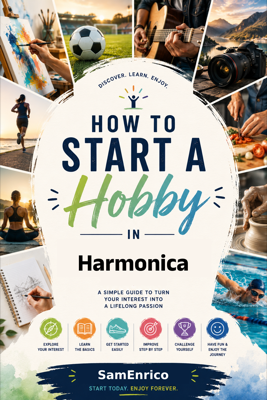
How to Start a Hobby in Harmonica eBook
How to Start a Hobby in Harmonica
by Mendez Sarah
How to Start a Hobby in Harmonica
Formats
Free sample
Chapter 1: The Pocket-Sized Revolution--–- The first time I saw a grown man cry over a harmonica, I was standing in a dimly lit blues club on the south side of Chicago. The musician was a grizzled sixty-year-old named Big Ray, and he wasn't crying from sadness. He was crying because, halfway through a slow, aching rendition of “Help Me,” he bent a note on his Hohner Special 20 so deeply, so perfectly, that the sound seemed to reach into his own chest and pull out something he hadn't known was there. The audience of forty-seven people sat in absolute silence. When he finished, a woman in the front row whispered, “That thing is the size of a candy bar.
How did it do that?”That question—how does such a small instrument produce such a massive emotional response?—is the reason you're holding this book. The harmonica is, by any objective measure, ridiculous. It fits in a jeans pocket. It costs less than a dinner for two at a mediocre restaurant. It has no keys, no strings, no buttons (unless you count the chromatic, which we'll get to later).
And yet, this tiny rectangle of metal, wood, and brass has been used to soundtrack the Great Depression, the Civil Rights movement, the folk revival of the 1960s, and every back-porch blues jam from Mississippi to Montana.This chapter is not about technique. You will not play a single note in the next twenty pages. Instead, this chapter is about something far more important: why you are about to embark on this journey, what makes the harmonica unique among all musical instruments, and how a $40 purchase can change the way you breathe, think, and connect with other human beings. By the time you finish this chapter, you will have a clear personal goal, a playlist of essential listening, and a burning desire to turn the page.The Toy Myth: Why Everything You Think You Know Is Wrong Let us begin with an exorcism. We need to banish a ghost that haunts every aspiring harmonica player: the persistent, unhelpful, deeply unfair perception that the harmonica is a toy.You have seen them.
They hang on keychains at gas station counters. They come in four-packs at drugstores, wrapped in plastic with names like “Blues Band” or “American Ace.” They are often gold-plated (badly) or painted with American flags. They cost $4.99. They are manufactured in factories that have never heard of quality control. And they have one purpose: to frustrate beginners into quitting before they start.Here is the truth that the toy industry does not want you to know.
A real harmonica—a Hohner Special 20, a Lee Oskar, a Seydel Session Steel—shares almost nothing with those trinkets except the basic shape. A real harmonica has precision-milled brass reeds that are tuned to within five cents of perfect pitch. It has an airtight comb (the middle section) that allows you to bend notes and control dynamics. It has reed plates that are screwed, not nailed, so they can be replaced or adjusted. It is a genuine musical instrument, designed by engineers and tested by professional musicians.The difference between a $5 toy and a $45 instrument is not forty dollars.
It is the difference between failure and success. I have taught hundreds of beginners over the years, and I have never—not once—seen someone learn to play on a toy harmonica. The toy leaks air, so you cannot play clean single notes. The reeds are misaligned, so you cannot bend. The tuning is approximate, so even when you think you are playing correctly, you sound out of tune.
The inevitable conclusion is not “this harmonica is garbage.” It is “I am garbage at harmonica.” And then you quit.So let us make a pact, you and I. You will ignore every harmonica that costs less than $40. You will ignore the ones with cartoon characters, the ones that come in blister packs, the ones marketed as “beginner toys.” You will go to a real music store or a reputable online retailer (Sweetwater, Musician's Friend, Rockin' Ron's) and you will buy one of the three models I recommend in Chapter 2. In return, I promise you that your harmonica will not be the barrier to your success. You will be the barrier, at first—your untrained lips, your shallow breathing, your impatient fingers.
But those barriers are temporary. A bad harmonica is permanent.The Harmonica Paradox: Small Size, Massive Impact Now that we have cleared the underbrush of misconception, let us appreciate the sheer improbability of the harmonica. It is, in many ways, the most democratic instrument ever invented.Consider the guitar. A decent beginner guitar costs $200-$300. It is the size of a small child.
It requires regular tuning, string changes, and a case to protect it from humidity. You cannot play it while walking down the street without looking like you are about to busk. You cannot slip it into your pocket and forget about it until a moment of inspiration strikes.Consider the piano. A beginner digital piano costs $500-$1000. It is heavy, it requires a stand, it needs electricity or batteries.
It is an anchor. You do not bring a piano to a party. You do not take a piano camping. You do not pull a piano out of your jacket to play a lullaby for a crying child on an airplane.The harmonica has none of these limitations. It weighs less than four ounces.
It requires no tuning (diatonic harmonicas are fixed-pitch instruments). It never needs new strings. It is virtually indestructible if you follow the simple maintenance rules in Chapter 11. You can play it in a car, on a mountaintop, in a hospital waiting room, at a protest march, on a fishing boat, in a jail cell (as many blues musicians have done), or on the moon (assuming you have air to blow).But the paradox is this: the harmonica's small size does not limit its emotional range. If anything, it amplifies it.
There is something about watching a musician put their entire mouth on a tiny metal box and produce a sound that feels like it comes from the marrow of their bones. The harmonica is intimate. It requires you to breathe into it—to share your breath, the most basic biological signal of life, with the instrument and with your listeners. You cannot hide behind a harmonica. You cannot pluck a string and look away.
When you play the harmonica, you are putting your lungs, your lips, your tongue, and your soul directly into the sound.This is why the harmonica has been the instrument of choice for so many outsiders, underdogs, and revolutionaries. The blues musicians of the Mississippi Delta played harmonicas because they were cheap and portable. The folk singers of the 1960s played harmonicas because they could be strapped around the neck while playing guitar, turning one person into a one-band army. The punk rockers of the 1970s played harmonicas because they were anarchic and loud. The street buskers of every era play harmonicas because they cut through traffic noise and stop pedestrians in their tracks.A Brief History of the Pocket-Sized Revolution To truly understand why the…
This is the end of the free sample. Get the eBook to keep going. Buy now
About this book
Details
- Author
- Mendez Sarah
- Publisher
- SamEnrico
- Language
- English
- ISBN
- 9781506117287
- Genre
- Non-Fiction, Informative, Educational
- Released
- 2026-06-02
- Pages (approx.)
- 131
- Available as
- eBook, Paperback, Audiobook

Read better in the ZLOADR app
Your eBooks on your phone or tablet. Sign in with your SamEnrico account and start reading.
More by Mendez Sarah
 Metta For The EnvironmentMendez Sarah$11.99
 Meditation for Anniversary AnxietyMendez Sarah$11.99
 Digital Stress Relationship BoundariesMendez Sarah$11.99
 Polysubstance Abuse HelpMendez Sarah$11.99
 The Dominic System GuideMendez Sarah$11.99
 Self Worth For Sensitive KidsMendez Sarah$11.99
 Exam Week Survival PlanMendez Sarah$11.99
 Loci Station SelectionMendez Sarah$11.99
 Southeast Talent GrowthMendez Sarah$11.99
 The Last Broadcast: The Mysterious Case of Orson Welles and the War of the Worlds PanicMendez Sarah$11.99
 Orpheus: The Song That Defied DeathMendez Sarah$11.99
 The AI Revolution: When Machines Outsmarted HumanityMendez Sarah$11.99
You may also like
 Hong Kong Handover 1997Dunn Johnnie$11.99
 Zumba For Postnatal Recovery CourseNeal Christian$11.99
 Zumba for BeginnersLadner Nikia$11.99
 YouTube Comment Mining GuideHumes Pandora$12.99
 Worry Box MeditationCarlin Rudy$11.99
 Workplace Stress MeditationNguyen Lynn$11.99
 Workplace Stress and Sleep RepairHawley Ivory$11.99
 Workplace Perfectionism CureDelaney Jeffry$11.99
 Workplace Injustice Anger GuideWallen Isabelle$11.99
 Work Addiction and Burnout LinkGreenwood Ester$11.99
 Women in Yoga and WellnessBeattie Galina$11.99
 Women in Stand Up ComedyChun Evangeline$11.99