
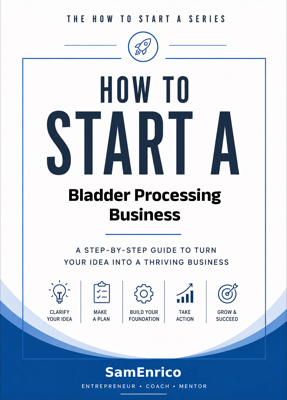
How to Start a Bladder Processing Business (Beginners Guide) eBook
How to Start a Bladder Processing Business (Beginn
How to Start a Bladder Processing Business (Beginners Guide)
Formats
Free sample
Chapter 1: The Million-Dollar Stench--–- The smell hit me before I saw anything. It was a thick, humid wall of ammonia and decay that clung to my clothes for three days. I was standing behind a small slaughterhouse in rural Iowa, watching a worker hose down viscera—including thirty-seven pristine animal bladders—into a drainage pit that fed directly into the local rendering truck. When I asked the owner what he paid to dispose of those bladders, he shrugged and said, “About four hundred dollars a month to the renderer. Why would I care?” When I told him that those same thirty-seven bladders, properly processed, could generate over two thousand dollars in monthly revenue, he looked at me like I had suggested farming unicorns on the moon.That moment changed everything.
Not because I was particularly brilliant or visionary. I was neither. It changed because I finally understood the single greatest secret of the circular economy: value is not in what something is. Value is in what something can become. The owner of that slaughterhouse saw bladders as a disposal problem because that is what everyone had always told him they were.
I saw them as a supply of collagen, protein, and pet chew原材料 because I had spent six months reading every book I could find on waste valorization, industrial ecology, and the hidden economy of offal.This book is not about waste. This book is about the fortune hiding inside the things everyone else pays to throw away. And there is no better place to start than the humble, overlooked, thoroughly misunderstood, and remarkably profitable animal bladder.Welcome to the million-dollar stench.The Mental Shift That Separates Winners from Landfills Every successful business in the history of waste valorization began with the same mental leap. Not a technological breakthrough. Not a billion dollars in venture capital.
A leap in perception.Consider the founders of Wasted, a Dutch company that turns human urine into fertilizer. They did not see a public health problem or a sewage treatment challenge. They saw a nutrient stream. Consider the founders of REPLOID, a South African company that feeds organic waste to Black Soldier Fly larvae. They did not see a disposal crisis.
They saw a protein supply chain. Consider the founders of Darling Ingredients, now a multibillion-dollar conglomerate that processes animal byproducts into fats, proteins, and fuels. They started with a single rendering truck and a simple insight: what the meat industry throws away, the chemical industry will buy.You, right now, staring at the idea of processing bladders, must make the same shift.Stop seeing bladders as offal. Stop seeing urine as waste. Stop seeing viscera as a nuisance.
Start seeing them as raw material—unprocessed, undervalued, and waiting for someone with the courage to look past the stench.This is not a semantic trick. It is the foundation of your entire business model. The vast majority of slaughterhouses, rabbit farms, and meat processors currently pay good money—often hundreds or thousands of dollars per month—to have bladders and urine hauled away. They view these materials as a liability. Something that attracts flies.
Something that generates odors. Something that invites regulatory scrutiny. Something that costs them money every single day.You are going to view these same materials as an asset. And because you view them differently, you will get paid twice: once to take the “problem” away from the supplier, and again to sell the solution to a customer.Before we go any further, let me be brutally honest about what this business is and is not. This book covers three distinct processing tracks, and you must choose one before you spend a single dollar.
The first track is animal bladder tissue processing—taking physical bladders from slaughtered animals and turning them into dried pet chews, collagen powder for cosmetics, or medical-grade scaffolds for research hospitals. The second track is urine processing—collecting liquid urine from rabbits, livestock, or municipal sources and stabilizing it into organic fertilizer that sells for premium prices to organic farms. The third track is mixed offal processing—using anaerobic digestion to turn bladders and other organs into biogas for heat or electricity, plus liquid fertilizer as a byproduct.Each track has different equipment requirements, different customers, different profit margins, and different tolerances for what I call the “tipping fee” model—getting paid to take waste away. Throughout this chapter and the rest of the book, I will signal which track each piece of advice applies to. If you try to do all three at once, you will fail.
I have watched dozens of aspiring entrepreneurs make this mistake. They buy a hydrolysis tank for collagen extraction, a bioreactor for urine stabilization, and an anaerobic digester for biogas—all at the same time. They run out of money before they process a single bladder. Pick one track. Master it.
Then consider expansion into adjacent tracks.But no matter which track you choose, the starting point is the same. You must train your brain to see value where everyone else sees garbage. You must learn to smell money.Why Bladders Are Currently the Most Undervalued Asset in Agriculture Let me give you a specific, concrete example. A single beef bladder weighs approximately two hundred to three hundred grams when fresh. It is composed primarily of collagen—the same protein that cosmetic companies pay hundreds of dollars per kilogram for in purified form.
It also contains elastin, glycosaminoglycans, and a complex three-dimensional matrix of connective tissue that medical researchers are increasingly interested in for urinary tract reconstruction, wound healing, and even bladder augmentation surgeries for spina bifida patients.Yet today, the vast majority of beef bladders in the United States are either rendered into low-value fat and protein meal (selling for pennies per pound) or sent directly to landfill (costing the slaughterhouse money). Why? Because slaughterhouses are optimized for meat production. They have high-efficiency lines for cutting steaks, grinding hamburger, and packaging roasts. They have trained butchers who can break down a carcass in minutes.
They do not have the equipment, the permits, or the trained labor to process bladders into high-value products. Nor do they want to. Their profit margins come from volume—processing hundreds of animals per hour—not from extracting every last molecule of value from each individual organ.This is your opportunity.The same dynamic applies to urine. A single adult rabbit produces approximately two liters of urine per week. That urine contains nitrogen, phosphorus, and potassium—the three macronutrients that form the backbone of the global fertilizer industry.
A one-thousand-rabbit farm generates over one hundred thousand liters of urine annually. Most farmers currently dump this urine into evaporation pits (which smell terrible and attract flies) or pay to have it trucked away to a wastewater treatment plant (which costs money). Some even treat it as a hazardous waste because of its ammonia content.But stabilized urine, properly processed, is liquid gold. Organic farmers pay premium prices for biological nitrogen sources because synthetic fertilizers are prohibited under USDA Organic certification rules. A single liter of stabilized rabbit urine can sell for five to ten dollars wholesale.
That same liter, if left untreated, costs the farmer money to discard. The gap between what something costs to throw…
This is the end of the free sample. Get the eBook to keep going. Buy now
About this book
Details
- Author
- Dickey Kristan
- Publisher
- SamEnrico
- Language
- English
- ISBN
- 9781505985405
- Genre
- Non-Fiction, Informative, Educational
- Released
- 2026-04-26
- Pages (approx.)
- 140
- Available as
- eBook, Paperback, Audiobook

Read better in the ZLOADR app
Your eBooks on your phone or tablet. Sign in with your SamEnrico account and start reading.
More by Dickey Kristan
 Remote Work Zone TransferDickey Kristan$11.99
 The Fitness Comparison TrapDickey Kristan$11.99
 Bundling Economics BriefDickey Kristan$11.99
 Gambling Addiction for PilotsDickey Kristan$11.99
 The Last Supper of the Condemned: Death Row in 19th-Century Latin AmericaDickey Kristan$11.99
 Technical Writing for Non Tech WritersDickey Kristan$12.99
 Learn to Play the Sopranino MandolinDickey Kristan$11.99
 Operations Admin AssistantDickey Kristan$11.99