
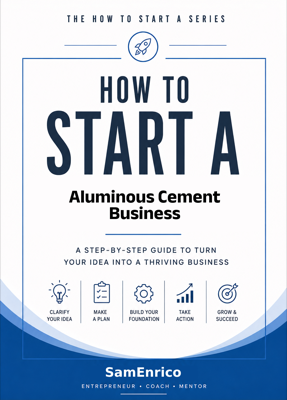
How to Start a Aluminous Cement Business (Beginners Guide) Paperback
How to Start a Aluminous Cement Business (Beginner
by Dill Simonne
How to Start a Aluminous Cement Business (Beginners Guide)
Formats
Free sample
Chapter 1: The Grey Lie--–- The first thing you need to understand about aluminous cement is that someone has been lying to you. Not maliciously, not conspiratorially, but lying nonetheless. The construction materials industry runs on inertia. Engineers specify what they learned in school twenty years ago. Contractors buy what their fathers bought.
And for the past one hundred and eighty years, what everyone has bought is ordinary Portland cement—a grey powder so ubiquitous that we have stopped questioning whether it is actually the right tool for every job. It is not. In fact, for a surprising number of industrial applications, Portland cement is not just suboptimal. It is actively, demonstrably dangerous. This chapter dismantles the myth that all cement is the same.
It introduces you to the high-performance alternative that will become your business: aluminous cement, also known as high alumina cement or calcium aluminate cement. You will learn why this material thrives where Portland cement fails. You will understand what inversion risk actually means—and why you should take it seriously without being paralyzed by fear. And you will discover the four markets where beginners with no industry connections can still build profitable businesses. By the end of this chapter, you will see the construction materials industry differently.
The grey lie will be exposed. And you will be ready to act.The Monopoly You Have Never Questioned Walk into any construction supply store in North America, Europe, or Asia. Find the cement aisle. You will see bags of Portland cement on pallets. Type I for general construction.
Type II for moderate sulfate resistance. Type III for high early strength. The labels change slightly, but the chemistry is fundamentally the same formula that was patented by Joseph Aspdin in 1824. Crush limestone and clay. Heat them in a kiln to fourteen hundred and fifty degrees Celsius.
Grind the resulting clinker with gypsum. The powder reacts with water to form a hard, stone-like mass. It is cheap. It is predictable. It works perfectly well for sidewalks, foundations, driveways, and skyscrapers.But here is the lie.
Portland cement is not universal. It is not a one-size-fits-all solution. In fact, it fails catastrophically in two specific environments that are far more common in industrial settings than most people realize.First, heat. When Portland cement is exposed to temperatures above three hundred degrees Celsius, the calcium silicate hydrates that give it strength begin to dehydrate and decompose. At five hundred degrees, it loses half its compressive strength.
At eight hundred degrees, it turns to dust. You can crumble it between your fingers. This is why the concrete lining of a steel furnace made with Portland cement would last approximately three days before collapsing into rubble. Yet steel mills, foundries, petrochemical plants, incinerators, and aluminum smelters all need materials that can withstand temperatures up to eighteen hundred degrees Celsius.Second, acid. Portland cement is highly alkaline, with a p H around twelve to thirteen.
When exposed to acids, a neutralization reaction occurs. The calcium hydroxide in the cement reacts with sulfuric acid to form gypsum—calcium sulfate dihydrate. Gypsum is soft. Gypsum expands. Gypsum disintegrates.
In sewer systems, bacteria convert hydrogen sulfide gas into sulfuric acid. This process, called biogenic sulfuric acid corrosion, eats through ordinary concrete at a rate of five to ten millimeters per year. A manhole liner made with Portland cement might last ten years before it needs replacement. In aggressive environments with high hydrogen sulfide levels, it can fail in two years.The existence of these failure modes is not a secret. Civil engineers learn about them in university.
But the construction industry has adapted around Portland cement's weaknesses rather than replacing it. For high-heat applications, they use refractory…
This is the end of the free sample. Get the Paperback to keep going. Buy now
About this book
Details
- Author
- Dill Simonne
- Publisher
- SamEnrico
- Language
- English
- ISBN
- 9781506030364
- Genre
- Non-Fiction, Informative, Educational
- Released
- 2026-04-25
- Pages (approx.)
- 125
- Available as
- eBook, Paperback, Audiobook

Read better in the ZLOADR app
Your eBooks on your phone or tablet. Sign in with your SamEnrico account and start reading.
More by Dill Simonne
 Ayurvedic Ear HealthDill Simonne$11.99
 Sugar Cravings and Thyroid DisordersDill Simonne$11.99Sugar Cravings and Thyroid DisordersDill Simonne$11.99
 Alcoholism Stages RecognitionDill Simonne$11.99
 Fintech Transaction Multiples GuideDill Simonne$11.99
 Music Tempo InfluenceDill Simonne$11.99
 The Refugee Camp VictimDill Simonne$11.99
 Cross Racial Identification FailuresDill Simonne$11.99
 Vitamin D For SADDill Simonne$11.99
 The Magnificent Obsession: How Henrietta Tower-Richards Built a Museum from RuinDill Simonne$11.99
 The Golden Age of Supermodels: How Europe Redefined Beauty and PowerDill Simonne$11.99
 How to Produce Textile and Fabric CraftsDill Simonne$11.99