
Non-FictionInformativeEducational
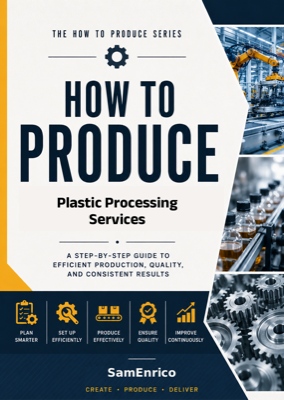
How to Produce Plastic Processing Services eBook
This publication, published by SamEnrico, covers H
This publication, published by SamEnrico, covers How to Produce Plastic Processing Services
Formats
Free sample
Chapter 1: The Granule Deception--–- Most people look at a plastic bottle or a car dashboard and see a finished thing. They do not see the war going on inside that thing—the war between heat, pressure, time, and a bag of tiny pellets that arrived that morning on a pallet. If you want to produce plastic processing services, you must unlearn everything you think you know about plastic. Plastic is not a material. It is a behavior.
And that behavior changes dramatically depending on which of the ten thousand formulations you happen to be running at 2:00 AM on a Tuesday when your dryer fails and your customer’s quality engineer is standing at your shipping dock with a set of calipers.This book is not about starting a plastic product business. Other books from Sam Enrico already cover that territory—how to start a door frame business, how to start a buoy business, how to start a packing goods business. Those books tell you what to sell. This book tells you how to make it. And making it begins with understanding the raw material that will either make you profitable or drive you bankrupt.
That raw material is not “plastic.” That raw material is a specific polymer with specific molecular weight, specific melt behavior, and specific enemies. The most dangerous enemy is not your competitor. It is your own assumption that all plastic pellets are the same.This chapter is called The Granule Deception because the deception is this: the granules look identical. Polypropylene pellets look like ABS pellets look like Nylon pellets. They all pour the same way.
They all feel dry. But when you heat them to five hundred degrees Fahrenheit and force them into a mold under twenty thousand pounds per square inch, their true personalities emerge. Some flow like water. Some flow like cold honey. Some release toxic fumes if you look at them wrong.
And every single one of them will betray you if you do not understand its Melt Flow Index, its drying requirements, and its thermal degradation point.Before you buy your first injection molding machine, before you sign your first lease on a production floor, before you hire your first operator, you must master the raw material. This chapter gives you that mastery. You will learn the difference between thermoplastics and thermosets—a distinction that will determine whether your machine can run a given job or whether you will ruin both the material and the mold. You will learn the top ten resins that constitute ninety percent of all commercial plastic processing, including their processing temperatures, shrinkage rates, and common applications. You will learn how to read a Material Safety Data Sheet not as a legal document but as a technical manual for your machine settings.
And you will learn the single most important number in all of plastic processing—the Melt Flow Index—and how it dictates every parameter you will ever set on a press.By the end of this chapter, you will never look at a bag of plastic pellets the same way again. You will see them not as raw material but as a set of instructions. Each pellet is telling you how hot to run your barrel, how much pressure to apply, how fast to inject, and how long to cool. Your job as a processor is to listen. The ones who do not listen are the ones who scrap entire production runs, miss delivery dates, and eventually close their doors.
The ones who listen become the service providers that OEMs trust with their most demanding parts.Let us begin with the most fundamental distinction in all of polymer processing.The Great Divide: Thermoplastics versus Thermosets If you remember only one thing from this entire chapter, remember this: thermoplastics can be melted and re-melted. Thermosets cannot. That single distinction will determine everything about your business model, your equipment choices, and your material sourcing strategy.Thermoplastics are the workhorses of the plastic processing industry. They account for approximately ninety percent of all plastic production. When you heat a thermoplastic, it softens.
When you cool it, it hardens. You can do this hundreds of times. The polymer chains are held together by weak secondary bonds (Van der Waals forces) that break when heat is applied and re-form when heat is removed. This reversibility is what makes injection molding, extrusion, blow molding, and rotational molding possible. You melt the plastic, shape it, cool it, and you are done.
If you make a bad part, you can grind it up and re-melt it. That ground-up scrap is called regrind, and we will discuss its economics and limitations in Chapter 2.Common thermoplastics include polyethylene (grocery bags, milk jugs), polypropylene (yogurt containers, automotive bumpers), polystyrene (disposable cups, foam packaging), ABS (Lego bricks, appliance housings), polycarbonate (bulletproof windows, eyewear lenses), PET (soda bottles, polyester fabrics), nylon (gears, zip ties), and acrylic (aquariums, signage). If you are starting a plastic processing service, you will likely run only thermoplastics. The equipment is simpler, the material is forgiving, and the market is enormous.Thermosets are a different animal entirely. When you heat a thermoset, it undergoes a chemical reaction called cross-linking.
The polymer chains form permanent covalent bonds with each other. This process is irreversible. Once a thermoset has cured, you cannot melt it again. If you try, you will simply burn it. Thermosets are strong, heat-resistant, and dimensionally stable, but they require different processing methods—typically compression molding or transfer molding rather than injection molding.
Common thermosets include epoxy (adhesives, circuit boards), phenolic (pot handles, electrical insulators), polyurethane (foams, coatings), and melamine (dinnerware, laminate countertops).For the purposes of this book and for the typical plastic processing service business, we will focus on thermoplastics. Thermosets require specialized equipment, longer cycle times, and chemical expertise that most general-purpose shops do not possess. If a customer asks you to run a thermoset part, refer them to a specialty molder. Your job is to be excellent at thermoplastics, not mediocre at everything.The Top Ten Resins: A Processor’s Field Guide You do not need to memorize every plastic ever invented. You need to master the ten resins that will walk through your door ninety percent of the time.
Each of these resins has a distinct personality. Treat them accordingly.1. ABS (Acrylonitrile Butadiene Styrene)ABS is tough, glossy, and machinable. It is the plastic of Lego bricks, computer housings, automotive interior trim, and power tool bodies. Processing temperature range: 400 to 460 degrees Fahrenheit.
Mold temperature: 120 to 180 degrees Fahrenheit. Shrinkage: 0.4 to 0.7 percent. ABS is hygroscopic—it absorbs moisture from the air—so it must be dried before processing. Typical drying: two to four hours at 180 degrees Fahrenheit. Without drying, you will see splay marks (silver streaks) on your parts.
ABS flows well and has good impact resistance even at low temperatures. It bonds well with adhesives and accepts paint and plating readily. The downside: ABS degrades if overheated, releasing styrene monomer vapor (which smells sweet and causes headaches). Never leave ABS sitting in a hot barrel for more than fifteen minutes without injecting.2. Polypropylene (PP)Polypropylene is the most widely used plastic on the planet by volume.
It is flexible, chemically resistant, and fatigue-resistant. You see it in yogurt containers, medicine bottles, automotive bumpers, living hinges (like…
This is the end of the free sample. Get the eBook to keep going. Buy now
About this book
Details
- Author
- Lyons Priscilla
- Publisher
- SamEnrico
- Language
- English
- Genre
- Non-Fiction, Informative, Educational
- Released
- 2026-06-02
- Pages (approx.)
- 160
- Available as
- eBook, Audiobook

Read better in the ZLOADR app
Your eBooks on your phone or tablet. Sign in with your SamEnrico account and start reading.
More by Lyons Priscilla
 Infertility Stress Couple GuideLyons Priscilla$11.99
 Affirmations for Law of AttractionLyons Priscilla$11.99
 Menopause Workplace GuideLyons Priscilla$11.99
 Stress and Sweating GuideLyons Priscilla$11.99
 Brand Positioning StatementLyons Priscilla$12.99
 Birthday and Anniversary AutomationsLyons Priscilla$11.99
 Eisenhower Matrix for Software DevsLyons Priscilla$11.99
 Confidence for Public SpeakingLyons Priscilla$11.99
 Atlantis Ruins GuideLyons Priscilla$11.99
 The Vanishing Bugatti: The $37 Million Heist That Shocked MonacoLyons Priscilla$11.99
 The Dark Money Mirage: How a Billionaire’s Secret War Funded the Tea PartyLyons Priscilla$11.99
 Mastering Consumption Tax: Vat & Gst GuideLyons Priscilla$11.99
You may also like
 Hong Kong Handover 1997Dunn Johnnie$11.99
 Zumba For Postnatal Recovery CourseNeal Christian$11.99
 Zumba for BeginnersLadner Nikia$11.99
 YouTube Comment Mining GuideHumes Pandora$12.99
 Worry Box MeditationCarlin Rudy$11.99
 Workplace Stress MeditationNguyen Lynn$11.99
 Workplace Stress and Sleep RepairHawley Ivory$11.99
 Workplace Perfectionism CureDelaney Jeffry$11.99
 Workplace Injustice Anger GuideWallen Isabelle$11.99
 Work Addiction and Burnout LinkGreenwood Ester$11.99
 Women in Yoga and WellnessBeattie Galina$11.99
 Women in Stand Up ComedyChun Evangeline$11.99