
Non-FictionInformativeEducational
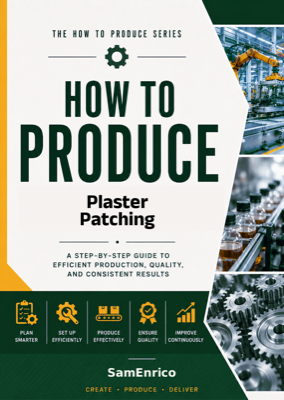
How to Produce Plaster Patching eBook
This publication, published by SamEnrico, covers H
by Maes Barb
This publication, published by SamEnrico, covers How to Produce Plaster Patching
Formats
Free sample
Chapter 1: The Wall Speaks...--The first mistake nearly every plaster patcher makes is treating the wall like dirt—an inert, silent, uniform slab to be filled and smoothed without consequence. You mix a batch of patching compound, trowel it on, sand it flat, and call it done. Three months later, a hairline crack appears. Six months after that, the patch pops loose and clatters to the floor. You blame the materials, the humidity, or bad luck.
But the wall was trying to tell you something from the very beginning, and you weren't listening.Every wall has a memory. It remembers the year it was applied, the hands that troweled it, the temperature of the room, and the type of lath that holds it. It remembers every moisture event, every vibration from passing trucks, every settlement crack that has been painted over. More importantly, the wall has a physical identity—a specific chemistry, density, porosity, and flexibility. If you apply a patching compound that does not respect that identity, the wall will reject it.
Not immediately, perhaps. But inevitably.This chapter is not about mixing plaster. It is about listening to the wall before you mix a single ounce of material. It is about diagnosis, history, and the physics of failure. By the time you finish this chapter, you will be able to walk into any room, tap on the wall, and know with reasonable certainty what it is made of, how old it is, and what kind of patching compound it will accept.
You will also learn the single most important rule in the entire book—a rule that most professional plasterers learn only after years of expensive failures.The rule is simple, and it governs every decision you will make from this point forward: The patch must be equal to or softer, and equal to or more breathable, than the original substrate. Violate this rule, and your patch will fail. Obey it, and your patch will outlive you.The Three Families of Plaster Before you can match a patch to a wall, you must understand the three fundamental families of plaster that have been used in construction over the past two centuries. Each family has a distinct chemical composition, physical behavior, and historical period of dominance. Each also has a different failure mode when patched incorrectly.Lime Plaster: The Breathable Ancestor Lime plaster is the oldest of the three, dating back thousands of years but remaining the standard for interior walls in North America and Europe until roughly the 1950s.
It is made from limestone (calcium carbonate) that has been heated to produce quicklime (calcium oxide), then slaked with water to create lime putty (calcium hydroxide). When applied to a wall, lime plaster absorbs carbon dioxide from the air and slowly reverts to calcium carbonate—a process called carbonation that can take months or even years to complete fully.The critical characteristics of lime plaster are softness and breathability. A properly cured lime wall has a compressive strength of roughly 100 to 300 pounds per square inch (psi)—significantly softer than modern gypsum or cement plasters. Its vapor permeability is exceptionally high, typically ranging from 15 to 30 perms, meaning water vapor can move freely through the wall assembly. This breathability is not a flaw; it is a feature.
Historic buildings rely on lime plaster to wick moisture away from wooden lath and structural timbers, preventing rot.Lime plaster is also flexible. It expands and contracts with temperature and humidity changes at a rate similar to the wood and masonry it adheres to. This flexibility is why so many historic lime walls remain intact after a century of settlement, earthquakes, and thermal cycling—they move with the building rather than cracking apart.However, lime plaster has a critical vulnerability: it is chemically incompatible with modern gypsum and cement patching compounds. A gypsum or cement patch applied to a lime wall is significantly harder (gypsum: 1,500 to 3,000 psi; cement: 3,000 to 10,000 psi) and far less breathable (gypsum: 3 to 8 perms; cement: 1 to 3 perms). The hard, impermeable patch acts like a rigid cap on a flexible, breathing wall.
As the lime wall moves and breathes around it, the patch cannot accommodate that movement. Cracks form along the interface. Eventually, the patch debonds entirely.If you take nothing else from this chapter, remember this: never patch a historic lime wall with modern gypsum or cement plaster. You might as well glue a ceramic tile to a rubber sheet and expect it to flex forever without cracking.Gypsum Plaster: The Modern Standard Gypsum plaster emerged as the dominant interior wall material in the mid-twentieth century, largely because it sets quickly, achieves high hardness, and can be applied in thinner coats than lime. Gypsum is calcium sulfate hemihydrate (Ca SO₄·½H₂O), derived from mined gypsum rock that has been heated to drive off water.
When mixed with water, it rehydrates and forms interlocking crystals of gypsum dihydrate, reaching full hardness in days rather than the months required for lime carbonation.Gypsum plaster is harder than lime—typically 1,500 to 3,000 psi in compressive strength—and significantly less breathable, with vapor permeability ranging from 3 to 8 perms. It is also more brittle, with less capacity to accommodate building movement. This brittleness is why gypsum walls often develop hairline cracks in older buildings that continue to settle, while lime walls stretch and flex without visible failure.From a patching perspective, gypsum plaster has two advantages. First, because it is harder and less breathable than lime, it is compatible with a wider range of patching compounds—including most modern gypsum-based products and even some polymer-modified formulations. Second, gypsum plaster bonds well to itself, meaning a patch made from fresh gypsum gauging plaster will typically adhere strongly to an existing gypsum wall, provided the surface is properly prepared.But here is the nuance that most guides miss: not all gypsum plasters are the same.
Gypsum plaster applied in the 1950s and 1960s often contained additives like lime, clay, or animal hair to improve workability and flexibility. Gypsum plaster applied after the 1980s is typically purer and harder. Patching a 1950s gypsum wall with a modern high-strength gypsum compound can still cause cracking if the patch is significantly harder than the original. The rule of "softer or equal" applies even within the same chemical family.Portland Cement Plaster (Stucco): The Exterior Workhorse Portland cement plaster, commonly called stucco, is the youngest of the three families. It emerged in the late nineteenth century and became the standard for exterior wall finishes in the twentieth century.
Portland cement is a hydraulic binder—meaning it sets and hardens through a chemical reaction with water, regardless of air exposure—and it achieves very high compressive strengths, typically 3,000 to 10,000 psi.Stucco is dense and relatively impermeable, with vapor permeability of only 1 to 3 perms. It is also highly rigid, with a coefficient of thermal expansion similar to concrete. These characteristics make stucco excellent for exterior applications where weather resistance and structural strength are priorities. They also make stucco a poor choice for interior patching of lime or gypsum walls, for reasons already discussed.However, stucco has its own patching requirements. Because it is hard and dense, stucco patches must also be hard and dense—a…
This is the end of the free sample. Get the eBook to keep going. Buy now
About this book
Details
- Author
- Maes Barb
- Publisher
- SamEnrico
- Language
- English
- Genre
- Non-Fiction, Informative, Educational
- Released
- 2026-05-23
- Pages (approx.)
- 140
- Available as
- eBook, Audiobook

Read better in the ZLOADR app
Your eBooks on your phone or tablet. Sign in with your SamEnrico account and start reading.
More by Maes Barb
 Self Talk for Job LossMaes Barb$11.99
 Hayloft Rest GuideMaes Barb$11.99
 Stress Inflammation ConnectionMaes Barb$11.99
 Flow Environment AuditMaes Barb$11.99
 Bubble Float RelaxationMaes Barb$11.99
 The Mindfulness Focus LinkMaes Barb$11.99
 Ultimate Frisbee Self HypnosisMaes Barb$11.99
 ABCDE for CaregiversMaes Barb$11.99
 The Siege of Jeddah Prison: A 19th-Century Bloodbath in the Heart of the Ottoman EmpireMaes Barb$11.99
 Shadows Over Istanbul: The Vanished DiplomatMaes Barb$11.99
 How to Become a Counter-supply WorkerMaes Barb$11.99
 Woolly Mammoths: Ancient ElephantMaes Barb$11.99
You may also like
 Hong Kong Handover 1997Dunn Johnnie$11.99
 Zumba For Postnatal Recovery CourseNeal Christian$11.99
 Zumba for BeginnersLadner Nikia$11.99
 YouTube Comment Mining GuideHumes Pandora$12.99
 Worry Box MeditationCarlin Rudy$11.99
 Workplace Stress MeditationNguyen Lynn$11.99
 Workplace Stress and Sleep RepairHawley Ivory$11.99
 Workplace Perfectionism CureDelaney Jeffry$11.99
 Workplace Injustice Anger GuideWallen Isabelle$11.99
 Work Addiction and Burnout LinkGreenwood Ester$11.99
 Women in Yoga and WellnessBeattie Galina$11.99
 Women in Stand Up ComedyChun Evangeline$11.99