
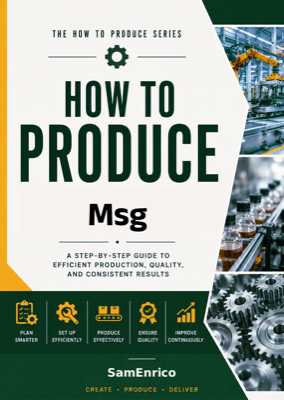
Non-FictionInformativeEducational
How to Produce Msg
This publication, published by SamEnrico, covers H
This publication, published by SamEnrico, covers How to Produce Msg
Formats
About this book
Free sample
Chapter 1: The Billion-Dollar Microbe--The most valuable bacterium on Earth lives in a Japanese soil sample collected sixty-nine years ago, weighs nothing you can measure on a bathroom scale, and has never made anyone sick. Its name is Corynebacterium glutamicum, and if you have eaten a bowl of soup, a bag of chips, a serving of instant noodles, or a restaurant meal in the past twenty-four hours, you have almost certainly consumed something this microbe helped produce. That is not hyperbole. It is the quiet reality of modern food manufacturing. The global MSG industry produces roughly three million metric tons annually, and ninety-nine percent of that comes from fermentation tanks seeded with this single species of Gram-positive, non-pathogenic bacterium.
The remaining one percent comes from older extraction methods or niche alternatives like fish hydrolysis, but those are historical curiosities or regional specialties. The industrial present and future belong to C. glutamicum.Before you can produce MSG, you must understand the organism that does the work. This is not optional. You cannot simply buy a bag of "MSG starter culture" off the internet, throw it into a barrel of molasses, and expect crystals to appear.
Fermentation is a partnership. You provide the food, the temperature control, the oxygen, and the p H management. The bacterium provides the enzymatic machinery that converts sugar into glutamic acid. If you neglect the biology, the bacterium will sulk, underperform, or die. If you understand the biology, you can push this microbe to produce one hundred eighty grams of glutamate per liter of broth—a concentration so high that the solution becomes thick as syrup and the product begins to crystallize inside the tank if you are not careful.This chapter tells the story of C.
glutamicum: where it came from, how it was discovered, how its metabolism works, why it leaks glutamate like a sieve with a hole poked in it, and what parameters you must control to keep it happy and productive. By the end of this chapter, you will understand why this particular bacterium won the evolutionary lottery and became the workhorse of the…
This is the end of the free sample. Get the eBook to keep going. Buy now
Contents
- Chapter 1
- Chapter 2
- Chapter 3
- Chapter 4
- Chapter 5
- Chapter 6
- Chapter 7
- Chapter 8
- Chapter 9
- Chapter 10
- Chapter 11
- Chapter 12
Details
- Author
- Holloman Karin
- Publisher
- SamEnrico
- Language
- English
- Genre
- Non-Fiction, Informative, Educational
- Released
- 2026-05-11
- Pages (approx.)
- 153
- Available as
- eBook, Audiobook

Read better in the ZLOADR app
Your eBooks on your phone or tablet. Sign in with your SamEnrico account and start reading.
More by Holloman Karin
 Bedtime Release MeditationHolloman Karin$11.99
 Weekly Goal Review RoutineHolloman Karin$11.99
 Jimmy Hoffa Disappearance Timeline ManualHolloman Karin$11.99
 Asana Goal and OKR TrackingHolloman Karin$11.99
 School Strike For Gaza MemoirHolloman Karin$11.99
 Job Loss for Gig WorkersHolloman Karin$11.99
 Mortgage Payment StressHolloman Karin$11.99
 Facebook Social Comparison EffectsHolloman Karin$11.99
 The Cleveland Torso Murderer: America's First Serial Killer in the ShadowsHolloman Karin$11.99
 The Boy General: Marlborough's Triumph at BlenheimHolloman Karin$11.99
 A Collector's Handbook to the Rolls-royce Silver Shadow I LwbHolloman Karin$11.99
 Growing BoragoHolloman Karin$11.99
You may also like
 Hong Kong Handover 1997Dunn Johnnie$11.99
 Zumba For Postnatal Recovery CourseNeal Christian$11.99
 Zumba for BeginnersLadner Nikia$11.99
 YouTube Comment Mining GuideHumes Pandora$12.99
 Worry Box MeditationCarlin Rudy$11.99
 Workplace Stress MeditationNguyen Lynn$11.99
 Workplace Stress and Sleep RepairHawley Ivory$11.99
 Workplace Perfectionism CureDelaney Jeffry$11.99
 Workplace Injustice Anger GuideWallen Isabelle$11.99
 Work Addiction and Burnout LinkGreenwood Ester$11.99
 Women in Yoga and WellnessBeattie Galina$11.99
 Women in Stand Up ComedyChun Evangeline$11.99