
Non-FictionInformativeEducational
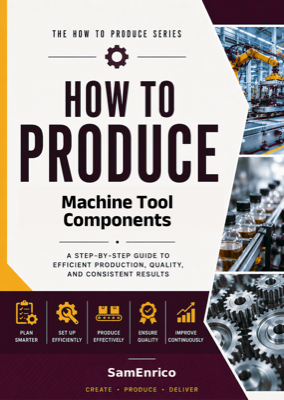
How to Produce Machine Tool Components
This publication, published by SamEnrico, covers H
This publication, published by SamEnrico, covers How to Produce Machine Tool Components
Formats
About this book
Free sample
Chapter 1: The Unseen Bones--–- Every machine tool that has ever shaped a precision part—from the spindle of a Swiss-type lathe to the bed of a five-axis machining center—owes its performance to a silent, often invisible foundation: the structural components that resist deflection, absorb vibration, and maintain alignment across decades of thermal cycles. These are the unseen bones of manufacturing: beds, columns, bases, rams, and saddles. Unlike generic mechanical parts, machine tool structural components are designed and produced to a radically different standard. Where an automotive bracket might tolerate 0.5 mm of flex, a machining center column must hold micron-level positioning accuracy while enduring cutting forces that would twist a lesser structure into scrap. This chapter establishes the fundamental philosophy, material science, and economic strategy behind producing these critical components.
Readers will learn why gray cast iron remains the gold standard for damping, how the choice between vertical integration and outsourcing impacts every subsequent production decision, and why thermal stability is not an afterthought but the first design parameter. By the end of this chapter, you will understand that producing a machine tool component is not simply machining a block of metal—it is engineering a controlled, predictable, and durable response to force, heat, and time.Defining the Machine Tool Component A machine tool component is any part that directly influences the geometric, kinematic, or dynamic accuracy of the machine. This definition excludes generic brackets, covers, or hardware. Instead, it includes:Beds and bases: The foundation that supports all other axes, resisting bending and torsion.Columns and rams: Vertical structures that must remain perpendicular to the bed under varying loads.Tables and saddles: Moving elements that slide or roll along guideways, requiring flatness and stiffness.Spindles and spindle housings: Rotary components that hold cutting tools or workpieces, demanding sub-micron roundness and thermal stability.Guideways and drive mounts: Surfaces and interfaces that constrain motion to precise trajectories.What differentiates these components from ordinary mechanical parts is the severity of their requirements. A machine tool structural component must exhibit:Static stiffness: Minimal deflection under cutting forces (typically 0.1–10 N/µm depending on machine size and application).Dynamic stiffness: Resistance to chatter and…
This is the end of the free sample. Get the eBook to keep going. Buy now
Contents
- Chapter 1
- Chapter 2
- Chapter 3
- Chapter 4
- Chapter 5
- Chapter 6
- Chapter 7
- Chapter 8
- Chapter 9
- Chapter 10
- Chapter 11
- Chapter 12
Details
- Author
- Hawley Juliann
- Publisher
- SamEnrico
- Language
- English
- Genre
- Non-Fiction, Informative, Educational
- Released
- 2026-06-02
- Pages (approx.)
- 160
- Available as
- eBook, Audiobook

Read better in the ZLOADR app
Your eBooks on your phone or tablet. Sign in with your SamEnrico account and start reading.
More by Hawley Juliann
 Russian Mafia in LondonHawley Juliann$11.99
 The Foster Care Food Bank ChildHawley Juliann$11.99
 Legacy Letter GuideHawley Juliann$11.99
 Benzo Tapering Practical Compassionate PrimerHawley Juliann$11.99
 Authority Persuasion HandbookHawley Juliann$11.99
 Albert NamatjiraHawley Juliann$11.99
 Slave Trade British Royal NavyHawley Juliann$11.99
 Community Court FounderHawley Juliann$11.99
 The Last Whisper of the Dodo: Extinction’s Silent WitnessHawley Juliann$11.99
 The Ghost Particle: How Neutrinos Changed EverythingHawley Juliann$11.99
 How to Start a Apple Wine Making Business (Beginners Guide)Hawley Juliann$11.99
 UN JPO Program Application GuideHawley Juliann$12.99
You may also like
 Hong Kong Handover 1997Dunn Johnnie$11.99
 Zumba For Postnatal Recovery CourseNeal Christian$11.99
 Zumba for BeginnersLadner Nikia$11.99
 YouTube Comment Mining GuideHumes Pandora$12.99
 Worry Box MeditationCarlin Rudy$11.99
 Workplace Stress MeditationNguyen Lynn$11.99
 Workplace Stress and Sleep RepairHawley Ivory$11.99
 Workplace Perfectionism CureDelaney Jeffry$11.99
 Workplace Injustice Anger GuideWallen Isabelle$11.99
 Work Addiction and Burnout LinkGreenwood Ester$11.99
 Women in Yoga and WellnessBeattie Galina$11.99
 Women in Stand Up ComedyChun Evangeline$11.99