
Non-FictionInformativeEducational
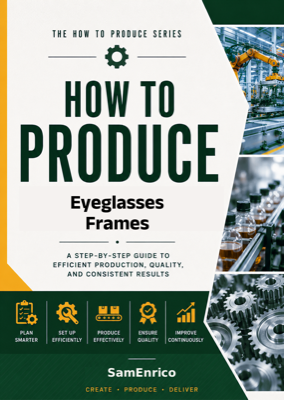
How to Produce Eyeglasses Frames
This publication, published by SamEnrico, covers H
by Paul Rodney
This publication, published by SamEnrico, covers How to Produce Eyeglasses Frames
Formats
About this book
Free sample
Chapter 1: The Glass Ceiling...--–- On a rainy Tuesday morning in a small workshop outside of Cadore, Italy, a 72-year-old master craftsman named Enzo placed a block of striped cellulose acetate into a five-axis CNC router and pressed start. Forty-seven minutes later, a rough frame front emerged. He then spent the next six hours hand-filing, tumbling, and polishing that single piece of plastic until it gleamed like liquid amber. That frame would eventually sell for 850ataboutiquein Tokyo.Fourthousandmilesaway,afactoryin Dongguan,China,injectedmolten Grilamidintoapolishedsteelmoldandproduced1,200identicalframesinthesameforty−sevenminutes.Thoseframeswouldsellfor850 at a boutique in Tokyo. Four thousand miles away, a factory in Dongguan, China, injected molten Grilamid into a polished steel mold and produced 1,200 identical frames in the same forty-seven minutes.
Those frames would sell for 850ataboutiquein Tokyo.Fourthousandmilesaway,afactoryin Dongguan,China,injectedmolten Grilamidintoapolishedsteelmoldandproduced1,200identicalframesinthesameforty−sevenminutes.Thoseframeswouldsellfor19 at a big-box retailer in Ohio. Both products were called “eyeglasses.” Both would hold prescription lenses. Both would pass basic safety tests. But they were not the same thing. And understanding exactly why they are different — not better or worse, but different — is the first real lesson in producing eyeglasses frames.–- If you picked up this book, you likely fall into one of three categories.
First, the entrepreneur who has a sketch on a napkin or a CAD file on a laptop and wants to turn it into a physical product without losing a fortune to overseas middlemen. Second, the industrial designer or product developer who has been tasked by an employer to launch an eyewear line and suddenly realizes they know nothing about base curves, hinge barrels, or why Italian acetate costs three times as much as Chinese acetate. Third, the maker — the person with access to a 3D printer or a small CNC mill — who wants to manufacture frames at a small scale, sell them directly to customers, and bypass the traditional supply chain entirely. All three of you share a common problem: the eyewear industry is opaque, secretive, and riddled with jargon, trade secrets, and long-established supply chains that actively resist disruption.–- This chapter exists to tear down that opacity.…
This is the end of the free sample. Get the eBook to keep going. Buy now
Contents
- Chapter 1
- Chapter 2
- Chapter 3
- Chapter 4
- Chapter 5
- Chapter 6
- Chapter 7
- Chapter 8
- Chapter 9
- Chapter 10
- Chapter 11
- Chapter 12
Details
- Author
- Paul Rodney
- Publisher
- SamEnrico
- Language
- English
- Genre
- Non-Fiction, Informative, Educational
- Released
- 2026-05-11
- Pages (approx.)
- 148
- Available as
- eBook, Audiobook

Read better in the ZLOADR app
Your eBooks on your phone or tablet. Sign in with your SamEnrico account and start reading.
More by Paul Rodney
 Walking Everyday GuidePaul Rodney$11.99
 The Davi Kopenawa BiographyPaul Rodney$11.99
 Migraine Aura MeditationPaul Rodney$11.99
 Random Stimulus IdeationPaul Rodney$11.99
 Gut Brain Axis And TraumaPaul Rodney$11.99
 Decatastrophizing AngerPaul Rodney$11.99
 Student Procrastination GuidePaul Rodney$11.99
 Sports Betting CompulsionPaul Rodney$11.99
 The Raven Mockers: Cherokee Spirits of the DyingPaul Rodney$11.99
 The Cairo Cipher: Decoding Egypt's First Serial KillerPaul Rodney$11.99
 Promotion Pitch Email TemplatesPaul Rodney$12.99
 Your First 30 Days Finding a Co-FounderPaul Rodney$12.99
You may also like
 Hong Kong Handover 1997Dunn Johnnie$11.99
 Zumba For Postnatal Recovery CourseNeal Christian$11.99
 Zumba for BeginnersLadner Nikia$11.99
 YouTube Comment Mining GuideHumes Pandora$12.99
 Worry Box MeditationCarlin Rudy$11.99
 Workplace Stress MeditationNguyen Lynn$11.99
 Workplace Stress and Sleep RepairHawley Ivory$11.99
 Workplace Perfectionism CureDelaney Jeffry$11.99
 Workplace Injustice Anger GuideWallen Isabelle$11.99
 Work Addiction and Burnout LinkGreenwood Ester$11.99
 Women in Yoga and WellnessBeattie Galina$11.99
 Women in Stand Up ComedyChun Evangeline$11.99