
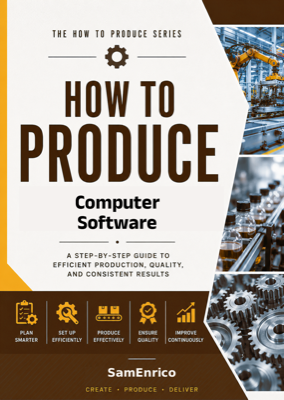
Non-FictionInformativeEducational
How to Produce Computer Software eBook
This publication, published by SamEnrico, covers H
This publication, published by SamEnrico, covers How to Produce Computer Software
Formats
Free sample
Chapter 1: The Value Compass--–- The email arrived at 11:47 PM on a Friday. Sarah, a senior engineer at a healthtech startup, had just finished a sixty-hour week shipping a beautiful new onboarding flow. Her code was elegant—factory patterns, perfect test coverage, zero linting warnings. The product manager replied to her Slack message with three words: "Nobody is using it."This is not a story about bad code. It was good code.
Clean code. Expensive code. It was also useless code because it solved a problem nobody had.Sarah’s team had spent three months building a feature that seemed important based on a single conversation with a single user three months prior. By the time it shipped, the user had changed their workflow. The competition had moved.
The problem no longer existed. Sarah had committed the most expensive sin in software production: she confused shipping with valuing.This chapter dismantles the most common fallacy in software development—that writing code is the primary goal. It is not. Producing computer software means producing value. Code is merely the currency.
If your code does not change a human behavior, reduce a cost, or increase a revenue stream, you have not produced software. You have produced activity disguised as progress.The distinction between a "program" and a "product" is the difference between a hobby and a profession. A program is an academic exercise, a personal script, or a proof-of-concept—it exists because coding is fun or interesting. A product is something people pay for, rely on, or would actively miss if it disappeared. This book is about producing products.
If you want to write programs for yourself, put this book down and open an IDE. If you want to produce software that matters to other humans, read every word of this chapter twice.The Startup That Built a Perfectly Useless Rocket Ship Let me tell you about a company called Medi Sync. They raised eight million dollars in Series A funding to build a "unified patient intake platform for rural clinics." The pitch was compelling: rural clinics have terrible software, doctors waste hours on paperwork, patients wait weeks for appointments. Medi Sync hired fifteen engineers from top companies, bought the best cloud infrastructure, and spent eighteen months building a masterpiece.The software was technically flawless. The microservices communicated via event-driven architecture.
The frontend used a state-of-the-art reactive framework. The test suite had ninety-four percent coverage. The deployment pipeline could push to production in twelve minutes. The engineering team celebrated their launch with champagne and a Medium post titled "How We Built the Future of Rural Healthcare."There was only one problem. They had never spoken to a rural clinic doctor after the initial pitch meeting.
They had never watched a nurse use existing software. They had never asked a patient to try a prototype. They built what they imagined the problem was, not what the problem actually was.When they finally demoed to ten clinics, the feedback was devastating. "Our internet goes down twice a week," one doctor said. "Your cloud system won't work at all." "I have sixty patients a day," said a nurse.
"I need three clicks maximum. Your system takes seventeen." "I can't read blue text on gray backgrounds," said an elderly patient. "My eyes aren't what they used to be."The product died. The eight million dollars evaporated. The engineers found new jobs.
The startup's website now shows a "shutting down" notice. Every line of code they wrote was technically perfect and commercially worthless because it violated the first law of software production: code solves problems; problems are owned by humans; humans must be consulted continuously.This story haunts me because I have lived its lesser version multiple times. Every engineer has. We build what we think the user wants, based on incomplete information, and we discover too late that we were wrong. The cost of being wrong is not just the code you wrote—it is the code you did not write instead.
Opportunity cost is the silent killer of software value.Program vs. Product: The One Question That Separates Hobbyists from Professionals Every software project begins with a question. Most engineers ask: "What technology should I use?" Better engineers ask: "What problem am I solving?" The best engineers ask: "Who will miss this if it disappears?"The difference between a program and a product is not complexity, scale, or programming language. It is dependency. A program has zero users who would suffer if it vanished tomorrow.
A product has at least one user—ideally many—whose work or life would get worse without it.Consider a Python script that renames files in a specific pattern. You wrote it for yourself. It saves you ten minutes per week. If it stopped working, you would be annoyed, but you could rename files manually. That is a program.
It is valuable to you, but nobody else depends on it.Now consider the same script used by an accounting team of twenty people. They run it every day to process invoices. If it stops working, invoices are late, vendors are angry, and the finance director misses their bonus. That is a product. The distinction is not technical—it is economic and social.
A product creates dependencies. Those dependencies are the only reliable measure of value.This distinction forces a shift in identity. A coder asks: "What can I build?" An engineer asks: "What should I build?" A product producer asks: "What problem, owned by whom, is worth solving at what cost?" The first question is about capability. The second is about judgment. The third is about value.Throughout this book, whenever you are tempted to start coding, stop and ask: "Will anyone miss this if I never ship it?" If the answer is no, you are building a program.
If the answer is yes, you are producing software. Only the latter belongs in production.I have seen teams spend months on features that every single person in the room agreed were important, only to discover that no external user cared. The agreement inside the team was an echo chamber. The silence from outside was the only real signal. Learn to distinguish the two.Brooks' Law and the Nine-Month Baby Fallacy In 1975, Fred Brooks published The Mythical Man-Month, a book based on his experience managing the development of IBM's OS/360.
One insight has become legendary: "Adding manpower to a late software project makes it later." This is Brooks' Law, and it is the most counterintuitive and most frequently violated principle in software production.Why does adding people slow things down? Not because new engineers are incompetent. Not because they are lazy. Because communication overhead grows faster than the team's productive capacity. A team of one engineer has zero communication channels.
A team of three has three channels. A team of five has ten channels. A team of ten has forty-five channels. Each new person adds not just work capacity but also coordination cost—meetings, code reviews, integration conflicts, knowledge transfer, and the subtle cost of disrupting flow.When a project is late, managers panic. Panic leads to adding people.
Adding people leads to more communication overhead. More overhead slows progress further. The project gets later. The manager adds more…
This is the end of the free sample. Get the eBook to keep going. Buy now
About this book
Details
- Author
- Reilly Marlena
- Publisher
- SamEnrico
- Language
- English
- Genre
- Non-Fiction, Informative, Educational
- Released
- 2026-05-25
- Pages (approx.)
- 149
- Available as
- eBook, Audiobook

Read better in the ZLOADR app
Your eBooks on your phone or tablet. Sign in with your SamEnrico account and start reading.
More by Reilly Marlena
 The NEAT Increase MethodReilly Marlena$11.99
 Bipolar Sleep Management GuideReilly Marlena$11.99
 Sustainability PositioningReilly Marlena$11.99
 Public Speaking for YouTubersReilly Marlena$11.99
 Improv for ParentsReilly Marlena$11.99
 The Infertility Difficult TalkReilly Marlena$11.99
 Gratitude for WorkReilly Marlena$11.99
 Therapy For Parental AngerReilly Marlena$11.99
 Silk and Steel: The Love That Defied the XiongnuReilly Marlena$11.99
 Woodstock '99: The Festival That Almost Burned Down the WorldReilly Marlena$11.99
 How to Become a Aviation Support Equipment RepairerReilly Marlena$11.99
 A Collector's Handbook to the Talbot 45, 65Reilly Marlena$11.99
You may also like
 Hong Kong Handover 1997Dunn Johnnie$11.99
 Zumba For Postnatal Recovery CourseNeal Christian$11.99
 Zumba for BeginnersLadner Nikia$11.99
 YouTube Comment Mining GuideHumes Pandora$12.99
 Worry Box MeditationCarlin Rudy$11.99
 Workplace Stress MeditationNguyen Lynn$11.99
 Workplace Stress and Sleep RepairHawley Ivory$11.99
 Workplace Perfectionism CureDelaney Jeffry$11.99
 Workplace Injustice Anger GuideWallen Isabelle$11.99
 Work Addiction and Burnout LinkGreenwood Ester$11.99
 Women in Yoga and WellnessBeattie Galina$11.99
 Women in Stand Up ComedyChun Evangeline$11.99