

Non-FictionInformativeEducational
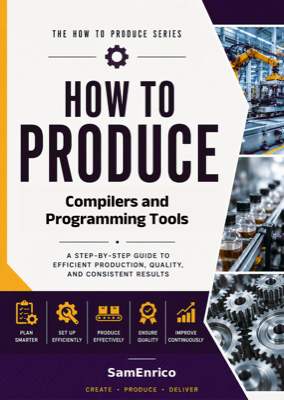
How to Produce Compilers and Programming Tools eBook
This publication, published by SamEnrico, covers H
This publication, published by SamEnrico, covers How to Produce Compilers and Programming Tools
Formats
Free sample
Chapter 1: The Forgotten Blueprint...--When you type gcc myprogram.c into a terminal and press enter, something quietly miraculous occurs. In the span of milliseconds, thousands of decisions are made, millions of bits are shuffled, and your human-readable poetry of if statements and while loops transforms into a binary ghost that your processor will chase until power is cut. Most programmers go their entire careers without peering behind this curtain. They treat the compiler as an appliance—like a microwave or a toaster—something that just works until it doesn't.But you are no longer one of those programmers.You picked up this book because somewhere along your journey, you realized that compilers are not magic. They are engineering.
Magnificent, intricate, and deeply logical engineering that follows principles so elegant they border on art. This chapter pulls back the veil on the compiler architecture—not as a dry academic diagram, but as a living pipeline that you will build, piece by piece, with your own hands by the time you finish this book.By the time you complete this chapter, you will understand exactly what happens from the moment you press "save" on a source file to the moment your program runs. More importantly, you will have a mental map that guides every decision in the chapters ahead—a map that separates the front-end (where languages are born) from the back-end (where machines wake up), with a crucial middle layer that makes modern compilation possible.The Compiler's Promise: Why We Build Them at All Before we dissect the machinery, we must ask a harder question: why build a compiler at all? In an age of interpreted Python, JIT-compiled Java Script, and cloud functions that run for milliseconds, does the art of compilation still matter?The answer is yes—more than ever.Consider the world around you. Every time you query a database, a query compiler translates your SQL into a plan.
Every time your phone recognizes "Hey Siri," a specialized compiler turns a speech model into optimized DSP instructions. Every time a game renders a frame, shader compilers convert HLSL into GPU-specific microcode. Even the Type Script you write at your day job undergoes transpilation—a form of compilation—before Java Script ever reaches a browser.Compilers are the universal translators of computing. They convert human intention into machine obedience.The reasons to write a compiler fall into four categories:Performance. C, C++, and Rust exist because sometimes Python's flexibility costs too much.
A good compiler can optimize away entire loops, inline function calls, and rearrange memory layouts in ways no human could maintain by hand. The fastest programs in the world are compiled—often by compilers that have been refined over decades.Portability. Java and Web Assembly proved that you can write once and run anywhere if you have a compiler targeting an intermediate representation. Your compiler can generate code for x86, ARM, RISC-V, and even GPUs without rewriting the front-end that understands your language.Ergonomics. Type Script, Coffee Script, and countless other languages exist not because they run faster, but because they feel better to write.
Their compilers transform pleasant syntax into the gritty reality that platforms require.Specialization. Regular expressions, SQL, HTML templates, CSS preprocessors—these are all compilers for domain-specific languages. When you build a DSL, you are building a compiler tuned to one narrow problem, and nothing else.You will build all of these capabilities in this book. Not at once, but layer by layer, starting from the foundation.The Pipeline That Changed Computing Every compiler follows the same fundamental pattern. Whether it's GCC with its fifteen million lines of code or a tiny recursive descent parser you write in an afternoon, the structure is recognizable.Here is the pipeline—memorize it, sketch it on a whiteboard, tattoo it on your forearm if you must:Phase 1: Lexical Analysis (The Scanner)Raw source code enters as a string of characters.
The lexer groups these characters into tokens—the atoms of your language. if (x + 123) becomes [IF, LPAREN, IDENT("x"), PLUS, NUMBER(123), RPAREN]. Whitespace and comments vanish. Error messages gain line numbers. This phase answers: "What words exist?"Phase 2: Syntax Analysis (The Parser)Tokens are flat; programs are trees.
The parser consumes tokens and produces an Abstract Syntax Tree (AST) that captures the grammatical structure. a + b * c becomes a tree where multiplication is deeper than addition, encoding precedence without parentheses. This phase answers: "How are the words arranged?"Phase 3: Semantic Analysis (The Checker)Trees have structure, but structure alone doesn't guarantee meaning. The semantic analyzer walks the AST, checking types, resolving variable references, enforcing scope rules. It catches x = "hello" + 3 before any code runs.
This phase answers: "Does the arrangement make sense?"Phase 4: Intermediate Representation Generation The AST is too high-level for machines and too language-specific for optimization. The compiler lowers it to an Intermediate Representation (IR)—a simpler, more regular language that sits between source and target. Three-address code, static single assignment (SSA), or LLVM IR. This phase answers: "How do we simplify before translating?"Phase 5: Optimization IR is designed for analysis. The optimizer runs passes—constant folding, dead code elimination, loop invariant hoisting—that make programs faster or smaller.
This phase answers: "Can we make the simplification better?"Phase 6: Code Generation IR becomes assembly or machine code. Instruction selection maps IR operations to CPU instructions. Register allocation maps unlimited temporaries to finite registers. Peephole optimization cleans up local inefficiencies. This phase answers: "How do we translate to bits?"Phase 7: Linking and Assembly Individual object files (your code, libraries, runtime) are stitched together.
Addresses are resolved. Relocations are patched. An executable emerges. This phase answers: "How do we make a runnable whole?"Seven phases. Each one is a chapter (or two) in this book.
But there is a deeper structure hiding within these seven—a boundary that separates what you say from where it runs.The Great Separation: Front-End, Middle-End, Back-End Look again at the seven phases. Draw a line after Phase 3. Draw another line after Phase 5. You now have three distinct regions:Front-End (Phases 1–3): Lexical analysis, syntax analysis, semantic analysis. Everything in the front-end depends on your source language.
Different languages have different keywords, grammars, and type systems. But the front-end knows nothing about x86, ARM, or RISC-V. It produces an AST, then an IR.Middle-End (Phases 4–5): IR generation and optimization. This is the bridge. The IR is carefully designed to be language-independent and target-independent.
C, Rust, and your new language can all compile to the same IR. The same optimizer can then improve that IR without caring whether it came from a functional language or an imperative one.Back-End (Phases 6–7): Code generation and linking. The back-end knows everything about your target CPU—its registers, instructions, calling conventions, and memory model. But it knows nothing about your source language. It consumes IR and produces machine code.
One back-end can serve many front-ends.This separation is not an academic nicety. It is the reason LLVM can compile C, C++, Rust, Swift, and Kotlin to x86, ARM, and Web Assembly. The same IR flows through the same optimizer into different back-ends. It is the reason GCC survived for three decades. And it is the pattern you will…
This is the end of the free sample. Get the eBook to keep going. Buy now
About this book
Details
- Author
- Lemmon Refugio
- Publisher
- SamEnrico
- Language
- English
- Genre
- Non-Fiction, Informative, Educational
- Released
- 2026-06-03
- Pages (approx.)
- 146
- Available as
- eBook, Audiobook

Read better in the ZLOADR app
Your eBooks on your phone or tablet. Sign in with your SamEnrico account and start reading.
More by Lemmon Refugio
 Driver Job Loss GuideLemmon Refugio$11.99
 The Difficult Employee TalkLemmon Refugio$11.99
 Receiving Creative FeedbackLemmon Refugio$11.99
 White Space Discovery GuideLemmon Refugio$11.99
 Feedback Capture GridLemmon Refugio$11.99
 Self Esteem for Customer ServiceLemmon Refugio$11.99
 Remote On Camera PresenceLemmon Refugio$11.99
 Julie Andrews At The OgunquitLemmon Refugio$11.99
 The Last Breath of Thera: A Volcanic ExodusLemmon Refugio$11.99
 The Dance of the Southern Cross: How a Colonial Ballroom Defied the StarsLemmon Refugio$11.99
 Australian Terriers: The Tough Little CompanionLemmon Refugio$11.99
 How to Start a Collapsible Box Made of Wood Business (Beginners Guide)Lemmon Refugio$11.99
You may also like
 Hong Kong Handover 1997Dunn Johnnie$11.99
 Zumba For Postnatal Recovery CourseNeal Christian$11.99
 Zumba for BeginnersLadner Nikia$11.99
 YouTube Comment Mining GuideHumes Pandora$12.99
 Worry Box MeditationCarlin Rudy$11.99
 Workplace Stress MeditationNguyen Lynn$11.99
 Workplace Stress and Sleep RepairHawley Ivory$11.99
 Workplace Perfectionism CureDelaney Jeffry$11.99
 Workplace Injustice Anger GuideWallen Isabelle$11.99
 Work Addiction and Burnout LinkGreenwood Ester$11.99
 Women in Yoga and WellnessBeattie Galina$11.99
 Women in Stand Up ComedyChun Evangeline$11.99