
Non-FictionInformativeEducational
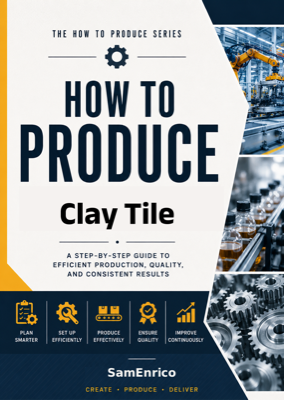
How to Produce Clay Tile eBook
This publication, published by SamEnrico, covers H
This publication, published by SamEnrico, covers How to Produce Clay Tile
Formats
Free sample
Chapter 1: The Longest Roof--–- The tile arrived in a battered cardboard box, wrapped in brown paper and old newsprint. It weighed just under two pounds, felt cool against my palm, and carried the faint orange dust of a place I had never visited. One edge was chipped. The surface showed a faint crawl of crazing lines, like the cracks in a dried riverbed. And yet, when I held it up to the morning light coming through my studio window, I understood immediately why the monastery roof in southern Spain had kept this exact shape for three hundred years before a winter storm finally brought it down.I had not planned to become a tilemaker.
I had planned, like most people who stumble into ancient crafts, to write about them from a safe distance. But the tile arrived with a note from a stone mason I had interviewed months earlier: "This came off the Convent of San Pablo restoration. The nuns say the original maker fired it in 1687. You should hold something that outlasted empires before you write about making things."He was right.That cracked, warped, imperfect rectangle of fired clay did something that no amount of reading could have accomplished. It made me want to make.
Not to buy, not to specify, not to admire from across a museum rope, but to dig my hands into a bag of clay and produce something that might, with luck and skill, still be whole when my great-grandchildren were old.This book is the record of that pursuit. And this first chapter is where we begin not with instructions but with wonder. Because before you can produce clay tile, you must understand why humanity has produced clay tile for thirty centuries without interruption. You must feel the weight of that tradition in your hands.The Oldest Roof in the World The oldest known fired clay tiles date to the early Bronze Age in Greece, specifically the site of Lerna in the Peloponnese. Excavators in the 1950s uncovered fired clay tiles embedded in the collapsed superstructure of the "House of the Tiles," a monumental building that gives its name to an entire archaeological period.
Those tiles, fired around 2200 BCE, were not the sophisticated interlocking profiles we know today. They were simple flat slabs, roughly rectangular, with a raised edge along one side to shed water.But they represented a revolutionary idea: that the most abundant material on Earth—common dirt—could be transformed by fire into a waterproof, fireproof, windproof shelter that outlasted the people who made it.Before clay tile, roofs were thatch, wood shingle, or stone slab. Thatch burned and rotted. Wood shingle splintered and decayed. Stone slab worked but required quarried stone and skilled masons, putting it out of reach for ordinary people.
Clay tile changed everything. It could be made from local clay by local hands, fired in a simple kiln, and installed by anyone strong enough to carry a ladder. For the first time in human history, durable shelter was democratized.The Greeks knew what they had. By the seventh century BCE, tilemaking had spread from the Peloponnese across the entire Greek world. Every city of any size had at least one tile works.
Roofing contracts from the period survive on stone inscriptions, spelling out exactly how many tiles per square meter, what profile, and what penalty for breakage. The tiles themselves were stamped with the maker's mark—the first branded building product in history.Walk through the ruins of ancient Corinth or Olympia today, and you will find those stamped tiles scattered among the fallen columns. Read the marks carefully, and you can trace trade routes from the kiln to the construction site. A tile stamped "AX" might have come from Axioupolis in Macedonia, carried south on a merchant ship, then hauled uphill by ox cart to a hillside sanctuary. That tile represents the first industrial supply chain, complete with brand identity and quality control.The Roman Revolution The Romans inherited Greek tile technology and perfected it.
By the first century BCE, Roman tilemakers had developed the tegula and imbrex system—flat pan tiles with raised side flanges, covered by half-cylinder ridge tiles—that would dominate European roofing for the next fifteen hundred years.What made the Roman system revolutionary was standardization. A Roman tegula measured approximately 45 by 60 centimeters, regardless of whether it was made in Britain, Gaul, or Syria. The imbrex tapered from a standard diameter at the wide end to a slightly smaller diameter at the narrow end, allowing them to nest. A Roman roofer could travel from Londinium to Jerusalem and find tiles that fit.That standardization did not happen by accident. The Roman army, always the engine of imperial logistics, published specifications for every construction material.
Tile dimensions were fixed by military decree. Kilns were inspected. Batches were tested. Reject rates above five percent could cost a contractor his contract—or his life, if the defective tiles collapsed onto a garrison of imperial soldiers.The surviving tiles tell the same story. Roman tilemakers stamped every piece with the name of the workshop, the date of firing, and sometimes the name of the supervising magistrate.
The stamps are not subtle—they were pressed into wet clay with wooden dies, leaving deep impressions that survive two thousand years of weather. You can read them today without magnification.The virtue of this system was consistency. A Roman builder knew exactly what he was getting. The vice, from the tilemaker's perspective, was inflexibility. If your local clay produced slightly different shrinkage (Chapter 7) or a different fired color (Chapter 2), you still had to hit the imperial dimensions.
Roman tilemakers developed sophisticated body formulations to compensate for local clay variation, blending different clays and adding grog to control drying behavior.That knowledge—the empirical science of clay bodies—was the Romans' true gift to tilemaking. They did not understand the mineralogy of clay. They had no X-ray diffraction, no particle size analysis, no thermal gravimetric measurement. But they understood that five parts one clay mixed with two parts another, left to weather for six months, then tempered with grog, produced a tile that fired true to specification. That understanding was passed from master to apprentice, generation to generation, for centuries.When the Roman Empire collapsed in the West, the knowledge did not disappear entirely, but it fragmented.
Regional tilemakers reverted to local traditions, producing tiles that fit local roofs for local buildings. The imperial specification was forgotten. What remained was the craft itself: the knowledge of how to dig clay, how to shape it, how to fire it, how to make it last.An Independent Invention: China While the Greeks and Romans developed their tile traditions around the Mediterranean, an entirely independent ceramic culture emerged along the Yellow River in China. Chinese tilemakers achieved by 200 BCE what their Western counterparts would not match for another thousand years: true glazed architectural ceramics.The Chinese tile tradition began with unglazed earthenware, similar to Greek and Roman production. But Chinese potters had a longer history of high-temperature ceramics, including the stoneware and proto-porcelain that appeared during the Shang dynasty (1600-1046 BCE).
That experience with glaze—with turning clay into glass—naturally extended to roof tiles.The Han dynasty (206 BCE-220 CE) saw the first…
This is the end of the free sample. Get the eBook to keep going. Buy now
About this book
Details
- Author
- Huntley Luvenia
- Publisher
- SamEnrico
- Language
- English
- Genre
- Non-Fiction, Informative, Educational
- Released
- 2026-05-08
- Pages (approx.)
- 126
- Available as
- eBook, Audiobook

Read better in the ZLOADR app
Your eBooks on your phone or tablet. Sign in with your SamEnrico account and start reading.
More by Huntley Luvenia
 Alcohol Recovery Hobby DiscoveryHuntley Luvenia$11.99
 Post Hypnotic Suggestion for PatienceHuntley Luvenia$11.99
 Dryer Vent Toxin GuideHuntley Luvenia$11.99
 The Silk Road Tycoon: The Untold Story of Diogo de Azambuja's African Gold EmpireHuntley Luvenia$11.99
 Change As TriggerHuntley Luvenia$11.99
 Soil ScientistHuntley Luvenia$11.99
 Kenya Remote Tech Talent HandbookHuntley Luvenia$12.99
 10 Ways to Use Abalone (Recipe Book)Huntley Luvenia$11.99
You may also like
 Hong Kong Handover 1997Dunn Johnnie$11.99
 Zumba For Postnatal Recovery CourseNeal Christian$11.99
 Zumba for BeginnersLadner Nikia$11.99
 YouTube Comment Mining GuideHumes Pandora$12.99
 Worry Box MeditationCarlin Rudy$11.99
 Workplace Stress MeditationNguyen Lynn$11.99
 Workplace Stress and Sleep RepairHawley Ivory$11.99
 Workplace Perfectionism CureDelaney Jeffry$11.99
 Workplace Injustice Anger GuideWallen Isabelle$11.99
 Work Addiction and Burnout LinkGreenwood Ester$11.99
 Women in Yoga and WellnessBeattie Galina$11.99
 Women in Stand Up ComedyChun Evangeline$11.99