
Non-FictionInformativeEducational
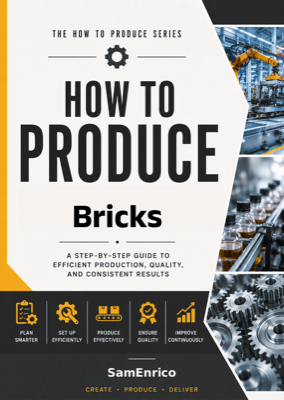
How to Produce Bricks
This publication, published by SamEnrico, covers H
This publication, published by SamEnrico, covers How to Produce Bricks
Formats
About this book
Free sample
Chapter 1: The Burnt Earth Legacy--– The first brick was not designed. It was discovered. Ten thousand years ago, somewhere in the floodplains of the Tigris and Euphrates rivers, a prehistoric builder noticed something strange. The sun-dried mud blocks that had been accidentally caught in a campfire had not crumbled back into dust like all the others. They had turned to stone.
That accidental fire marked the single most important moment in construction history—the birth of ceramic technology. From that smoking pile of transformed earth, every brick ever made descends.This chapter argues that to become a great brick producer, you must first understand the 9,000-year journey that brought us to today's advanced manufacturing methods. Bricks are not merely stacked rectangles of clay. They are time machines, each one carrying within its matrix the accumulated wisdom of every civilization that came before. The Romans perfected the fired brick.
The Industrial Revolution mechanized it. The 21st century is now reimagining it without fossil fuels. By understanding the past, you learn from failures that have already been paid for in collapsed walls, ruined kilns, and bankrupt producers. You also learn which problems have been solved and which remain open for innovation. This chapter traces the long arc of brickmaking from the first sun-dried blocks to the automated, sustainable factories of today, and it distills the crucial lessons that every producer must carry into their own work.The Ancient Origins: Mud, Sun, and the First Cities Before there were kilns, there were mud bricks.
The earliest known bricks date to approximately 7000 BC in the region of modern-day Turkey and Syria, near the ancient settlement of Çatalhöyük. These were not fired. They were simply clay, mixed with water and organic tempering materials like straw or chaff, pressed into wooden molds, and left to bake under the relentless Middle Eastern sun. Sun-dried bricks, often called adobe, have a single advantage: they require no fuel. But they have a catastrophic limitation—water dissolves them.For early agricultural villages, this was an acceptable risk.
Rainfall was minimal, and buildings could be repaired annually. But as settlements grew into cities, the limitations of sun-drying became…
This is the end of the free sample. Get the eBook to keep going. Buy now
Contents
- Chapter 1
- Chapter 2
- Chapter 3
- Chapter 4
- Chapter 5
- Chapter 6
- Chapter 7
- Chapter 8
- Chapter 9
- Chapter 10
- Chapter 11
- Chapter 12
Details
- Author
- Minton Monika
- Publisher
- SamEnrico
- Language
- English
- Genre
- Non-Fiction, Informative, Educational
- Released
- 2026-05-06
- Pages (approx.)
- 149
- Available as
- eBook, Audiobook

Read better in the ZLOADR app
Your eBooks on your phone or tablet. Sign in with your SamEnrico account and start reading.
More by Minton Monika
 Diversification After Client LossMinton Monika$11.99
 Nobel Physics Black Hole DiscoveriesMinton Monika$11.99
 The 48 Hour Rule WorkbookMinton Monika$11.99
 Hesitation Pause DetectionMinton Monika$11.99
 Rewire Shame Self TalkMinton Monika$11.99
 Guided Meditation Scripts BeginnerMinton Monika$11.99
 Mammoth Cave VanishedMinton Monika$11.99
 The Timbuktu Calculus: How African Mathematicians Outpaced the WorldMinton Monika$11.99
 The Phantom Fleet: How a Rogue Navy Saved the WhalesMinton Monika$11.99
 Natural Language Processing FundamentalsMinton Monika$11.99
 The Mineral Guide to AdeliteMinton Monika$11.99
 How to Become a AdjudicatorMinton Monika$11.99
You may also like
 Hong Kong Handover 1997Dunn Johnnie$11.99
 Zumba For Postnatal Recovery CourseNeal Christian$11.99
 Zumba for BeginnersLadner Nikia$11.99
 YouTube Comment Mining GuideHumes Pandora$12.99
 Worry Box MeditationCarlin Rudy$11.99
 Workplace Stress MeditationNguyen Lynn$11.99
 Workplace Stress and Sleep RepairHawley Ivory$11.99
 Workplace Perfectionism CureDelaney Jeffry$11.99
 Workplace Injustice Anger GuideWallen Isabelle$11.99
 Work Addiction and Burnout LinkGreenwood Ester$11.99
 Women in Yoga and WellnessBeattie Galina$11.99
 Women in Stand Up ComedyChun Evangeline$11.99