
Non-FictionInformativeEducational
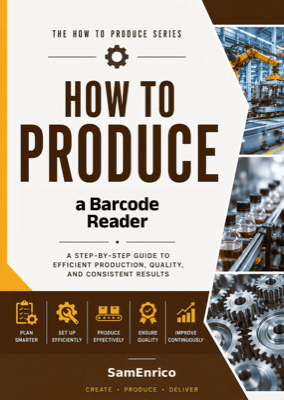
How to Produce a Barcode Reader
This publication, published by SamEnrico, covers H
This publication, published by SamEnrico, covers How to Produce a Barcode Reader
Formats
About this book
Free sample
Chapter 1: The Language of Lines--– When I was twelve years old, I watched a cashier scan a crumpled pack of gum across a red laser window, and that small beep – that single, satisfying chirp – struck me as something close to magic. How did a pattern of simple black and white stripes tell a computer exactly what the product was, how much it cost, and whether there were twenty-four more packs in the back room? Years later, as an engineering student, I learned that there is no magic. There is only geometry, algebra, and a few decades of clever compromises. And before you can build a barcode reader – before you can select a single component or write a single line of firmware – you must first understand the visual language that reader is meant to speak.
Barcodes are not random. Each symbology is a purpose-built data encoding system, designed for specific industries, printing methods, error tolerances, and scanning environments. Choosing the wrong decoding approach for a given barcode guarantees failure. This chapter, therefore, is not a gentle introduction. It is a foundation.
By the time you finish, you will understand the anatomy of any barcode you encounter, you will know why a QR code can survive being partially torn while a UPC cannot, and you will have a reference table that will guide every design decision in the chapters that follow.The Birth of an Idea: Norman Woodland and the Bullseye– The story of the barcode begins not in a supermarket, but on a beach. In 1948, a graduate student named Bernard Silver overheard a conversation at the Drexel Institute of Technology in Philadelphia. A local food chain president had asked one of the deans to research a method of automatically capturing product information at checkout. The dean dismissed the idea as impractical. Silver, however, did not.
He mentioned the challenge to his friend Norman Woodland, and the two began working on a solution.– Woodland, who had worked on the Manhattan Project and was about to teach mechanical engineering, spent the winter of 1949 in a Miami apartment. He was stuck. One day…
This is the end of the free sample. Get the eBook to keep going. Buy now
Contents
- Chapter 1
- Chapter 2
- Chapter 3
- Chapter 4
- Chapter 5
- Chapter 6
- Chapter 7
- Chapter 8
- Chapter 9
- Chapter 10
- Chapter 11
- Chapter 12
Details
- Author
- Ackerman Janee
- Publisher
- SamEnrico
- Language
- English
- Genre
- Non-Fiction, Informative, Educational
- Released
- 2026-05-07
- Pages (approx.)
- 145
- Available as
- eBook, Audiobook

Read better in the ZLOADR app
Your eBooks on your phone or tablet. Sign in with your SamEnrico account and start reading.
More by Ackerman Janee
 Couples Stress Relief HandbookAckerman Janee$11.99
 The Workaholic Therapy Companion GuideAckerman Janee$11.99
 Non Hormonal Options WorkbookAckerman Janee$11.99
 Validating In Laws FeelingsAckerman Janee$11.99
 The Silent Cartographers: Uncharted Seas and Hidden FortunesAckerman Janee$11.99
 How to Become a Lowerator OperatorAckerman Janee$11.99
 German BAV Raise OptimizationAckerman Janee$12.99
 Chrysoprase (Green Nickel Bearing Chalcedony) MiningAckerman Janee$11.99
You may also like
 Hong Kong Handover 1997Dunn Johnnie$11.99
 Zumba For Postnatal Recovery CourseNeal Christian$11.99
 Zumba for BeginnersLadner Nikia$11.99
 YouTube Comment Mining GuideHumes Pandora$12.99
 Worry Box MeditationCarlin Rudy$11.99
 Workplace Stress MeditationNguyen Lynn$11.99
 Workplace Stress and Sleep RepairHawley Ivory$11.99
 Workplace Perfectionism CureDelaney Jeffry$11.99
 Workplace Injustice Anger GuideWallen Isabelle$11.99
 Work Addiction and Burnout LinkGreenwood Ester$11.99
 Women in Yoga and WellnessBeattie Galina$11.99
 Women in Stand Up ComedyChun Evangeline$11.99