
Non-FictionInformativeEducational
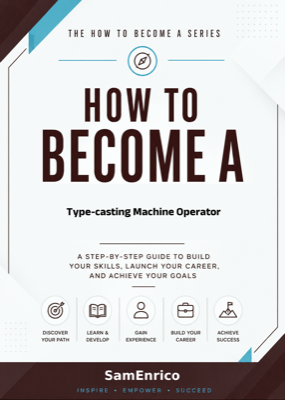
How to Become a Type-casting Machine Operator eBook
How to Become a Type-casting Machine Operator
by Bohn Sha
How to Become a Type-casting Machine Operator
Formats
Free sample
Chapter 1: The Last Hot Metal--– The first thing you need to understand about becoming a type-casting machine operator is that you are not entering a trade. You are entering a brotherhood of ghosts, misfits, and stubborn romantics who refused to let a better way kill the right way. The machines you are about to learn—massive, roaring, temperamental beasts of cast iron and molten lead—were pronounced dead in 1970. Then again in 1985. Then again in the mid-1990s, when the last daily newspaper retired its Linotype fleet and the obituaries ran in offset, not hot metal.
And yet, here you are, reading this book. And somewhere, in a drafty warehouse in Pennsylvania, a retired machinist is oiling a distributor bar. In a garage in Oregon, a former journalist is casting slugs for wedding invitations. In a museum in London, a volunteer is teaching a twenty-two-year-old how to read a matrix tooth pattern. The machines are still running.
The metal is still hot. And you are about to learn why.This chapter is not a technical manual. It is not a list of parts or a diagram of the casting cycle. You will get all of that soon enough. Instead, this chapter is an invitation.
It is the story of how a nineteenth-century invention built the twentieth-century world, how that world forgot its debt to the men and women who set hot metal, and how a small, stubborn group of preservationists, artisans, and curiosity-driven eccentrics are keeping the craft alive. By the time you finish this chapter, you will know why learning to operate a type-casting machine is not a career choice but a calling. You will understand the weight of the legacy you are about to carry. And you will be ready to step into the shop.The World Before the Hot Metal Machine To understand what you are about to become, you must first understand what replaced. Before the Linotype, before the Monotype, before any machine that could cast type on demand, every single letter in every single book, newspaper, pamphlet, and broadside was set by hand.
A compositor—the trade name for a hand typesetter—would stand at a slanted wooden case divided into compartments, each containing dozens of copies of a single character. He would read from a manuscript, pluck individual pieces of type from the case, and assemble them in a handheld composing stick, one agonizing letter at a time. A skilled compositor might set one thousand letters per hour. A daily newspaper of eight pages contained roughly one hundred thousand letters. You do the math.This was not merely slow.
It was a bottleneck that constrained the entire information economy. In the early nineteenth century, the fastest printing press could produce far more sheets per hour than any team of compositors could supply with type. The press was hungry, and the compositor was the limiting factor. Inventors across Europe and America threw themselves at the problem. If you could mechanize typesetting—or better yet, mechanize both typesetting and typefounding in a single continuous process—you would not just make a fortune.
You would change civilization.The first breakthroughs came in typefounding, the separate craft of manufacturing individual pieces of type. Hand casting using a hand mold was painstaking work: a skilled type founder could cast perhaps four thousand pieces per day. By the 1850s, machines like the pivotal caster (a lever-operated device that mechanized the hand mold) and later the Thompson Caster (one of the first fully automatic type casters) had increased output dramatically. The Thompson, which you will encounter again in Chapter 10 of this book, could produce individual types at a rate of sixty to ninety per minute—a thirtyfold improvement over hand casting. But these were foundry machines, not composing machines.
They still required a human to pick the type from the case and assemble it into words, lines, and pages.The real revolution would come when someone figured out how to combine selection, assembly, and casting into a single machine.Ottmar Mergenthaler and the Miracle of the Linotype The name you need to remember is Ottmar Mergenthaler. He was a German-born watchmaker who immigrated to the United States in 1872 with no English, no money, and a head full of mechanical genius. He was hired by a company trying to build a mechanical typesetter—several had tried and failed—and within a few years, he had abandoned their approach entirely.The conventional wisdom of the time held that any typesetting machine should mimic the hand compositor: it should select individual types from a case and assemble them in a line. Mergenthaler realized this was a dead end. The mechanical complexity of picking, aligning, and justifying hundreds of individual pieces of type per minute was simply too great.
Instead, he asked a different question: what if the machine cast each line as a single solid piece of metal? The letters would be molded into a brass matrix—a negative image of each character—and then molten lead would be pumped into the assembled matrices to form a line, or "slug," of type. After casting, the matrices would be automatically returned to their storage channels. The machine would never need human hands to touch the type again.This was the Linotype, from "line o' type." Mergenthaler completed his first working model in 1884. It was crude, unreliable, and prone to spectacular jams.
But it worked. In 1886, the New York Tribune installed the first commercial Linotypes, and within a decade, every major newspaper in the Western world had followed. The Linotype could set four thousand to seven thousand letters per hour—four to seven times faster than a hand compositor. But raw speed understates the transformation. The Linotype did not just make typesetting faster.
It made it continuous. A hand compositor had to stop to distribute type back to the case. The Linotype never stopped. Matrices flowed down the distributor bar, nested in their channels, and were ready for the next line almost instantly. A well-tended Linotype could run eight hours a day, five hundred lines per hour, day after day, year after year.The impact on literacy, journalism, and democracy cannot be overstated.
The Linotype made it economically possible to produce daily newspapers of forty, sixty, eighty pages. It enabled the rise of the mass-market paperback. It put the daily news in the hands of working-class readers who had never before had access to affordable print. When Mergenthaler died in 1899, his machine had already reshaped the information landscape of the United States. A century before the internet, the Linotype was the first technology to truly democratize the printed word.The Human Legacy of Hot Metal But the Linotype was not just a machine.
It created a new class of skilled industrial labor: the Linotype operator. These were almost exclusively men in the early decades, though women entered the trade in significant numbers during World War I and World War II, and a few became masters of the craft. The Linotype operator occupied a strange liminal space between blue-collar labor and white-collar skill. He—and later she—stood on a metal floor in front of a roaring keyboard, wearing a leather apron and heat-resistant gloves, the smell of hot…
This is the end of the free sample. Get the eBook to keep going. Buy now
About this book
Details
- Author
- Bohn Sha
- Publisher
- SamEnrico
- Language
- English
- ISBN
- 9781506061870
- Genre
- Non-Fiction, Informative, Educational
- Released
- 2026-05-09
- Pages (approx.)
- 121
- Available as
- eBook, Paperback, Audiobook

Read better in the ZLOADR app
Your eBooks on your phone or tablet. Sign in with your SamEnrico account and start reading.
More by Bohn Sha
 Africa Rising Consumer ReportBohn Sha$11.99
 The Door in Face Negotiation TacticBohn Sha$11.99
 Probate Avoidance StrategiesBohn Sha$11.99
 Red Light Meditation TechniqueBohn Sha$11.99
 Doorway Visualization New SpaceBohn Sha$11.99
 The Bloodied Crown: How Money Fueled the French Wars of ReligionBohn Sha$11.99
 Window Sign PainterBohn Sha$11.99
 Teaching Phonics to Chinese LearnersBohn Sha$12.99
 Freelance Terms of Service GuideBohn Sha$12.99
 Understanding OsteosclerosisBohn Sha$17.99
You may also like
 Hong Kong Handover 1997Dunn Johnnie$11.99
 Zumba For Postnatal Recovery CourseNeal Christian$11.99
 Zumba for BeginnersLadner Nikia$11.99
 YouTube Comment Mining GuideHumes Pandora$12.99
 Worry Box MeditationCarlin Rudy$11.99
 Workplace Stress MeditationNguyen Lynn$11.99
 Workplace Stress and Sleep RepairHawley Ivory$11.99
 Workplace Perfectionism CureDelaney Jeffry$11.99
 Workplace Injustice Anger GuideWallen Isabelle$11.99
 Work Addiction and Burnout LinkGreenwood Ester$11.99
 Women in Yoga and WellnessBeattie Galina$11.99
 Women in Stand Up ComedyChun Evangeline$11.99